Brigadier W.J. Megill
Algonquin Regiment
5th Infantry Brigade
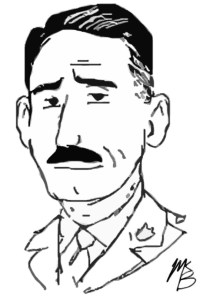
It was perfectly clear that the attack should have been called off at a very early stage in the morning. I suggested this not later than perhaps 8:00 or 9:00 o’clock. Instead the Corps commander was pressing the divisional commander and he was pressing us to get on with an attack which we knew was almost hopeless. Under these circumstances one does not quit. You do as much as you possibly can and hope that someone will see the light and give you some relief.
(Quoted in Copp, The Brigade, 88)
Born in Ottawa on 26 June 1907, William Jemmett Megill was a graduate of Queen’s University and RMC who had risen from the ranks of the Royal Canadian Corps of Signals which he joined in 1923. He was attending staff college in India when the Second World War began. Following general staff appointments with 3rd Division headquarters, he was promoted to brigadier with I Canadian Corps headquarters in June 1943. General Harry Crerar, described him as “the type of man who needs to experience in order to know. He is not what I would call imaginative … his lack of field experience definitely handicaps him.” To gain command experience, Megill request a revision in rank to lieutenant-colonel and was posted to the Algonquin Regiment in October 1943.
Megill succeeded Lieutenant-Colonel G.P. Henderson who had been reassigned to take over the Black Watch. Although Megill had hoped to gain real combat experience prior to a higher posting, in February 1944, he was promoted back to brigadier of the 5th Infantry Brigade, replacing Brigadier Victor Whitehead. Megill commanded the brigade from D-Day to VE-Day, the longest continuous service of any Canadian Army brigadier in the campaign. His leadership style, however, proved controversial with many subordinates and he secured the removal of several underperforming battalion commanders.
Lieutenant-Colonel Syd Thomson of the Black Watch remarked more favourably, “Megill like Hoffmeister in Italy, frequently came to my tactical headquarters … Furthermore Megill would listen to a battalion commander’s opinion.” For his leadership in the battles for France, Belgium and Holland, Megill earned the Distinguished Service Order. The citation read in part: “with unlimited endurance and without regard for his personal safety under shell, mortar and small arms fire, directed these difficult operations from the most forward position.” After the defeat of Germany, he took command of a brigade in the occupation army before returning to Canada in 1946.
Following appointments as deputy chief of the General Staff and later commanding officer of 25th Canadian Infantry Brigade Replacement Group during the Korean War, Megill was promoted to major-general in 1954. When assigned to the truce commission in Indochina, he remarked, “This type of duty will be completely new to me. I could certainly say how I would go about organizing a brigade for an attack, but this is something entirely different.” Megill retired from the army in 1959.
He died in Kingston on 12 September 1993.
 World War Graphic History
Do you have any history on my father, William Leslie Graff? He was a second lieutenant in the Canadian Irish Regiment. Wounded in action. I soul like to know any info you may have. Thank you. Robert Graff