Lieutenant-Colonel G.H. Christiansen
Stormont, Dundas and Glengarry Highlanders
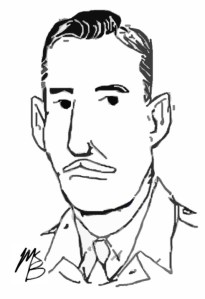
A fairly tall and heavily built offr who has a quiet and pleasant manner and good military bearing. He has a rather slow manner of speech and does not give the impression of a fast thinker. He appears intelligent and capable of doing a job if given plenty of time. He is slow in reaching a decision but is quite determined once he has reached it. Motivation appears to be good.
(Officer Survey and Classification Board report, 2 Jan 1945)
Born on 5 May 1899 in Arnprior, Ontario, Goddard Henry Christiansen was a high school teacher in Kingston and commissioned officer with Princess of Wales Own Regiment since 1932. As an eighteen-year-old, he had enlisted with the 69th Battery in December 1917 and served in France with the Canadian Field Artillery in the final hundred days of the First World War. By the early 1930s, he worked as a machine shop teacher and football coach at Kingston Collegiate and Vocational Institute.
He was promoted to captain in 1938 and completed the militia staff course just prior to the outbreak of the Second World War. Following training with the PWOR, in June 1940, Christiansen took a leave of absence from teaching for active military service. He joined the recently mobilized Stormont, Dundas and Glengarry Highlanders, which went overseas in July 1941.
He was promoted to major shortly after arrived in the United Kingdom and succeeded Lieutenant-Colonel W.S. Rutherford in December 1942. In a letter to the battalion’s first commanding officer, Lieutenant-Colonel W.J. Franklin, Christiansen assured those at home that the troops, “are far from unheard of in the Canadian Army and their conduct and performance have been noted on more than one occasion. At the present time they are highly training and efficient and morale at the peak.”
On D-Day, Christiansen was one of the only First World War veterans to lead a battalion ashore at Juno Beach. After two months of hard fighting, he was unceremoniously fired after significant senior officer turnover in 9th Infantry Brigade. Following heavy losses in Operation Spring in late July 1944, Lieutenant-Colonel Charles Petch of the North Nova Scotia Highlanders and Brigadier D.G. Cunningham, a prewar militia officer with the PWOR, refused another costly assault. Major-General Rod Keller of 3rd Canadian Division, who had directed the attack, and II Canadian Corps commander Guy Simonds decided to immediately remove both subordinates. Christiansen likewise would have refused committing his unit to another wasteful attack if ordered. In a message to Keller, Christiansen stated boldly:
Without going into all the circumstances which accumulated until I felt that only drastic action on my part would create any impression, I will sum up what I have to say in two short statements (A) I have lost confidence in the leadership and comd that kept every unit of our div in action continuously in spite of severe casualties and culminated in the launching of several hundred worn our and disorganized men under the name of the North NS Highrs into the attack on Tilly La Campagne on 25 Jul 44. When it was apparent that they could be written off I was warned to be ready to go to their assistance. (B) Under the circumstances or similar ones I would have and will refuse to put the SD & F Highrs in.
Keller submitted an adverse report on his subordinate colonel to General Simmonds, who criticized Christiansen’s “impression that battle can be fought on limited liability basis” and found he was “unfitted to lead Canadian troops with determination.” He was replaced by Lieutenant-Colonel Roger Rowley in command of the SDGH on 4 August 1944.
Discouraged, Christiansen went back to England to command a reinforcement unit and depot battalion. Despite the circumstances behind his removal, Major-General H.W. Foster of 1st Canadian Division in Italy specifically requested Christiansen for command of the West Nova Scotia Regiment in December 1944. Although Petch who had also been sacked by Simmonds received as second chance in Italy with the 4th Princess Louise Dragoon Guards, Christiansen would not again command a battalion in battle. In January 1945, he appeared before an officer classification board to decide his future:
This Board found Col. Christiansen a rather difficult offer to assess. He does not offer much information … He does not impress as an energetic and forceful officer and seems too reserved in manner to inspire subordinates with enthusiasm. The Board could not but feel that Col. Christiansen’s attitude was that of a man who that irrespective of how he present his case, judgment would invariably be rendered in accordance with the views already expressed by his superiors and that he had little chance of vindicating himself in any way or receiving favourable consideration for military employment.
Overseas Lt-Col. Christiansen is apparently a hard working, conscientious offr, whose knowledge is basically sound, his manner and personality undoubtedly limit his usefulness … He is definitely not wanted and can therefore not be considered in any unit of formation under comd of that [Canadian Reinforcement Unit] headquarters.
Col Christiansen expressed himself as most desirous of returning to a theatre of operations and feels that given another chance he can successful command a bn … He states that he now appreciates that it is the duty of a battalion comd to carry out the orders of his superiors whether or not they appear to adversely affect his bn … The Board however are not prepared to recommend that Col. Christiansen be employed as a bn comd in a theatre of operations, as it is apparent his previous reaction to higher authority might well re-occur despite his statement and sentiments to the contrary.
With no possibility of further military service overseas, Christiansen returned to Canada and resigned from the army in April 1945. The next month he also resigned from Kingston Collegiate and Vocational Institute to live in England. By the late 1970, he was living in Australia, where he died in 1982.
 World War Graphic History
Perfect timing, Matthew – I’m working on a project on the Tilly 3! Probably won’t finish it until next year but it’s humming along in the background… Any notion where one might find the transcript from the Court of Inquiry that investigated the disobedience of an order that saw Cunningham, Petch, and eventually Christiansen sacked? DHH doesn’t have it and apparently LAC can’t find it.
Fantastic! Such an interesting case. I don’t know if there would have been a formal transcript from a court of inquiry per say. I do however have Petch’s personnel file which includes details on his adverse report and appeal. I can send to you if you wish!
Yes, please, and thank you! 😁Sent from my iPad