Lieutenant-Colonel Don MacLauchlan
Calgary Highlanders
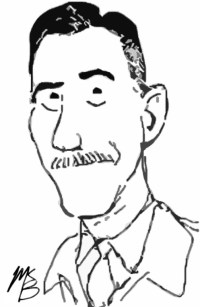
There is no doubt that MacLauchlan never succeeded in hiding his fears well enough to give his men the impression that he was courageous–a possible great failing in a field commander. He had voided the front even though, ironically, he found himself under fire, or close to it, several times … In later years [Brig] Megill would recall: ‘It was quite genuine battle exhaustion that knocked him out.
(Bercuson, Battalion of Heroes, 180)
Born on 19 July 1905 in Charlottetown, Prince Edward Island and raised in Alberta, Donald George MacLauchlan joined the Calgary Highlanders out of high school in 1921. His enthusiasm for soldiering and time devoted to militia training cost him his job as a newspaperman just a year before the outbreak of war. He went overseas as a company commander in August 1940 and became second-in-command in England. He succeeded Lieutenant-Colonel J. Fred Scott in February 1942, although his appointment appeared tenuous.
In his inspection tour of the overseas Canadian regiments, General Bernard Montgomery had been unimpressed, candidly stating of MacLauchlan:
He is completely out of his depth as a battalion commander, and knows practically nothing about how to command and train a battalion. He is possibly a good Coy Comd. He is so completely at sea that he inspires no confidence at all. He is a very decent chap; but I am sorry for him as he just knows nothing whatever about it.
The assessment likely delayed his promotion to lieutenant-colonel until July but Canadian authorities found no suitable replacement. Unlike some of the other commanding officers Montgomery targeted with such criticism, MacLauchlan maintained his position through the two-year training period before going into action.
The Calgary Highlanders deployed to Normandy as part of the 5th Infantry Brigade, 2nd Division on 6 July 1944. A strict disciplinarian, he had failed to generate much of a rapport with his officers and men and appeared to some been more comfortable with administrative work than personally leading the troops. Despite early difficulties in the battalion’s first experience with combat, MacLauchlan remained longer in command longer than perhaps expected given superior’s doubts about his abilities.
On the contrary, he was rewarded with a D.S.O. for gallantry under heavy fire in the August assault at Clair Tizon: “demonstrating outstanding leadership, by his personal courage and example, determination and endurance enabled his battalion to inflict a severe defeat on the enemy in this important engagement.”
After four months, it appeared obvious to Brigadier Bill Megill of the 5th Brigade that MacLauchlan needed a rest if not removal from command. Suspected to be suffering battle exhaustion, he was replaced by Major Ross Ellis in October 1944. The men expressed surprise when the emotionally detached former commander bid them farewell “almost in tears.” In February 1945, MacLauchlan returned to Canada, where he was assigned to a training centre in Saskatchewan.
He died on 15 March 1992 and is buried in Calgary.
 World War Graphic History
The Calgary Highlanders published a new regimental history last April – I was honoured to be the author. I also served as a bearer at Lt Col MacLauchlan’s burial in Calgary, long after he died when his ashes were returned to the regiment for interment. He was an important – and interesting – study. During my research I found evidence that he had accidentally shot himself carrying a .22 rifle home from the armouries (not an unusual activity in those days, there were indoor ranges in the basement and I suspect you could walk home with a firearm in Calgary in the 1920s without raising many eyebrows). There is correspondence on file in the regimental archives talking about some presumed bad blood in the family home, which we didn’t feel merited inclusion in the history, but anecdotally it appears his parents were very cold toward each other, and this rubbed off on young Donald who was not well liked by the men. I concluded that the veteran interviews talking about his “American helmet” probably referred to a British style helmet issued widely to Canadians, but for some reason, not to some battalions in 2nd Canadian Division, and the vets assumed he was going out of his way to seek protection for himself which was likely not the case. Whatever his faults, I think the consensus is that he earned the DSO at Clair Tizon.
So, the story behind the helmet. In a conversation I had with great uncle Don back in 1981 the subject of kit came up. He really liked the American kit and thought it was a shame that the Canadians didn’t adopt it. As mentioned numerous times, he was a strict disciplinarian and so any man being caught “out of uniform” would have to be disciplined. On the other hand, he could wear American kit as a protest. It is as simple as that.