Brigadier John Rockingham
Royal Hamilton Light Infantry
9th Infantry Brigade
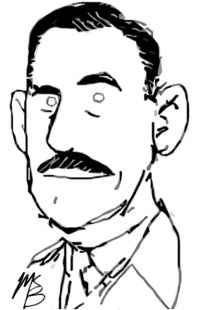
During the action, Lieutenant Colonel Rockingham completely embodied the qualities of the infantry commander. He showed great coolness, good judgement, determination and ability as a leader. His dash and offensive eagerness infected the whole battalion and contributed in no small degree to the success attained.
(D.S.O. citation, 2 Aug 1944)
Born on 24 August 1911 in Sydney, Australia, John Meredith Rockingham grew up in Canada, Barbados, England, and Australia before permanently settling in British Columbia in 1930. Commissioned for several years with the Canadian Scottish Regiment, he mobilized for overseas service in 1940. Two years later he transferred to the Royal Hamilton Light Infantry, which had sustained heavy losses in the Dieppe Raid of 19 August 1942. He became second-in-command and succeeded Lieutenant-Colonel J.J. Hurley in April 1943.
In February 1944, Rockingham handed command over to Major W.D. Whitaker to take up duties with 2nd Division headquarters before attending the war staff college at Camberley. During his absence the RHLI prepared for the invasion of Normandy and landed in France with the 2nd Division in July.
On 14 July 1944, Lieutenant-Colonel Whitaker was evacuated with a shell wound and temporary command passed to Major G.M. MacLachlan. Four days later Rockingham arrived in France and took command the regiment in the action at Verrieres Ridge a week later. He earned the D.S.O. and on 8 August received a promotion to brigadier of 9th Infantry Brigade, replacing Brigadier D.G. Cunningham, who had clashed with General Keller and Simonds. Command of the RHLI again passed to MacLachlan.
“Falaise was the most spectacular,” he said of the fighting in August 1944. “Never have I seen such slaughter. That was where we smashed the German 7th Army. They were trapped and they knew it but they kept counterattacking, fighting like rats.” Rockingham led the brigade until the end of the war, earning a D.S.O. Bar during the invasion of Germany:
From the first this officer demonstrated outstanding qualities of leadership, skill and personal courage under fire, which have characterised his command throughout the hard fighting in Normandy, Belgium and Holland. He spurred on his battalions in valorous attacks on heavily fortified positions … followed thirty-six hours of the heaviest type of close infantry fighting against a fanatic enemy.
Following demobilization, he returned to his prewar career with the BC Electric Railway but would return to military duty with the outbreak the Korean War in 1950. He was appointed to command the 25th Brigade of the Canadian Army Special Force and served in theatre for over a year before being succeeded by Brigadier M.P. Bogart. When asked on return home which UN troops were the best, Rockingham replied, “Why the Canadians … and all you have to do is look up their record to get proof of that.”
He retired from the Canadian Army in 1966 with the rank of major-general. He then served as honorary colonel of the Canadian Scottish, his original regiment.
He died in Qualicum Beach, British Columbia on 7 July 1987.
 World War Graphic History
Pingback: Korea: The Conflict Canadians Remember, Despite Being Labeled the 'Forgotten War' - TruthUSA News Hub
Pingback: Coreia: A “Guerra Esquecida” que os canadenses realmente se lembram | Opinião | Guerra da Coreia | Canadá Guerra da Coreia | "guerra esquecida" Canadá | Epoch Times Brasil