Brigadier G.W. Robinson
5th Armoured Regiment (8th Princess Louise’s Hussars)
2nd Armoured Brigade
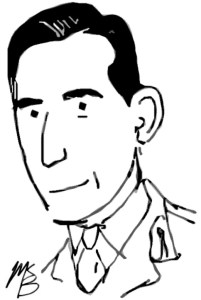
We were proud of his promotion, proud for him and proud for the Regiment. But an awful sense of loss went through all of us when we realized what it meant. He’d made us as a Regiment. He’d taken up there in England when we were far from ready and he’d turned us into a unit and a damn good unit. There is no doubt that his tough training saved us lives and casualties. He fought us well. You couldn’t have asked for a better man, anyway you want to look at it. We were awful, awful sorry to see him go.
(Quoted in Douglas How, The 8th Hussars, 288)
Born on 7 December 1907 in London, Ontario, George William Robinson was an insurance executive and squadron commander of the 1st Hussars when it mobilized for active service in summer 1940. Redesignated the 6th Canadian Armoured Regiment, it went overseas in October 1941 with Robinson rising to second-in-command. In May 1942, he replaced Lieutenant-Colonel H.S. Gamblin of the 5th Armoured (8th Princess Louise’s New Brunswick Hussars) Regiment.
Although many Maritimes troopers were initially hesitant about the appointment of an Ontario commander, Robinson proved himself a competent and dedicated leader. One soldier remarked, “We have without a doubt the finest Colonel in the Army. Just a young chap but brilliant, every one of us thinks there is no one just like him.” After eighteen months of training and preparation, the New Brunswick Hussars arrived in the Italian theatre in December 1943 as part of 5th Armoured Brigade, 5th Canadian Armoured Division. It fought under Robinson’s command for the next year as the Allies advanced north up the Italian peninsula through the German defences.
On 3 December 1944, Robinson was promoted to brigadier and transferred to the Northwest theatre where he succeeded Brigadier J.F. Bingham in command of the 2nd Armoured Brigade. Lieutenant-Colonel J. W. Eaton arrived a few days later to take command of the New Brunswick Hussars.
For his leadership in the liberation of the Netherlands, Robinson was made a Commander of the Order of the British Empire as well as Commander of the Orange Order by the Dutch Government:
Although his units were widely dispersed in support of various infantry brigades, yet by constant personal liaison and careful supervision of all administrative arrangements he ensured that the armoured units from his command were always at the maximum of operational efficiency. During periods between operations he organized and personally supervised training programmes designed to maintain the units at the peak of their fighting effectiveness. By the aggressive and efficient manner in which he directed all phases of his command Brigadier Robinson made a major contribution to the success of operations which led to the liberation of the Netherlands.
Robinson retired from the regular army in August 1945 and returned to his business career in London, Ontario. He was chairman of the city’s transportation commission when he died on 11 June 1971.
 World War Graphic History
Hello,
G.W.Robinson was my great grandfather- this is a terrific write up about him, thank you. His eldest son, George William Robinson (Jr.) is my beloved grandpa. He lives in a small mountain town in BC, and is 90 this year! He will love to see this.
That’s great to hear, thank you very much!