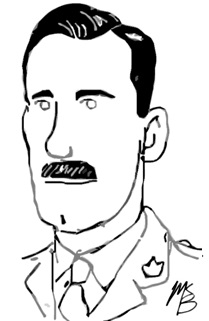
Lieutenant-Colonel Alan W. Embury
Saskatoon Light Infantry
Mr. Embury charged that Socialism was the same whether it was national Socialism of Fascism or Nazism or the Russian Socialism “of our local talent.” The system had never worked in any place where tried and it meant the loss of personal and individual freedom and control and domination by the Socialists …. What sensible differences can there be between a pro-Russian Socialist and a Communist?
(Leader-Post, 1 May 1948, 10)
Born on 5 November 1907 in Regina, Saskatchewan, Alan Williams Embury was a Saskatoon lawyer, RMC graduate and son of First World War brigadier and judge J.F.L. Embury. He served as adjutant with Saskatoon Light Infantry overseas before transferring to the judge advocate general branch. His legal training served him well in many different roles in court martial proceedings as prosecutor, court member and judge advocate.
One of his earliest notable prosecutions concerned the April 1941 case against Lieutenant E.G.A. Boulton of the Royal Canadian Army Service Corps. At a small dinner gathering at the estate of a former MP, Boulton, a Canadian-born, naturalized American officer, had “more or less monopolised the conversation and he was definitely anti-British and defeatist.” He stated that Hitler would dominate Europe for a decade, disparaged Allied leadership and strategy, and repeated American isolationist opinions. Boulton was charged under Section 5(5) of the Army Act for “spreading reports calculated to create unnecessary alarm or despondency.” The judge advocate could find little to say on the accused’s behalf besides suggesting he might have continued to avoid mixing with civilians due to his “unfortunate conversational ability.”
In his closing address, Embury argued that the recent fall of France, the ongoing Blitz, and the fear of invasion added to the severity of Boulton’s opinions. “The great sacrifices of the Canadian Forces in the last war,” the prosecutor argued, “and the ideals of the present Force, should be rather more jealously regarded than to permit irresponsible people to make such statements to our prejudice.” Boulton was found guilty and sentenced to cashiering plus two years’ imprisonment.
Following court martial duties, Embury rejoined the Saskatoon Light Infantry as company commander and later second-in-command in Italy. He succeeded Brigadier J.A. Calder on his promotion to 1st Infantry Brigade in July 1944. That summer the Saskatchewan legislature held a general election with three seats designated for overseas forces candidates. As the only Saskatchewan unit in the field, its nominee would likely win the seat for the Mediterranean theatre.
The battalion assembled to vote on its candidate, which struck Major H.C. Mitchell as “one of the most bizarre incidents in the army.” Mitchell, who shared a mutual dislike with Embury, wrote of the internal nomination process:
That was, to me, a very disgusting spectacle. We were an army unit on active service where the life of everyone was dependent on the discipline of everyone respecting the chain of command. It was utterly fantastic to think that ordinary humans could step out of that role for an hour and listen to the Commanding Officer of the Battalion compete against those under his command for a popular job. It was the most mischievous scheme that anyone could have concocted to undermine the morale that we had spent years building.
Embury won. He made an honest bid. He pointed out that he was a lawyer, a soldier, and that he had been with the Battalion throughout it’s time overseas. He thought that he could be of some service to us in Regina. He wanted the job.
After the overseas voting finished in October 1944, Embury earned a plurality of the nearly 3,000 votes (28%) of the Saskatchewan servicemembers in the Mediterranean. He relinquished command of the battalion in January 1945 to take his seat in the Saskatchewan Legislature. He was replaced by Major D.E. Walker, who remained in command until the end of the war.
Although Embury sat as an independent member he ran for re-election as a Progressive Conservative in 1948. He contested the Regina City constituency as the anti-socialist candidate against the CCF government of Tommy Douglas. Defeated, Embury resumed his law career as King’s Counsel in Regina. He was active in the Royal Canadian Legion and served as honorary colonel of the Saskatoon Light Infantry.
He died in Regina on 22 September 1978.
 World War Graphic History