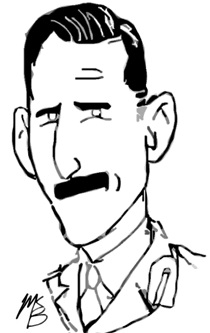
Brigadier J. Allan Calder
Royal Montreal Regiment
Saskatoon Light Infantry
1st Infantry Brigade
If I had known then what I know now, I would have refused the order. Of course, refusing an order is a “no-win” proposition, because it can never be proved what would have happened if the order had been carried out.
(Calder interview, quoted in Dancocks, D-Day Dodgers, 390)
Born in Montreal in 1908, James Allan Calder joined the Canadian Officer Training while a student at McGill University and was commissioned with the Royal Montreal Regiment in 1930. He went overseas as a battalion adjutant in December 1939 and took command in April 1941, succeeding Lieutenant-Colonel G. Victor Whitehead. In January 1943, Calder was promoted to colonel with the Canadian Reinforcement Depot in Italy. He reverted to lieutenant-colonel a year later when finally appointed to a battlefield command.
He succeeded Lieutenant-Colonel E.J.S. Dudley and Major R.C. Irving of the Saskatoon Light Infantry in February 1944. He served as commanding officer until July. Major A.W. Embury took over the SLI while Calder was promoted to command the 1st Infantry Brigade, succeeding Brigadier Dan Spry.
Calder’s service as brigadier lasted under six months. His first reversion in rank had been voluntary; the second reduction would not. Major-General Harry Foster claimed Calder “lacked inspiring leadership, also understanding the principle of command … I have not confidence in his ability to command a Brigade in action.” Following setbacks at the Lamone River in early December 1944, Corps Commander Charles Foulkes determined to sack Calder, who felt that he had been made a scapegoat for the operation’s failure. He was removed from command, demoted to lieutenant-colonel, and sent back to England. Foulkes justified his decision to General Harry Crerar:
I thoroughly investigated this party and I have come to the conclusion it failed mainly because of the lack of inspired leadership and ability to command on the part of Calder. The consolidation was not properly buttoned up, and Calder was unable to read the battle properly … I’m afraid that Calder will not do as a brigade commander.
Brigadier J.D.B. Smith, who had been acting 1st Division commander during the Lamone operation, took over the 1st Brigade while Calder received a training regiment in England. On the disposal of senior officers send back from the front, Foulkes had advised:
It has been the accepted policy, recently confirmed by the Army Commander, that officers who have failed as leaders in battle will, under no circumstances, be given further employment in any appointment involving the training of reinforcements. This policy, I am sure you will agree, is sound, as an officer who cannot handle himself well in battle is in no position to instruct others in what he himself has failed to do.
Calder retired from the army at the end of 1945 and in the 1950s became honorary colonel for the Royal Montreal Regiment.
He died on 14 August 1995 and is buried in Montreal.
 World War Graphic History