Lieutenant-Colonel Rowan Coleman
Loyal Edmonton Regiment
Lincoln and Welland Regiment
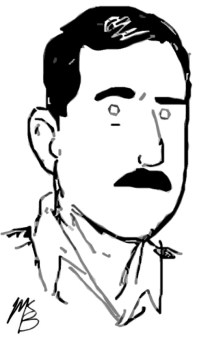
Rowan was, beyond doubt, one of the most liked and respected officers in the 2nd Brigade … Armed with only his pipe, he was completely unflappable, and always exuded a quiet confidence, no matter how desperate the situation … He was one of the few officers who went out of his way to show me the ropes and give me a little encouragement when I badly needed some help. Yet, he would not suffer gladly junior officers who didn’t measure up, or who groused about their problems.
(C. Sydney Frost, Once a Patricia, 424)
Born in Winnipeg on 22 June 1915, Rowan Corry Coleman, was son of the president of the Canadian Pacific Railway and a graduate of McGill University and Dalhouise law school. Commissioned with the McGill Officer Training Corps in 1940, he joined the PPCLI in the United Kingdom and served as a company commander during the invasion of Sicily in July 1943. Earlier that year, Coleman had been one of the Canadian officers attached to the British First Army in North Africa to gain combat experience fighting with the Royal Buffs in Tunisia.
Early in the Sicily campaign, he earned the Military Cross for heroism taking the town of Leonforte:
Coleman launched the attack against stubborn opposition with great determination and with complete disregard for his own safety in the face of enemy fire. He displayed leadership and skill of a high order in the employment of supporting arms, destroying large numbers of the enemy including two tanks.”
On the elevation of Lieutenant-Colonel Cameron Ware to take command of the PPCLI in August, Coleman became second-in-command. In early May 1944, he replaced Lieutenant-Colonel E.W. Day of the Loyal Edmonton Regiment. However, he was put out of action just a few weeks later when twice wounded at the Hitler Line. Lieutenant-Colonel Bell-Irving formerly of the Seathforth Highlanders took over in June.
After recovery, Coleman was promoted to colonel of a reinforcement brigade in England. By February 1945, he had reverted to assume command of the Lincoln and Welland Regiment in Northwest Europe, succeeding Lieutenant-Colonel W.T. Cromb, who would go on to command the Loyal Eddies after VE-Day. “It was obviously a period of intense reorganization,” he said of the condition of the shattered battalion. “Went through a period of interviewing the survivors, that is down to the rank of company sergeant major, just to see what was left … That was the situation when I arrived and lasted for a week and then we were put back into the order of battle.”
“In light of all my past experience,” he recalled of the intense fighting and the heavy casualties to come, “it was the worst period that I had ever had in the war.” For his personal leadership capturing the German town of Friesoythe on 12 April, Coleman earned the Distinguished Service Order:
The bold advance of this Battalion through woods, road blocks and mines, in the face of a determined enemy, was only possible because the Commanding Officer demanded of his troops nothing which he did not do himself.
Coleman died in Montreal on 21 September 1996
 World War Graphic History
What a crock of shit. Coleman was the worst officer and was hated by his men. Nice that he was with the Lincs for a couple months and awarded himself one of the D.S.O.s that should have gone to someone that actually did some fighting. What a joke.
His DSO citation is quite unimpressive, but how can his actions at Leonforte and Agira be forgotten? I have not heard much about him being disliked while he was with the Eddies, but maybe the Lincs felt differently. Do you have a source?