Major-General Chris Vokes
Princess Patricia’s Canadian Light Infantry
2nd Infantry Brigade
1st Canadian Division
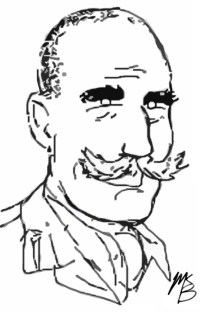
My idea of command was everybody should know what I looked like, to start with. I thought then, and came to conclude I was I was absolutely right, it is essential for soldiers to know the face and the appearance of their commanding officer. So that they would know what I looked like, I ordered a parade of all hands … By that time, the soldiers would have seen what I looked like, and heard me, and they would be able thereafter not only to identify me but to identify with me.
(Vokes, My Story, 68)
In his public persona and performance, Christopher Vokes encouraged a notorious reputation as a forceful, profane, womanizing, hard-drinking ruthless soldier. Born in Armagh, Ireland on 13 April 1904, Vokes graduated RMC in 1925 before being commissioned with the Royal Canadian Engineers. He attended McGill University and the staff college at Camberley, England. Following mobilization in 1939, he became general staff officer with 1st Canadian Infantry Division and later assumed temporary command of the PPCLI in October 1941.
He took over for a month from Lieutenant-Colonel Bob Linsday who was attending an officer’s course. Vokes had assumed he was sent to smarten up the Princess Pats but the posting was just as likely to give him experience commanding a battalion. In June 1942, he was promoted to head the 2nd Infantry Brigade. On 10 July 1943, the 2nd Brigade landed in Sicily as part of Operation Husky. Notorious for his irreverent and controversial style, Vokes famously attempted to set up a brothel to see to his troops’ needs.
Shortly after the invasion of the Italian peninsula, Vokes succeeded an ill Major-General Guy Simonds in command of the 1st Canadian Division. Under his leadership, Canadian infantry attacked Ortona in winter 1943, pushed through the Hitler Line in spring 1944 and attempted to break through the Gothic Line in summer 1944. His brother, Lieutenant-Colonel F.A. Vokes of the 9th Armoured Regiment was killed in action on 31 August 1944.
In November, after General E.L.M. Burns was removed as commander of I Canadian Corps, Vokes believed for a time that the position of highest-ranking Canadian officer in Italy would be his. However, he soon learned that General Charles Foulkes had been appointed the new corps commander. “I have often wondered whether someone got the names Vokes and Foulkes mixed up,” Vokes later wrote. “have lost no sleep over that command shuffle, but I have sometimes speculated about what later might have been … No doubt about it, I was hurt for a few hours.”
Instead of a promotion, Vokes was transferred to Northwest Europe in command of the 4th Armoured Division. Also disappointed by the miscommunication, Brigadier George Kitching, who had been relieved of the 4th Division months prior, recalled Vokes asked him if he had considered resigning his commission after being fired. “No, that never entered my mind,” Kitching replied, “although there was a time that day when I thought I might shoot myself,” to which Vokes grinned.
In his memoir, Vokes recounted his thoughts on taking command of the 4th Division in December 1944:
I knew roughly what I might be getting into. No one’s reputation is quite what he himself perceives it ought to be. Nevertheless it is quite true that both fame and notoriety precede one and about this nothing can be done. I knew that at the least I would face looks askance because I was infantry, not armour, and a converted engineer at that. And I expected, furthermore , some of my pecadillos would perhaps have been noised about, possibly even some chitchat about my soft and melodious voice and gentle disposition.
(Vokes, My Story, 188)
By early 1945, the division prepared for the final offensive with the Allied invasion of western Germany. On 14 April 1945, in retaliation for the sniping death of Lieutenant-Colonel Fred Wigle of the Argyll and Sutherland Highlanders of Canada, Vokes ordered the razing of the town of Friesoythe. “I confess now to a feeling still of great loss over Wigle,” he wrote in his memoir. “And a feeling of no great remorse over the elimination of Friesoythe.” He commanded the Canadian Army Occupation Force in Germany until 1946 and retired from the army in 1959.
Vokes died in Oakville, Ontario on 27 March 1985.
In his posthumous autobiography Vokes had dictated his memoirs into a cassette, which co-author and journalist John P. Maclean then transcribed and edited. This odd collection of off-colour anecdotes and battle stories made for good quotes, but the style also reinforced his self-image of an irascible, vulgar, outspoken old soldier. PPCLI veteran C. Sydney Frost strongly objected to this portrayal of a general he had respected, arguing in his own memoir:
Vokes comes through as a strange man who could be vindictive, vicious, impulsive, impetuous; uncaring about casualties unless they were prohibitively heavy … Any civilian, not knowing Vokes, would come to the conclusion that the man and the soldiers he led were a bunch of brutal licentious, hired assassins … The book is a cruel defamation not only of Vokes’ character but of the character of the fine soldiers he led.
 World War Graphic History