Major-General Rod Keller
Princess Patricia’s Canadian Light Infantry
1st Infantry Brigade
3rd Canadian Division
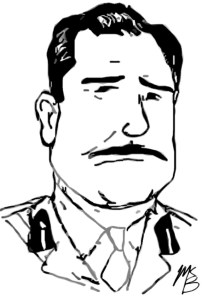
You don’t know who’s going to be killed next or who’s going to be promoted. Everybody’s got to be ready to move up at least two places. Every private has got to be ready to become a corporal on five minutes’ notice, every corporal a sergeant-major, every sergeant-major a captain, every lieutenant a major.
(Keller in Winnipeg Tribune, 24 June 1943, 7)
Born in Gloucestershire, England on 2 October 1900, Rodney Frederick Leopold Keller, immigrated to Kelowna, British Columbia as a child. He graduated from RMC in 1920 and took a commission with the PPCLI. As a prewar captain with the Permanent Force, he went overseas as a brigade major with the general staff. In June 1941, he was appointed to replace Lieutenant-Colonel J.N. Edgar in command of the regiment. The next month he was promoted again to brigadier of the 1st Canadian Infantry Brigade.
Keller continued his rapid rise with another promotion to major-general of the 3rd Canadian Division in September 1942. In an interview with the press a year before the division went into action in France, Keller explained his leadership philosophy:
First, the Canadian solider is a human being with the same hopes and fears, strengths and weaknesses that any of the rest of us have. Second, he has got a brain it is my duty and the duty of all my commanders to keep that brain occupied, so that when he’s asked to carry out a task the soldier knows there’s a reason for it. Provided a commander will do that for his me, they’ll do anything humanly and inhumanly possible for him.
Popular with many troops, and portraying himself as a soldier’s general, Keller expressed particular distaste for the term “brass hat.” He explained, “It suggests a guy who sits down and eats big meals, drinks good wines and sleeps in a feather bed. The soldier who mutters about brass hats forgets that everybody who wears one has been through the mill, too.” In fact, his brigadiers and staff complained that Keller lived up to this stereotype; drinking too much and spending too much time away from duty to visit his mistress.
Keller commanded the 3rd Division in the landings at Juno Beach on D-Day, but the heavy fighting in Normandy proved a heavy strain. Some of his staff derisively whispered, “Keller was yeller.” Although the British desired his replacement, and a “high-strung” Keller even offered resignation, General Guy Simonds of II Canadian Corps refused. “The individual qualities of General Keller are unimportant at the moment,” Simonds reasoned, “in comparison with the bigger problem of maintain the morale.”
Shortly thereafter, Keller was wounded by friendly fire and put out of action anyway. On 8 August 1944, during Operation Totalize, US Army planes had accidently carpet-bombed 3rd Division headquarters. He was heard shout as he was being carried away that he would shoot the first American he saw. Major-General Dan Spry was brought from the Italian theatre as his replacement. Medically unfit and overstrained, Keller returned home to Kelowna, British Columbia in October 1944.
Keller died in London on 21 June 1954, before he could leave for home after participating in the tenth anniversary of D-Day at Normandy.
 World War Graphic History
Hello
Just a small suggestion, I saw earlier on in this biography, a misspelling. This greatly reduces it’s credibility as a source, so I suggest you fix it.
It is the word spelt “permeant”, although I have no doubt you meant to say “Permanent”.
Thank you!