Lieutenant-Colonel E.H. Wildblood
1st Bn., Leinster Regiment (Royal Canadians)
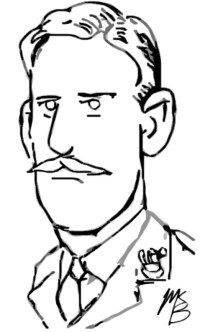
The following are the considered opinions submitted by the Court …
That the situation at present obtaining in Palestine is exceedingly dangerous and demands firm and patient handling if a serious catastrophe is to be avoided.
(Maj-Gen. Palin, Brig. Wildblood, and Lt-Col. C.V. Edwards, Palin Commission, 1920)
Born on 2 May 1878 in Cheshire, England, Edward Harold Wildblood was a solider, sportsman, and big game hunter. He fought as a trooper in Roberts’ Horse during the Boer War and was commissioned with the Leinster Regiment in 1900. He served with the 1st Battalion in the heavy fighting at Ypres through to its deployment on the Salonika front. By early 1917, he had succeeded Lieutenant-Colonel J.D. Mather in command.
In September 1917, the 10th (Irish) Division, which included the 1st Leinsters, transferred to Egypt. Wildblood led the battalion against the Ottoman Turks throughout the Sinai and Palestine campaigns. By October 1918, he was promoted to brigadier general, and command of the 1st Leinsters passed to Major Bertram C. Riall.
In 1920, Wildblood served on the three-member Palin Commission (presided by Major General Philip Palin), the first British court of inquiry on the question of Palestine. The commission was critical of Zionists for exacerbating Arab fears about their displacement, the Balfour Declaration for its ambiguity on the meaning of a homeland for Jewish people, and the fundamental inconsistency of British propaganda:
there can be little doubt that the declared policy of the Allies in favour of the self-determination of small nations encouraged the Palestinians to think, that whether they were to be permitted to unite themselves to the great Arab State forming on their borders or no, they at least, under the mandate of one of the Great Powers, would be permitted to work out their own salvation and be masters in their own house…
The Jewish title based on the tenacious historical memory of the race and a profound religious sentiment which appeals so strongly to those European and American peoples who have absorbed the Old Testament narrative and prophesies with their earliest essays in their native tongue, means less than nothing to a people who see themselves menaced with deprivation by a race they have hitherto held in dislike and contempt.
The final report was, however, never published.
Wildblood commanded the 1st Battalion, Royal Tank Corps during the Waziristan campaign on the northwest Indian frontier. He died shortly thereafter on 12 March 1926. His son, Pilot Officer T.S. Wildblood died during the Battle of Britain in August 1940.
 World War Graphic History