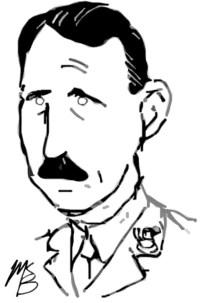
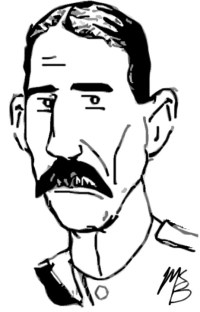
Lt-Col. Canning

Lieutenant-Colonel A. Canning
3rd Bn., Leinster Regiment (Royal Canadians)
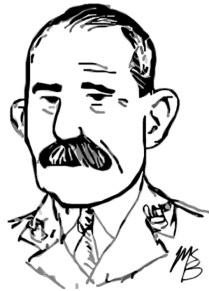
Canning

His departure was sorely regretted by all ranks, for during the twelve months he had been with the 7th, his capabilities as a commander had only been surpassed by his solicitude for the men’s welfare, so that he had made his way into out hearts as a popular soldier.

(Capt. S.J. Wilson, The Seventh Manchesters: July 1916 to March 1919, 4)

Born on 3 October 1861 in Wiltshire, England, Albert Canning was a veteran of the Anglo-Egyptian War (1882) and the Sudan campaign (1884-5). He had joined the ranks of the 19th Hussars in 1881, received a commission in the South Wales Borders in 1888, became a captain with the Leinster Regiment in 1895 and retired as a major in 1911. He came out of retirement on the outbreak of the Great War to take command of the 3rd (Special Reserve) Battalion.

Continue reading

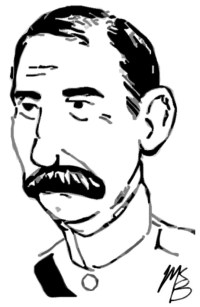
Lt-Col. Bullen-Smith

Lieutenant-Colonel G.M. Bullen-Smith
2nd Bn., Leinster Regiment (Royal Canadians)
BullenSmith

 his departure, followed by that of Lieutenant-Colonel Bullen-Smith, left scarcely any of the officer who had landed with the Battalion in September, 1914. Death had claimed his due as he had done from other units in the field; many had been so severely wounded as to be unfit for further service in the field; and the ever-growing national army drained off the few remaining Regular officers from their own units.

(Whitton, The History of the Prince of Wales’s Leinster Regiment, vol. 2, 224)

Born in India on 5 February 1870, George Moultrie Bullen-Smith attended Sandhurst and was commissioned a second lieutenant in 1891. He was appointed to The Black Watch before being exchanged for another officer in the Leinster Regiment in 1894. When the 2nd Leinsters went to France in September 1914, Bullen-Smith was second-in-command. He became acting battalion commander following the wounding of Lieutenant-Colonel W.T.M. Reeve on 19 November 1914.

Continue reading

Lt-Col. Reeve

Lieutenant-Colonel W.T.M. Reeve
2nd Bn., Leinster Regiment (Royal Canadians)
Reeve

“Terrier” Reeve was devoted to the Battalion in which he had done all his regimental service and of which he had been adjutant and commanding officer. After his severe wound in 1914 he could have secured a comfortable appointment at home but his high sense of duty urged him to beg to be sent to the front again.

(Whitton, The History of the Prince of Wales’s Leinster Regiment, vol. 2, 153)

Born in France on 29 June 1866, William Tankerville Moneypenny Reeve was the commanding officer of the 2nd Battalion, Leinster Regiment on the outbreak of the Great War. He had joined the 2nd Leinsters after graduating from Sandhurst in 1887. He went to Africa as part of the expeditionary force against the Ashanti Empire in 1900. He remained part of the West African Field Force and commanded the Gold Coast Regiment from 1909 to 1911.

Continue reading

Maj. Conyers

Major Charles Conyers†
1st Bn., Leinster Regiment (Royal Canadians)
Conyers

6pm – Trench in firing line lost. Battalion ordered to counter attack. Left about 11pm. ‘C’ Coy gained the captured trench but were obliged to retire owing to enfilade machine gun fire being brought to bear on them. Major Conyers (commanding Bn) mortally wounded.

(1st Bn., Leinster Regiment War Diary, 11 May 1915)

Charles Conyers was born on 19 November 1867 at his family estate Castletown Conyers in Limerick, Ireland. He had been commissioned since 1889, served in the Boer War, and was a major with the Royal Irish Fusiliers on the out break of the Great War. He transferred to the 1st Battalion, Leinster Regiment to succeed Lieutenant-Colonel C.B. Prowse on 29 April 1915

Continue reading

Lt-Col. Prowse

Lieutenant-Colonel C.B. Prowse†
1st Bn., Leinster Regiment (Royal Canadians)

Between the newly captured German lines the Brigadier was cheering us on, when a big shell dropped about 20 or 30 yards away, and a piece must have hit him on the explosion for he was seen to fall. Several men rushed to his assistance. Before he died he cheered the men, and told them to keep up the name of the “Stonewall Brigade.”

(The Wells Journal, 14 July 1916, 5)

Charles Bertie Prowse was born in West Monkton, England on 23 June 1869. He had been commissioned since 1889 and served as a staff officer during the Boer War. He was commanding officer of the 1st Battalion, Prince Albert’s (Somerset Light Infantry) Regiment during the early fighting of 1914 in France. He briefly took command of the 1st Battalion, Leinster Regiment in March 1915 until his promotion to brigadier general of the 11th Infantry Brigade the next month.

Continue reading

Lt-Col. White

Lieutenant-Colonel S.R.L. White
1st Bn., Leinster Regiment (Royal Canadians)
White

The new colours which you have just present have yet to justify existence, but I have no hesitation in saying that we are willing to a man to do under them what we have done under the old ones, to keep them flying for the honour of the Regiment and the glory of the British Army, whether in this country or in any other where duty calls us to fight for our King and country.

(Col. White, 4 Feb 1913, in F.E. Whitton, The History of the Prince of Wales’s Leinster Regiment, vol. 1, 167)

Samuel Robert Llewellyn White was born in Blackrock, County Dublin, Ireland, on 4 June 1863. He was commissioned with the Leinster Regiment in 1885 and served as a captain during the Boer War, for which he was awarded the Distinguished Service Order. He became commanding officer of the 1st Battalion in 1911. As the unit was stationed in Fyzabad, India at the outbreak of the Great War, it did not arrive to France until December 1914.

Continue reading