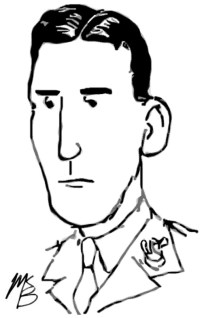
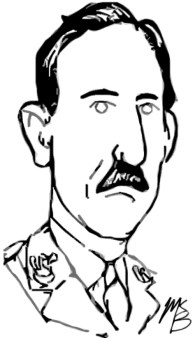
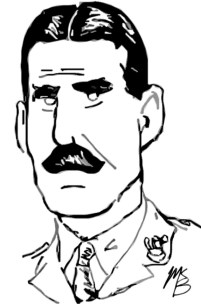
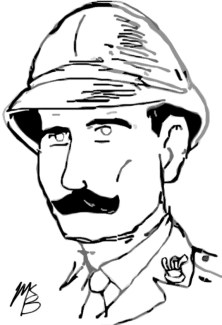
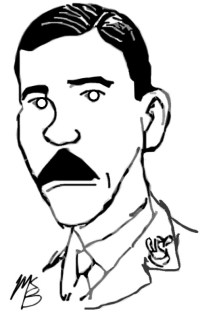
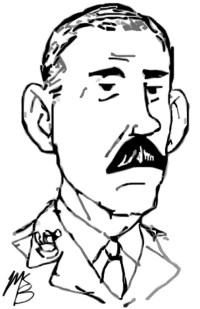
Lt-Cols. Jameson & McDonnell

Lieutenant-Colonel E.J. Jameson
Jameson
&
Lieutenant-Colonel John McDonnell
McDonnell
5th Bn., Leinster Regiment (Royal Canadians)

He was not the showy or popularity-seeking kind, but always pursued the even tenor of his path to duty. Reserved, rather taciturn, a somewhat lonely figure, he yet inspired confidence and esteem. Outwardly he appeared a man of care and silent sorrow, which rather belied his age and vigour. He knew his work, had confidence in himself and inspired it in others. Fearless and impartial, he never spared a subordinate, from a private upwards. But he never spared himself.

(Tribute to Lt-Col. Jameson in Whitton, The History of the Prince of Wales’s Leinster Regiment, vol. 2, 393)

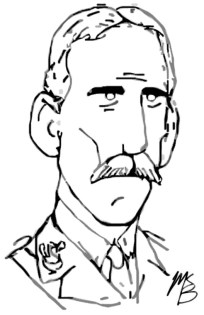
Both majors who succeeded Lieutenant-Colonel E.F. Farrell in command of the 5th Battalion, Leinster Regiment would each later lead a battalion in the field before being killed in action. Born on 11 June 1875 in Dublin, Edmond James Jameson died of wounds on 27 March 1917 while in command 1/4th Essex Regiment during the First Battle of Gaza. Born on 2 November 1878 in Dublin, John McDonnell died with the 1st Inniskilling Fusiliers at Ypres on 29 September 1918.
Continue reading

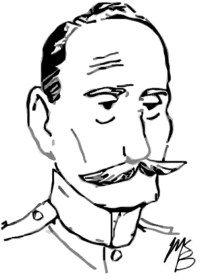
Lt-Col. Colquhoun

Lieutenant-Colonel J.C. Colquhoun
6th Bn., Leinster Regiment (Royal Canadians)
Colquhoun

“Once a Leinster always a Leinster.”

(Whitton, The History of the Prince of Wales’s Leinster Regiment, vol. 2, 96)

Born in Perthshire, Scotland on 31 December 1870, Julian Campbell Colquhoun was the second son of Colonel William Campbell Colquhoun of Clathick Estate. After finishing school, he joined the 2nd Battalion, Leinster Regiment, was promoted to captain in 1898, and served in the Boer War. He retired to the reserve of officers in 1907 but immediately reported for duty in August 1914. He was posted to the new 6th {Service) Battalion under the command of Lieutenant-Colonel John Craske.

Continue reading

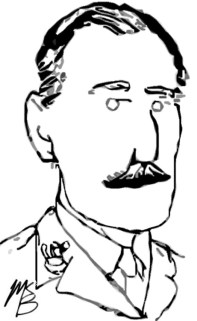
Lt-Col. Stannus

Lieutenant-Colonel T.R.A. Stannus
7th Bn., Leinster Regiment (Royal Canadians)
Stannus

Although severely wounded, and thereby unluckily precluded from leading them to the attack his careful supervision and preliminary preparations undoubtedly ensured the success which his men attained. His adjutant was wounded at the same moment, but Lieut.-Colonel Stannus declined all aid until the other officer had been attended to. He had previously done splendid work when acting as O.C., on one occasion frustrating a raid with great loss to the enemy, entirely through personal foresight and grasp of the situation.

(Lt. Col. Stannus, D.S.O. citation, 18 Sept 1917)

Born on 29 September 1870 in Clonygowan, Ireland, Thomas Robert Alexander Stannus was a long serving soldier and Boer War veteran. He was taken prisoner and later wounded in action with the Imperial Yeomanry in South Africa. Having served with the Leinster Regiment since 1889, he retired to the Special Officer Reserve in April 1914. On the outbreak of the Great War, he rejoined the 4th (Extra Reserve) Battalion at the rank of major.

Continue reading

Lt-Col. Buckley

Lieutenant-Colonel G.A.M. Buckley
7th Bn., Leinster Regiment (Royal Canadians)
Buckley

We are not yet out of the wood, let us see to it that at the eleventh hour nothing is done to detract from the high honour that has come to us. I appeal to you once again–officers and men let us pull ourselves together for the last lap … As for me, my heart has bled for you all during these days and nights of trial. I shall thank God when I see you all safely out, and there is no prouder colonel in the whole British Army than I am to-day.

(Lt. Col. Buckley, 5 Aug 1917 in Whwiitton, The History of the Prince of Wales’s Leinster Regiment, vol. 2, 428)

 Born on 25 October 1866 in Christchurch, New Zealand George Alexander McLean Buckley was a sheep farmer, land broker, county politician, sportsman, swimmer, polo player, model yacht enthusiast, explorer, and soldier. He joined the British Army in 1885 and served in India before returning to New Zealand in 1891 to manage the large Lagmhor Estate. Noted for his many interests and adventurous spirit, he travelled to Patagonia in 1897 and joined partway Ernest Shackleton’s 1907 expedition to Antarctica. By the outbreak of the Great War, he had been living in England for ten years and took up soldiering once again.

Continue reading

Lt-Col. Craske

Lieutenant-Colonel J. Craske
6th Bn., Leinster Regiment (Royal Canadians)
Craske

“When I am sniped, I always sit down,” and did so—still in the open, while the remainder wasted little time in taking advantage of some convenient rocks. More sniping—then a volley of oaths from Craske whose staccato imprecation “Mygod, mygod. Damnfellowsgotme. Damnitall. Damnitall,” was characteristic. Fortunately the wound was a slight one in the left arm.

 (Whwhiitton, The History of the Prince of Wales’s Leinster Regiment, vol. 2, 334)

Born in Somerset, England on 7 November 1869, John Craske was commissioned with the Leinster Regiment in 1890 and fought in the Boer War, for which he received the Distinguished Service Order. Unlike many officers of the “Royal Canadians,” he had a personal connection to the Dominion. In 1899, he married Grace Oliver of Halifax, Nova Scotia, daughter of William Silver Oliver, former Canadian deputy surgeon general.

Continue reading

Lt-Col. Murphy

Lieutenant-Colonel A.D. Murphy
2nd Bn., Leinster Regiment (Royal Canadians)
Murphy

The commanding officer seemed to bear a charmed life, and it became a belief in the Battalion that he could not be killed. But he exposed himself fearlessly not because he was invulnerable but because he was brave. No braver man than Alfred Durham Murphy ever stepped on French soil.

(Witton, The History of the Prince of Wales’s Leinster Regiment, vol. 2, 244)

When Major Alfred Durham Murphy assumed command of the 2nd Leinsters in August 1916 at the age of twenty-six, he was one of the youngest battalion commanders on the Western Front. Born on 4 July 1890 in Southwark, Surrey, England, was the son of a retired Tipperary colonel and joined his father’s regiment in 1911. He went to France in September 1914 with the 2nd Leinsters as a junior lieutenant but by May 1916 was second-in-command.

Continue reading

Lt-Col. Orpen-Palmer

Lieutenant-Colonel R.A.H. Orpen-Palmer
2nd Bn., Leinster Regiment (Royal Canadians)
OrpenPalmer

Now that the actual disbandment of the Battalion is about to commence, I wish all ranks to know how proud I have been to command such a body of men. At Home and Abroad, in peace and in war, whether in France, Belgium, Colchester or Silesia, the Battalion has won a fine reputation second to none, a reputation acknowledged everywhere by Brigade and Divisional Commanders. It is a grief and more to all of us that we see our splendid Regiment destroyed; but it is through no fault of our own, and we as Irishmen have done our duty, to our Country and our Empire.

(Lt-Col. Orpen-Palmer, Part 1 Orders, 5 June 1922)

Born in Dublin on 26 December 1877, Reginald Arthur Herbert Orpen-Palmer was commissioned a second lieutenant with the Leinster Regiment in 1898 and served in the Boer War. All three of his brothers served as officers in the First World War, including one who lost an eye fighting with the Leinster Regiment in fall 1914. Initial news reports misidentified R.A.H. Orpen-Palmer as the wounded brother but was adjutant for the 5th (Extra Reserve) Battalion until he went to France in April 1915.

Continue reading

Lt-Col. Mather

Lieutenant-Colonel J.D. Mather
1st Bn., Leinster Regiment (Royal Canadians)
Mather

I was just sitting down to breakfast (in the M de Prémesques farm) when the greatest burst of fire I have every heard broke out … C and D companies (Leinster Regt) had been driven out of their trenches by the enemy’s attack.

(J.D. Mather, diary, 20 October 1914 in 2nd Bn., Leinster Regiment War Diary)

Born in North Shields, Northumberland, England on 17 March 1872, John Dryden Mather had been commissioned with the Leinster Regiment in 1892 and served in the Boer War. Following sick leave for bronchitis in April 1915, Mather joined the 1st Leinsters on 26 June 1915. He took command after Lieutenant-Colonel Charles Conyers had been mortally wounded in action on 11 May. Following a relatively quiet summer after the heavy fighting of late 1914 and early 1915, the 1st Leinsters learned their division was to be redeployed from the Western Front. In November 1915, the 27th Division sailed from Marseilles “for an unknown destination.”

Continue reading

Lt-Col. Farrell

Lieutenant-Colonel E.F. Farrell
5th Bn., Leinster Regiment (Royal Canadians)
Farrell

PATRICK WHITE asked the Secretary of State for War whether he will state the name of the commanding officer of the 5th Battalion Leinster Regiment, formerly the Meath Militia; whether he is aware that on the annual training of the men instructions were issued on their separating that they were not to join the Irish Volunteers, and that anyone so doing would be dealt with by the military authorities; whether such threats were issued with the sanction of the military authorities; and what instructions, if any, have been issued to officers with regard to their attitude towards men who wish to join the Irish Volunteers?

 (Hansard, Vol. 65, 20 July 1914)

Born in Dublin on 1 January 1863, Edward Francis Jenico Joseph Farrell and his family had deep connections with the Leinster Regiment. In 1886, he had been commissioned in the 5th Battalion, also known as the Royal Meaths from its pre-1881 militia identity. Four of his nephews also served with the regiment during the Great War. On the eve of the war, with tensions over Home Rule in Ulster threatening civil war in Ireland, Nationalist MP Patrick White, alleged that Farrell had threatened his reservists to not join the Irish Volunteers. Prime Minister Asquith replied, “the statement is wholly incorrect and that he has issued no such instructions.”

Continue reading

Lt-Col. A.A. Weldon

Lieutenant-Colonel A.A. Weldon
4th Bn., Leinster Regiment (Royal Canadians)
AAWeldon

I think myself, the later rebellion ill judged and ill advised as it was, has opened the eyes of the people to the dangers of carrying arms which should never have been allowed … At the same time, I think out of ill may come some good as some measure of local government will be devised with the wish of the whole country which will bring peace to this unhappy country in the future.

(Lt. Col. A.A. Weldon in Freeman’s Journal, 3 August 1916, 6)

Born on 1 March 1863 in London, Sir Anthony Arthur Weldon, had been commissioned in the Leinster Regiment in 1885 and served in the Natal Field Force during the Boer War. He was aide-de-camp to Commander-in-Chief of the Forces Lord Wolseley from 1895 to 1900. On the death of his father in January 1900, Weldon became the 6th Barnonet of Dunmore. Since 1908, he was commanding officer of the 4th Leinsters.

Continue reading