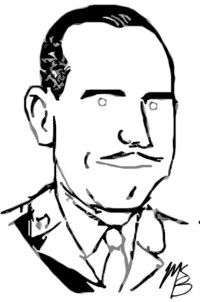
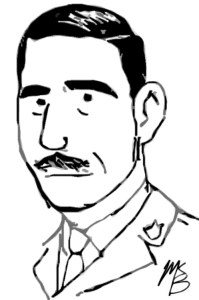
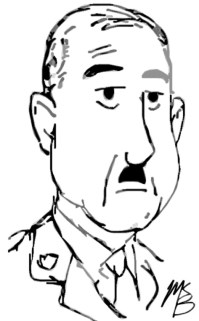
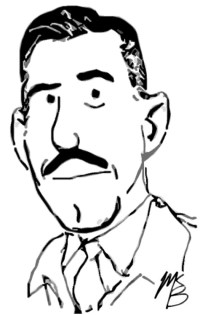
Lt-Col. G.L. Lalonde

Lieutenant-Colonel Lucien Lalonde
Régiment de Maisonneuve
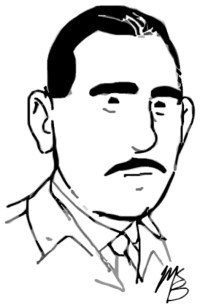
Lalonde

German officers are hypocrites and constitute a class that should be watched closely, especially when they appear submissive and eager to cooperate. Isms of any kind are no good for use. Those who preach them in Canada have never been to the countries they speak so glowingly about. In fact, they don’t know what they are talking about.

(Lalonde in Montreal Gazette, 15 Mar 1946, 2)

Born in Montreal on 14 December 1908, George Lucien Lalonde graduated from L’Assomption College in 1926 and the University of Montreal with a law degree in 1930. He mobilized as with the Régiment de Maisonneuve, and went overseas as a captain in August 1940. When Lieutenant-Colonel Robert Bourassa fell ill, Major-General Victor Odlum of the 2nd Division considered Lalonde for the appointment. It was, however, deemed inappropriate to promote a captain over the unit’s other senior officers. Instead, he went to the war staff college.
Continue reading

Lt-Col. J. Bibeau

Lieutenant-Colonel Julien Bibeau
Régiment de Maisonneuve
Bibeau

But impressive as this official recognition of its service undoubtedly is, glimpses more vivid and human into the quality of the regiment’s spirit are provided in certain recorded incidents. Such is the story of how Lt.-Col. Julien Bibeau won the D.S.O. at Calcar, when some members of the regiment had been surrounded by Nazi paratroopers, and he had led a party to their rescue shouting: “Follow me, we are not going to let our boys get killed like that!”

(Montreal Gazette, 29 Nov 1945, 8)

Born in Montreal in January 1908, Julien Bibeau was a graduate of the University of Montreal and sales manager for Maple Leaf Mills. Having belonged to the Cadet Officer Training Corps at university, he took a commission with the Régiment de Maisonneuve in 1937. He graduated from senior officer school in 1943, and by the time the regiment deployed to France after D-Day in July 1944, he served as second-in-command under Lieutenant-Colonel Lefort Bisaillon.

Continue reading

Lt-Col. H.L. Bisaillon

Lieutenant-Colonel H. Lefort Bisaillon
Régiment de Maisonneuve
Bisaillon

Not once, even when under exceedingly difficult situations, has he neglected doing the utmost for those under his command. His calmness and mastery of himself were a striking example to all ranks and whenever the battle was at its highest pitch he would go around to the coys to counsel and help them out.

(War diary, 18 Aug 1944)

Born in Quebec in 1907, Henri Lefort Bisaillon was the son of Colonel Pierre Bisaillon who had commanded the 85th Regiment from 1915 to 1920. He took a commission in his father’s old unit, now redesignated Régiment de Maisonneuve, in 1928. While stationed in the United Kingdom, in November 1942, he succeeded Lieutenant-Colonel M.L. de Rome and would lead the unit to France as part of the 5th Brigade, 2nd Division after D-Day.

Continue reading

Lt-Col. M.L. de Rome

Lieutenant-Colonel M.L. de Rome
Régiment de Maisonneuve
DeRome

Lieutenant Colonel de Rome has, during the last 8 months, trained and commanded with outstanding success the Special Force Detachment attached to H.Q., Canadian Army. His quick grasp of the unusual problems involved, his application, enthusiasm and drive, have been an inspiration to all ranks, British and Canadian, in his Detachment.”

(O.B.E. citation, 19 Apr 1945)

Born in Ottawa on 8 January 1911, Maurice Louis de Rome belonged to the Cadet Officer Training Corps at the University of Montreal and joined the Régiment de Maisonneuve in 1935. He joined the Royal 22nd Regiment on mobilization in September 1939. Then in July 1942, he succeeded Lieutenant-Colonel J.R. Roche in command of the Maisonneuve regiment. His tenure would be brief and returned to Quebec in November 1942. However, he would soon be assigned to more secretive and sensitive duties.

Continue reading

Lt-Col. J.R. Roche

Lieutenant-Colonel J.R. Roche
Régiment de Maisonneuve
Roche

To my personal knowledge he is a very intelligent, active and efficient officer. I would say that he probably had a good military knowledge on paper … I feel that after a short time he could be relied on to efficiently carry out orders given to him by a higher Commander, and to show good leadership in in his work. He is, of course, completely bi-lingual.

(Maj-Gen. Odlum to McNaughton, 5 Sept 1941)

Born in Ottawa on 18 June 1907, John Redmond Roche was a Montreal lawyer and superintendent of the Quebec provincial police. A graduate of the University of Montreal, he had headed the Cadet Officer Training Corps since 1938 and previously belonged to the Regiment de Chareauguay. He went overseas with the 1st Division general staff as deputy-assistant adjutant general in December 1939. He was briefly posted to France in May 1940 but returned to England “before things became hot.”

Continue reading

Lt-Col. P. Brosseau

Lieutenant-Colonel Paul Brosseau
Régiment de Maisonneuve
Brosseau

It was recruited to full strength under its gallant leader, Col. Robert Bourassa, himself a veteran of the last war, and who unfortunately, after proceeding to England with his units, has now been invalided back and lies here paralyzed. He led the van of Canada in recruiting and the sympathy of all Canadians must go out to him now, to console him in his suffering.

(J. A. Matthewson, provincial treasurer, 25 Nov 1941)

Born in Laprairie, Quebec on 25 March 1893, Robert Bourassa was a lawyer, former crown prosecutor, and commanding officer of the Régiment de Maisonneuve since 1936. He had belonged to the Cadet Officer Training Corps at Laval University and enlisted in the 1st Canadian Tank Battalion in April 1918 shortly after passing the Quebec Bar. Facing defence budget cuts in the interwar years, Bourassa advocated for a new regimental armoury in Maisonneuve, which had yet to be built by the declaration of war in September 1939. “What we want is a suitable place that the men can easily reach,” he stated exactly a year earlier, “not a tombstone to a regiment that will necessarily disappear if it is located in the far east end of the city.”

Continue reading

Lt-Col. R. Bourassa

Lieutenant-Colonel Robert Bourassa
Régiment de Maisonneuve
Bourassa

It was recruited to full strength under its gallant leader, Col. Robert Bourassa, himself a veteran of the last war, and who unfortunately, after proceeding to England with his units, has now been invalided back and lies here paralyzed. He led the van of Canada in recruiting and the sympathy of all Canadians must go out to him now, to console him in his suffering.

(J. A. Matthewson, provincial treasurer, 25 Nov 1941)

Born in Laprairie, Quebec on 25 March 1893, Robert Bourassa was a lawyer, former crown prosecutor, and commanding officer of the Régiment de Maisonneuve since 1936. He had belonged to the Cadet Officer Training Corps at Laval University and enlisted in the 1st Canadian Tank Battalion in April 1918 shortly after passing the Quebec Bar. Facing defence budget cuts in the interwar years, Bourassa advocated for a new regimental armoury in Maisonneuve, which had yet to be built by the declaration of war in September 1939. “What we want is a suitable place that the men can easily reach,” he stated exactly a year earlier, “not a tombstone to a regiment that will necessarily disappear if it is located in the far east end of the city.”

Continue reading