The Hockey Pioneer

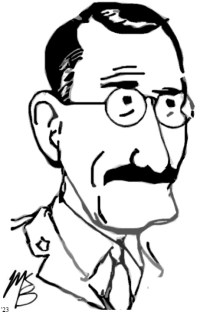
Major Lennox Irving
240th (Renfrew) Battalion

We have the best type of manhood in the world in our brave troop fighting somewhere or everywhere in France. To appreciate even in the slightest degree, one mast see the heroes as they go into the trenches, go over the parapet, facing fearful odds, and then see them at their rest camps preparing for a great attack.

(Maj. Irving, Ottawa Journal, 11 Aug 1917, 16)

After the formation of the 240th Battalion, former 42nd Regiment commanding officer, fifty-three year old Lennox Irving came out of retirement to serve as second-in-command to Lieutenant Edgar John Watt. Born in Renfrew, Canada West on 16 May 1863, Irving was a barrister, militiaman and early hockey pioneer. While a student at Queen’s University, he participated in the first hockey game against the Royal Military College in 1886. Irving scored the lone goal to give Queen’s the victory. The two schools compete for the Carr-Harris Challenge Cup every year to commemorate this first hockey game.
Continue reading

The Professor

It seems fitting to begin this project with Professor P. G. C. Campbell of the 253rd Battalion, a man who understood the value of historical inquiry.

Lieutenant Colonel P. G. C. Campbell
253rd (Queen’s University) Highland Battalion
PGC campbell

We moderns, however go with magnifying glass and dissecting knife to the past, attempting to discover how our forebears lived and thought, and ever present in our researches is the question, how do these things throw light on ourselves; to what extent can we trace a continuity of process between the past and the present?

(P.G.C. Campbell, “Early Roman Religion,” Queen’s Quarterly, 1909, 58)

Percy Gerald Cadogan Campbell was a professor of Romance languages and French at Queen’s University in Kingston, Ontario from 1902 until his retirement in 1949. The son of a Scottish Anglican chaplain, Campbell was born on 8 January 1878 in Calais, France. After graduating from Balliol College, Oxford, he moved to Canada to take a teaching position at Queen’s. In Kingston, Campbell joined the 14th Militia Rifles (The Princess of Wales’ Own), rising to the rank of major.

Continue reading