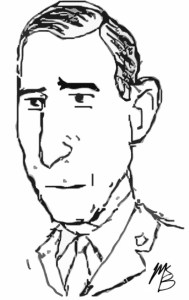
Lt. Col. Lalor

Lieutenant Colonel W.J.A. Lalor, M.C.
2nd Motor Machine Gun Brigade

This Officer gives a history of four years service in France, as a Machine Gun officer. Towards the end of his service, he states, he was developing symptoms of a fear neurosis, and this was finally precipitated by being blown up … There has been a strong tendency to repress his Overseas experiences, and towards self-reproach, as a result of his break-down. He states, now, he is afraid of the crowds, and cannot go to a Theatre. He is afraid to go over a bridge for fear that he will jump off. He has not made up his mind about his future.

 (Maj. A.A. Fletcher, Neurological Report, 13 Nov 1919)

Born in Muskoka, Ontario on 22 May 1878, William James Austin Lalor was a prospective homesteader in the west when the Great War broke out. He enlisted with the 1st Battalion in September 1914 and went to France in February 1915. Shortly thereafter he transferred to the Machine Gun Brigade, earning the Military Cross and a promotion to captain.
Continue reading

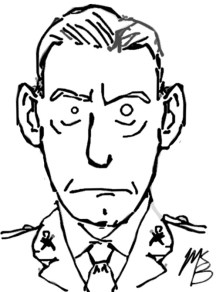
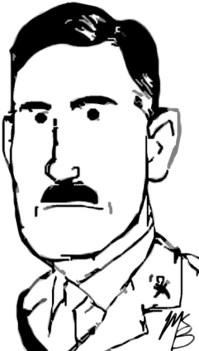
The Swede

Lieutenant Colonel Harry F. Meurling, M.C.
2nd Motor Machine Gun Brigade
Meurling

I was in command of the 2nd M.M.G. Bge. at the time, and I had as 2ic a man by the name of Mureling [sic], he was not a Canadian, and spoke very broken English, which was very hard to understand, and he was a most objectionable fellow indeed, how ever he got where he was is more than I can tell.

(Col. W.J.A. Lalor to Col Snelgrove, 18 Dec 1936)

Harry Frederick Victor Meurling was a Swedish civil engineer born on 23 April 1875. When he enlisted with the 5th Canadian Mounted Rifles in May 1915 he cited military experience in the Swedish Royal Navy and the Belgian Congo. Of his time serving the notorious central African regime of King Leopold, Meurling stated in 1922: “Many mistakes were made, the blame for which were more rightly laid to human nature than on him in particular, and history, I am sure will only remember him as a man with a great vision and the courage to carry it out.” Continue reading

The Veteran Advocate

Lieutenant Colonel W.K. Walker, D.S.O., M.C.
1st Motor Machine Gun Brigade

I am not opposed to the Vimy Ridge Memorial and plan to be present at the unveiling in July … I am, however, opposed to extravagant war memorials. Particularly when so many of our fine men, who gave their all in the war, are still in need. Anyway, these war memorials will probably only be destroyed in the next war.

(Lt. Col. W.K. Walker, Ottawa Citizen, 11 April 1936, 16)

Born in Cleator Moor, England on 12 July 1888, William Keating Walker was a Church of England missionary living in British Columbia. On the outbreak of the war, despite having no  active military service, he first joined Elliott’s Horse, a small privately raised unit of veteran soldiers. Although many volunteers intended to join their old British regiments on arrival to England, Walker vowed, “I was a Canadian by adoption; a Canadian I would remain, and as a Canadian I would fight.” He was commissioned with the Royal Canadian Dragoons in November 1914. 

Continue reading

Lt. Col. Wilkin

Lieutenant Colonel F.A. Wilkin, M.C.
1st Motor Machine Gun Brigade
Wilkin

Has headaches – nearly constant and at times severe. States that his memory and thinking and reasoning power become very poor after he has been at work a few hours. Insomnia.

 (Medical Board Report of Lt Col. Wilkin, 28 Sept 1918)

Born in Yokohama, Japan on 8 July 1872, Francis Alfred Wilkin was an Alberta land surveyor and member of the Corps of Guides. He joined the Canadian Motor Machine Gun Brigade in January 1915 as a lieutenant and succeeded Lieutenant Colonel Raymond Brutinel as commanding officer in October 1916. Worn down after long service, he was replaced in March 1918 by Major William Keating Walker.

Continue reading

Lt. Col. Moodie

Lieutenant Colonel R.R. Moodie
205th (Hamilton Tigers) Battalion

He is suffering from neurasthenia with insomnia, loss of appetite, general debility, severe headaches, nervous chills and constant pain in temporal region and back of neck. Mental concentration is impossible, and he is easily worried over trifles.

(Proceedings of Medical Board, 3 Sept 1916)

Born in Hamilton, Ontario on 6 August 1884, Robert Roy Moodie was a knitting manufacturer, prominent sportsman and president of the city’s Tiger Football club. A member of the 91st militia and the Canadian Field Artillery, Moodie first joined Lieutenant Colonel Walter Stewart’s 86th Machine Gun Battalion at the rank of major in October 1915. By early 1916, he had received authorization to raise a sportsmen’s battalion from Hamilton, the 205th Tigers, which took its nickname from the city’s sports team.

Continue reading