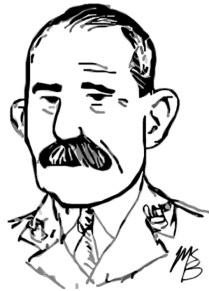
Lt-Col. H.W. Weldon

Lieutenant-Colonel Henry Weldon
2nd Bn., Leinster Regiment (Royal Canadians)
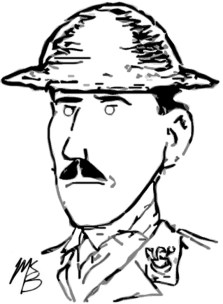
The Regiment has unfortunately lost some most valuable officers … all of whom had done splendid work, which would have brought recognition had they been fortunate enough to survive.

(Weldon to Maj. Gen. Prior in Whitton, The History of the Prince of Wales’s Leinster Regiment, vol. 2, 174)

Born in Dublin on 2 November 1878, Henry Walter Weldon was commissioned a lieutenant in 1900 and served in South Africa. He was adjutant for the 1st Leinsters and temporarily took command after Second Ypres following the death of Lieutenant-Colonel C. Conyers on 12 May 1915. He served with the battalion now under the command of Lieutenant-Colonel J.D. Mather on the Salonika front in 1916.
Continue reading

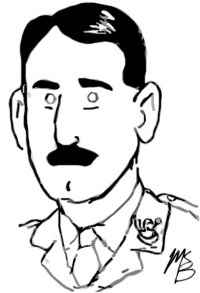
Maj. Frend

Major J.R. Frend
2nd Bn., Leinster Regiment (Royal Canadians)

Heavy hostile shelling of TEMPLEUX QUARRIES commenced about 11:30am until 12:30pm. Extremely accurate. Lt. Col. Murphy, DSO, MC [and others] were in HQ mess attending to wounded when a shell dropped right in their midst killing the CO … Shelling was kept up at intervals of 50 minutes throughout the day & night. Major J.R. Frend assumed command of Bn. at 1 pm.

(2nd Bn. Leinster Regiment War Diary, 6 Nov 1917)

Following the death of Lieutenant-Colonel A.D. Murphy, Major John Roberts Frend took command of the 2nd Leinsters. He was born on 7 February 1883 in Cloghjordan, Tipperary. He served in the Boer War and joined the Leinster Regiment before emigrating to Australia in 1909. On the outbreak of the Great War, he rejoined his old regiment and served with the 2nd Leinsters in France.

Continue reading

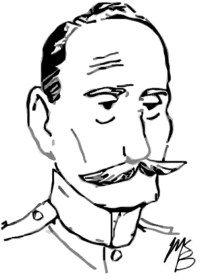
Lt-Col. A.A. Weldon

Lieutenant-Colonel A.A. Weldon
4th Bn., Leinster Regiment (Royal Canadians)
AAWeldon

I think myself, the later rebellion ill judged and ill advised as it was, has opened the eyes of the people to the dangers of carrying arms which should never have been allowed … At the same time, I think out of ill may come some good as some measure of local government will be devised with the wish of the whole country which will bring peace to this unhappy country in the future.

(Lt. Col. A.A. Weldon in Freeman’s Journal, 3 August 1916, 6)

Born on 1 March 1863 in London, Sir Anthony Arthur Weldon, had been commissioned in the Leinster Regiment in 1885 and served in the Natal Field Force during the Boer War. He was aide-de-camp to Commander-in-Chief of the Forces Lord Wolseley from 1895 to 1900. On the death of his father in January 1900, Weldon became the 6th Barnonet of Dunmore. Since 1908, he was commanding officer of the 4th Leinsters.

Continue reading

Lt-Col. Canning

Lieutenant-Colonel A. Canning
3rd Bn., Leinster Regiment (Royal Canadians)
Canning

His departure was sorely regretted by all ranks, for during the twelve months he had been with the 7th, his capabilities as a commander had only been surpassed by his solicitude for the men’s welfare, so that he had made his way into out hearts as a popular soldier.

(Capt. S.J. Wilson, The Seventh Manchesters: July 1916 to March 1919, 4)

Born on 3 October 1861 in Wiltshire, England, Albert Canning was a veteran of the Anglo-Egyptian War (1882) and the Sudan campaign (1884-5). He had joined the ranks of the 19th Hussars in 1881, received a commission in the South Wales Borders in 1888, became a captain with the Leinster Regiment in 1895 and retired as a major in 1911. He came out of retirement on the outbreak of the Great War to take command of the 3rd (Special Reserve) Battalion.

Continue reading