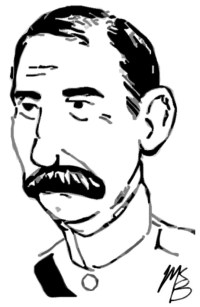
Lieutenant-Colonel G.M. Bullen-Smith
2nd Bn., Leinster Regiment (Royal Canadians)

… his departure, followed by that of Lieutenant-Colonel Bullen-Smith, left scarcely any of the officer who had landed with the Battalion in September, 1914. Death had claimed his due as he had done from other units in the field; many had been so severely wounded as to be unfit for further service in the field; and the ever-growing national army drained off the few remaining Regular officers from their own units.
(Whitton, The History of the Prince of Wales’s Leinster Regiment, vol. 2, 224)
Born in India on 5 February 1870, George Moultrie Bullen-Smith attended Sandhurst and was commissioned a second lieutenant in 1891. He was appointed to The Black Watch before being exchanged for another officer in the Leinster Regiment in 1894. When the 2nd Leinsters went to France in September 1914, Bullen-Smith was second-in-command. He became acting battalion commander following the wounding of Lieutenant-Colonel W.T.M. Reeve on 19 November 1914.
 World War Graphic History