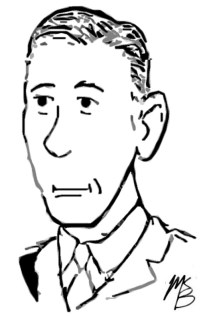
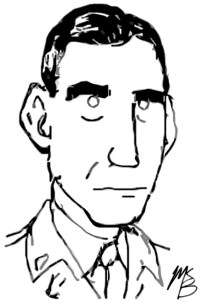
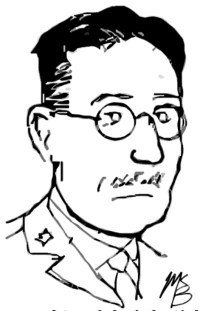
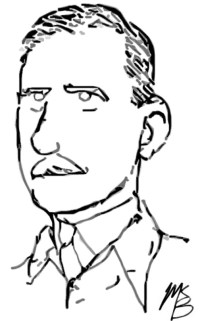
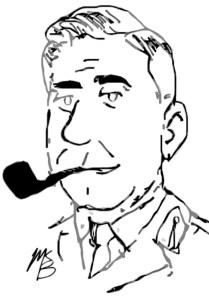
Maj. R.M. Horsey

Major Rowland Horsey
Carleton and York Regiment
Horsey

Major Horsey during this period constantly exposed himself to this fire, moving continuously from position to position, advising, encouraging and cheering on the defence. His coolness and cheerfulness sustained and inspired all ranks in the face of the most determined onslaughts.

(D.S.O. citation, 17 Apr 1945)

Born on 12 March 1913 in Victoria, British Columbia, Rowland McDonald Horsey enlisted with the Canadian Scottish Regiment in September 1939 and went overseas as a lieutenant two years later. Promoted to captain he was attached to the Carleton and York Regiment as a reinforcement officer at Ortona. He rose to major and company commander at the Hitler Line by May 1944.
Continue reading

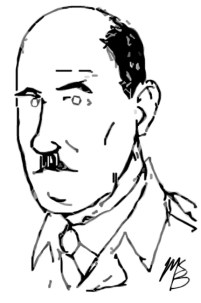
Lt-Col. J.P. Ensor

Lieutenant-Colonel Jack Ensor
Carleton and York Regiment
Ensor

 Officers and NCO’s were prime targets and didn’t last long. Jerry snipers watched for them. Even our colonel, Jack Ensor had no rank insignia. They also hid their binoculars and pistols inside their tunics.

We called everyone by their first name. When we wanted our colonel, we hollered Jack, his name was Jack Ensor. A lot of boys from St. Stephen knew him anyway from back home.

(Quoted in Robert Hawkins, We Will Remember Them, 63)

Born in Charlotte, New Brunswick on 5 February 1919, John Parks Ensor worked for Ganong chocolate company and as a teenager joined the Carleton and York Regiment under the command of Hardy Ganong. He earned a commission overseas and within a four years became one of the youngest lieutenant-colonels in the field and one of the very few battalion commanders to have risen from the ranks.

Continue reading

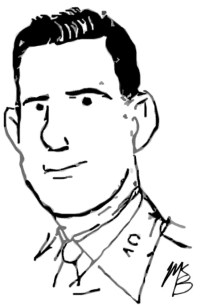
Lt-Col. E.D. Danby

Lieutenant-Colonel Dick Danby
Carleton and York Regiment

Throughout the entire operation although stalked by snipers and under continuous mortar fire Major (A/Lieutenant Colonel) Danby led his unit with the utmost gallantry and dash. His personal example steadied and encouraged his men and contributed greatly to the success of their attack.

(D.S.O. citation, 16 Nov 1944)

Born in Vancouver on 20 December 1915, Ernest Deighton “Dick” Danby was a young lieutenant with the Seaforth Highlanders when he was selected to be aide-de-camp by General R.G. Pearkes of the 1st Canadian Division in 1940. He attended the War Staff College at Camberley, England and served as a general staff officer with the division during the Sicily campaign. In August 1943, when Lieutenant-Colonel J.E.C. Pangman took charge of the Carleton and York Regiment, Danby became the new second-in-command.

Continue reading

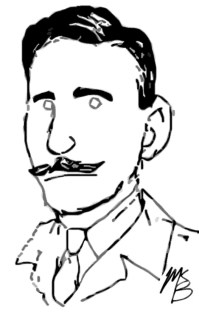
Lt-Col. F.L. Nicholls

Lieutenant-Colonel Fred Nicholls
Royal Regiment of Canada
Carleton and York Regiment

Lt Col Nicholls is a figure of mystery. No record of what unit he came from could be found, he effectively commanded the CYR for only three months, was then away sick for a period … He is described by survivors as a nice fellow, but beyond that no one interviewed could recall anything about him.

(Tooley, Invicta dissertation, 324)

Born on 8 June 1906 in Whitstable, England, Frederick Leslie Nicholls was a Bell Telephone Company engineer and member of the Royal Regiment of Canada since 1926. He had received a commission in 1931. He was stationed with the regiment in Iceland, attended the War Staff College at Camberley, and became the regiment’s second-in-command after the Dieppe Raid. He then served as brigade major of the 6th Infantry Brigade from November 1942 until his appointment to command the Royal Regiment on 22 January 1943, succeeding Lieutenant-Colonel A.H. Fraser.

Continue reading

Lt-Col. J.E.C. Pangman

Lieutenant-Colonel Jack Pangman
Carleton and York Regiment
Essex Scottish Regiment
Pangman

We have entered a major war. Industry is anticipating or is already sharing in the increased money put into circulation by our war effort … The war profits of the present struggle will not accrue to the common shareholders so directly or fully as was the case in the last war. This time government control of prices and excess profit taxes should be an effective rein on large profits. Industry will have to pay its share of the war costs.

(Pangman, Financial Post, 20 Jan 1940, 8)

Born in Toronto on 12 June 1908, John Edward Case Pangman was a stockbroker and fifteen-year prewar member of the Queen’s Own Rifles. He mobilized for active service in June 1940, and went overseas with the regiment as second-in-command the following summer. After attending the War Staff College at Camberley, England, he was posted to Sicily to replace Lieutenant-Colonel F. Dodd Tweedie of the Carleton and York Regiment in August 1943.

Continue reading

Lt-Col. F.D. Tweedie

Lieutenant-Colonel F. Dodd Tweedie
Carleton and York Regiment
Tweedie

This is a hazard faced by all historians, since none of their major sources, be they documents or oral testimony, are infallible, and judgement have to be made on the balance of probability. Thus most narrative history may be, at best, no more than an approximation of what actually happened.

(Tweedie, foreword to Tooley, Invicta: The Carleton add York Regiment in the Second World War, vii)

Born in Centreville, New Brunswick on 14 September 1901, Frederick Dodd Tweedie was an Edmundston lawyer and active member of the Rotary Club. A prewar militia major, he succeeded Lieutenant-Colonel W.C. Lawson in command of the Carleton and York Regiment in February 1942. While he was responsible for training and leading the regiment for over a year before it went into action in Sicily, by the end of August he would be unceremoniously removed.

Continue reading

Lt-Col. W.C. Lawson

Lieutenant-Colonel Walter C. Lawson
Carleton and York Regiment
Lawson

The Colonel says that we officers must work 24 hours a day and sleep when we can find time. He says we must study at night after our lecture. Naturally he doesn’t, and he even sleeps until 9 a.m. and has a sleep at noon. Everyone here is hoping he will be sent home. He hasn’t a friend, and all the men hate him which isn’t good for the Regt.

(anonymous Carleton and York officer, Nov 1941 censor reports)

Born in King’s County, New Brunswick on 1 February 1889, Walter Cyril Lawson was a teacher and cadet instructor. Commissioned with the 26th Battalion in February 1915, he earned a field promotion to captain and the Military Cross before being severely wounded by a shell explosion at Passchendaele. He became a lawyer after the war and was elected Liberal member of the provincial legislature for Sunbury County in 1935.

Continue reading

Maj-Gen. H.N. Ganong

Major-General Hardy Ganong
Carleton and York Regiment
3rd Infantry Brigade
8th & 6th Divisions
GanongHN

Gen. Ganong is the proud owner of about 30 pipes, all of which are presentation pieces marking milestones on his eventful military career. His batman, who has served with him since the outbreak of the present war, know each of them by the first name of the donor. The General refers to them in the same way … But getting back to the matter of the General’s first cigarette. He will smoke it, he has promised, in the Allied officers’ mess in Tokyo!

(Vancouver Sun, 16 Oct 1943, 6)

Born in St. Stephen, New Brunswick on 18 April 1890, Hardy Nelson Ganong was a manufacturer, curler, and First World War veteran. He went to France in November 1916 as a reinforcement junior officer with the 5th Canadian Mounted Rifles. Wounded in March 1917, he returned to the field eight months later and served until the end of the war. A member of the militia since 1909, he became commanding officer of the Carleton and York Regiment in 1938 and mobilized with the battalion the next year.

Continue reading