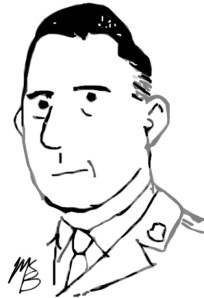
Lt-Col. G.R.H. Ross

Lieutenant-Colonel G.R.H. Ross
5th Armoured Regiment (8th Princess Louise’s Hussars)
RossGRH

The success of a regiment is seldom accredited to its second-in-command, his job supposedly being whole administrative, but to Lt-Col Ross should go as much recognition as to any other who ever served with the unit … To the regiment Lt-Col. Ross has been more than just its second-in-command. He has been an integral part of the regiment that has profited so much by his judgement and decision and the regiment has been an integral part of him.

(The 8th Hussar, vol. 1, no. 2, Sept 1945, 11)

Born on 16 December 1904 in Woodstock, New Brunswick, George Robert Hay Ross was the long-serving second-in-command of the 5th Armoured Regiment. He had joined the Princess Louise’s Hussars in 1927, mobilized in July 1940 as second-in-command of “A” Squadron and became second-in-command of the regiment overseas in April 1942. Serving with the Hussars through the war, he finally took command in August 1945, succeeding Lieutenant-Colonel John W. Eaton.
Continue reading

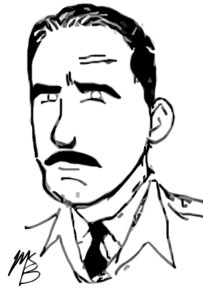
Lt-Col. J.W. Eaton

Lieutenant-Colonel Jack Eaton
5th Armoured Regiment (8th Princess Louise’s Hussars)
Eaton

During the last 8 months I have had the privilege and high honour of commanding this regiment. Never in my 5 years in the army have I enjoyed myself so much. In the battles we have been in, never once was the result in doubt.

(Eaton farewell address, war diary, Aug 1945)

Born in Toronto on 4 September 1912, John Wallace Eaton was a member of the prominent department store family. A graduate of RMC and member of the militia since 1931, he joined the Governor General’s Horse Guards in 1940. His twin sister Colonel Margaret Eaton later served as director general of the Canadian Army Women’s Corps and his younger brother Captain Erskine Robert Eaton was killed in the Dieppe Raid.

Continue reading

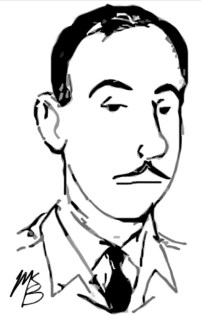
Brig. G.W. Robinson

Brigadier G.W. Robinson
5th Armoured Regiment (8th Princess Louise’s Hussars)
2nd Armoured Brigade
Robinson

We were proud of his promotion, proud for him and proud for the Regiment. But an awful sense of loss went through all of us when we realized what it meant. He’d made us as a Regiment. He’d taken up there in England when we were far from ready and he’d turned us into a unit and a damn good unit. There is no doubt that his tough training saved us lives and casualties. He fought us well. You couldn’t have asked for a better man, anyway you want to look at it. We were awful, awful sorry to see him go.

(Quoted in Douglas How, The 8th Hussars, 288)

Born on 7 December 1907 in London, Ontario, George William Robinson was an insurance executive and squadron commander of the 1st Hussars when it mobilized for active service in summer 1940. Redesignated the 6th Canadian Armoured Regiment, it went overseas in October 1941 with Robinson rising to second-in-command. In May 1942, he replaced Lieutenant-Colonel H.S. Gamblin of the 5th Armoured (8th Princess Louise’s New Brunswick Hussars) Regiment.

Continue reading

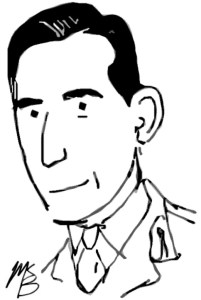
Lt-Col. H.S. Gamblin

Lieutenant-Colonel H.S. Gamblin
5th Armoured Regiment (8th Princess Louise’s Hussars)
Gamblin

I was 17 years old at the time of my enlistment and therefore had to have the consent of my parents, which they reluctantly gave … I had discovered that anyone under the age of 18 would not be accepted for overseas duty. Therefore when the time came for my enlistment in the 4th Overseas Siege Battery, I gave my age as 18 and had no trouble about it.

(Gamblin interview, “Memories of WWI,” c. 1980)

Born on 21 December 1897 in Cody’s, New Brunswick, Harold Seymour Gamblin was a farmer, First World War veteran, and commanding officer of the 8th Princess Louise’s (New Brunswick) Hussars since 1938. He had served as a gunner and sergeant with an artillery battery in France until August 1918 when he was wounded by a shell explosion. After the war, he worked for the Soldier’s Settlement board and joined the militia.

Continue reading