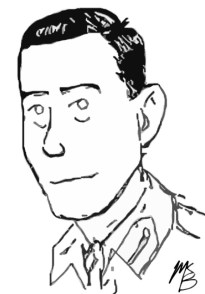
Lt-Gen. E.L.M. Burns

Lieutenant-General Tommy Burns
4th Armoured Brigade
2nd & 5th Canadian Divisions
II
Canadian Corps
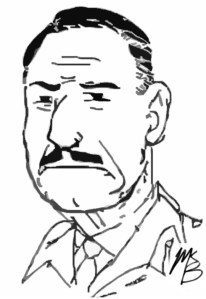
Having thus confronted death, and learned that its presence does not paralyze, and having known that while fear may clutch, it does not necessarily strangle, I feel that I am a happier man. I reason (perhaps fatuously), What am I likely to experience that will be harder to bear than that which I have borne?

(Arlington B. Conway, “In Praise of War,” 1927, 391)

Born in Montreal on 17 June 1897, Eedson Louis Millard Burns graduated from the Royal Military College in 1914 and took a commission in the Canadian Engineers. He served as a staff officer in the 3rd Division in France where he was twice wounded and earned the Military Cross. In the 1920s, he worked as an instructor at RMC while continuing his own professional staff officer education. During the interwar, he wrote several articles on military science and defence issues as well as contributions to American Mercury under a pen name, “Arlington B. Conway.”
Continue reading

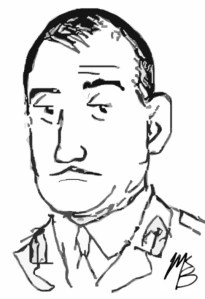
Lt-Gen. E.W. Sansom

Lieutenant-General E.W. Sansom
3rd & 5th Canadian Divisions
II Canadian Corps

We’ve all seen those supposedly terrifying pictures of grim German soldiers. We can beat those unsmiling automatons. We are going to lick them with cheerful young Canadians, quick thinking lads who know how to take it. The accent is on youth.

(Quoted in Star Weekly, 18 Oct 1941, 28)

Born on 18 December 1890 in New Brunswick, Ernest William Sansom was a First World War veteran and professional army officer. Serving in the Canadian Machine Gun Corps, and earning the D.S.O., he commanded the 2nd Battalion for the final month of the war and then the 1st Battalion until demobilization in 1919. He joined the Permanent Force in 1920 and by the start of the Second World War was director of military training.

Continue reading

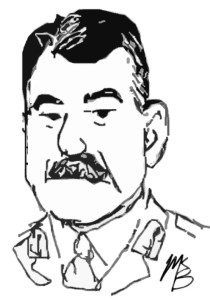
Maj-Gen. J.H. Roberts

Major-General Ham Roberts
1st Infantry Brigade
2nd Canadian Division

I consider Dieppe was well worthwhile, as we learned a lot about what not to do. Out later successful landings in North Africa, Italy, etc. could scarcely have been carried out without it. Had we been allowed to have two old battleships or cruisers, Dieppe might have been a very different story.

(Quoted in Brantford Expositor, 17 Dec 1962, 1)

Born in Pipestone, Manitoba on 21 December 1891, John Hamilton Roberts was an RMC graduate, First World War veteran, and long-serving artillery officer. He was commissioned with the Royal Canadian Horse Artillery in August 1915 and went to France two months later. He earned the Military Cross and was wounded in March 1918. After the outbreak of the Second World War, he was appointed commanding officer of 1st Field Regiment, RCA.

Continue reading

Maj-Gen. B.M. Hoffmeister

Major-General Bert Hoffmeister
Seaforth Highlanders of Canada
2nd Infantry Brigade

5th Armoured Division
Hoffmeister

I’ll never forget one of my most embarrassing moments, having given my usual spiel, and having told them how important it was to keep right up close to the shell bursts, that the first shell bursts were all forward and there was absolutely no danger. In keeping up, you got to the German positions before they got their heads up, it reduced casualties and so on … when one round landed behind us. We were all flat on the ground, of course … but every soldier in that company looked around at me as if to say, “OK wise guy, what have you got to say about this?”

(Hoffmeister quoted in Delaney, The Soldiers’ General, 124)

Widely regarded as Canada’s most successful and respected general in the Second World War, Bertram Meryl Hoffmeister commanded a battalion, a brigade, and a division from the landings at Sicily, through the Italian campaign until the final battles in Northwest Europe. Born in Vancouver on 15 May 1907, he was a lumber sales manager and member of the Seaforth Highlanders of Canada since 1927. He mobilized as a captain in September 1939 and three years later assumed command of the regiment he would lead into battle.

Continue reading