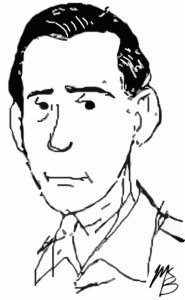
Lt-Col. H.A.C. Blair-Imrie

Lieutenant-Colonel Hew Blair-Imrie
5th/7th Battalion, Gordon Highlanders
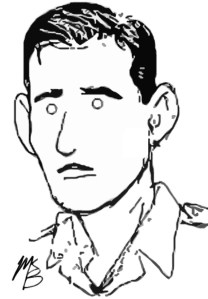
… while a bevy of padres of various denominations descended on me and started being sympathetic. Actually what I wanted at that moment was not sympathy (although I quite like the wounded hero role!) but a stimulant … well I got my stimulant in the form of hot sweet tea!’

(Blair-Imrie to wife quoted in Jon Latimer, Alamein, 198)

Born on 24 July 1915 in Brecknock, Breconshire, Wales, Hew Angus Christopher Blair-Imrie was an officer in the 5th Black Watch, which his father had commanded during the First World War. The younger Blair-Imrie served as a company commander during the Second Battle of El Alamein where he was wounded and earned the Military Cross.
Continue reading

Lt-Col. M.A. Lindsay

Lieutenant-Colonel Martin Lindsay
9th Parachute Battalion
1st Battalion, Gordon Highlanders

I rise with trepidation and ask for the traditional indulgence of the House. In the course of the last 18 months I have had the honour of commanding an infantry battalion in sixteen operations, and anyone who has had that experience will be familiar with the agonies of apprehension before and after zero hour, but, Mr. Speaker, I am convinced that, for sheer misery, there is nothing to touch the suspense of waiting to catch your eye for the first time.

(Martin Lindsay, Hansard, 7 Nov 1945)

Born on 22 August 1905 in London, Martin Alexander Lindsay was a Scottish noble and explorer. After adventures to West Africa, the Congo, and the far North, he led the British Trans-Greenland Expedition in 1934. After attending Royal Military College, Sandhurst in 1925, he had been commissioned in Royal Scots Fusiliers but retired from the army in 1936 when named Conservative Party candidate for the riding of Brigg. The outbreak of the Second World War paused his political career, and he rejoined the army. Given his arctic experience, he served as a staff officer during the Norwegian campaign in April 1940.

Continue reading

Lt-Col. J.A. Grant-Peterkin

Lieutenant-Colonel J.A. Grant-Peterkin
15th Scottish Reconnaissance Regiment
1st Battalion, Gordon Highlanders

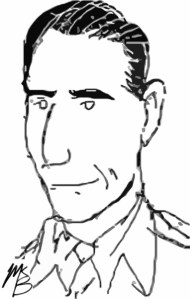
Grant-Peterkin is a tremendous success as C.O. He has personality, brains and charm, but above all, drive and enthusiasm. He is a tall, well-built man with sharp features and very blue eyes, clean-shaven, and fair hair brushed nearly straight back.

(Martin Lindsay, So Few Got Through, 148)

Born on 15 September 1909 in Kinloss, Moray, Scotland, James Alexander Grant-Peterkin was a cricket player and commissioned officer in the Queen’s Own Cameron Highlanders since 1929. He served as brigade major with 4th Infantry Brigade with the British Expeditionary Force in 1940 and was then posted as an instructor to the staff school at Camberley. He was appointed to command 15th Scottish Reconnaissance Regiment in February 1943.

Continue reading

Lt-Col. H.C.H.T. Cumming-Bruce

Lieutenant-Colonel Harry Cumming-Bruce 
1st Battalion, Gordon Highlanders

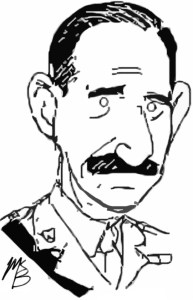
He seems a charming chap; perhaps a slightly unorthodox military figure with his rather old-fashioned curly moustache, white framed horn-rimmed spectacles and slight stoop … I hope to God he knows his job.

(Martin Lindsay, So Few Got Through, 12)

Born on 29 May 1910 in Barnet, Hertfordshire, England, Henry Charles Hovell-Thurlow-Cumming-Bruce was the heir to Baron Thurlow. He attended Eton College and Royal Military College, Sandhurst before taking a commission with the Seaforth Highlanders in 1930. In the mid 30s, he served as aide-de-camp to the British High Commissioner for Palestine and Transjordan and held posts in the Middle East during the early phase of the Second World War.

Continue reading

Lt-Col. W.A. Stevenson

Lieutenant-Colonel W.A. Stevenson
1st Battalion, Gordon Highlanders

During the whole of these operations the personal example of cheerfulness of the C.O. and his obvious control of every situation was mainly responsible in keeping the battalion steady and intact. A remark made by one of the men illustrates this. When the C.O. seized a bren gun to cover the withdrawal of “S” Coy HQ a soldier was heard to say “There goes the mobile reserve: now we are all right.”

(D.S.O. citation, 31 Aug 1944)

Born in Guildford, Surrey on 7 September 1912, William Alexander Stevenson was the son of Major-General Alexander Gavin Stevenson, (1871—1939), a veteran of the Egyptian Army, the Boer War and First World War. The oldest son, W.A. Stevenson, belonged to the Queen’s Own Cameron Highlanders and was stationed in India at the outbreak of the Second World War. His younger brother, Wing Commander Michael Gavin Stevenson died on active service in Egypt on 29 November 1942.

Continue reading

Maj. H.W. Cairns

Major Hugh Cairns
5th Battalion, Queen’s Own Cameron Highlanders

Members of the Battalion at this time will remember Colonel Cairns sitting out under an apple tree in an orchard in Battalion H.Q.’s area behind the “‘Triangle,’ quite impervious to the sniping self-propelled gun, which dropped many shells into this area at unpredictable moments, with generally unpleasant results: his gallantry and example at Ste Honorine will not easily be forgotten.

(Historical Records of the Queen’s Own Cameron Highlanders 1932-1948, 103)

Born on 27 Jan 1911 Dalkeith, Midlothian, Scotland, Hugh William Cairns was a grandson of Lord Chancellor Hugh Cairns, 1st Earl Cairns (1819—1885). Cairns was commissioned in the Cameron the Highlanders and served in India before the outbreak of the Second World War. He joined the 5th Battalion in May 1944 and led C Company on landing in France a month later.

Continue reading

Lt-Col. B.C. Bradford

Lieutenant-Colonel Bill Bradford
5th Battalion, The Black Watch

Owing to severe casualties in past fighting the bn under Lt Col Bradford’s comd has los most of its key personnel and a great deal of extra work descended on him. The fact that his bn carried out its tasks so brilliantly is entirely due to the able leadership and energy of Lt Col Bradford who was at all times an inspiration and example to his officers and men.

(D.S.O. citation, 2 Sep 1944)

Born on 15 October 1912 in London, Berenger Colborne Bradford was educated at Eton College and the Royal Military College at Sandhurst. He was commissioned with the Black Watch (Royal Highland Regiment) in 1932, later serving in India and the Sudan. As a captain and adjutant with the 1st Battalion, he was taken prisoner along with the rest of the 51st Division when surrounded by German forces at St Valéry on 12 June 1940. He slipped away from the prisoner-of-war march a week later.

Continue reading

Lt-Col. C.N. Thomson

Lieutenant-Colonel Chick Thomson
5th Battalion, The Black Watch

Thomson was in a dreadful state. He came back the following day and I had to get the doctor and the padre to keep him for a few hours. And there he was a D.S.O., he got two or three D.S.O.s altogether; it was too much. It wasn’t their fault. They had been fighting in the desert. They’d been sitting around north London or wherever it was they sat without being properly trained, and they were thrown into this bocage country with Germans popping out. 

(Lt-Col. Terence Otway, interview, 1989)

Born on 17 January 1907 in Monifieth, Angus, Scotland, Charles Newbigging Thomson was a Territorial Army officer with the 4/5th Battalion, Black Watch. He became captain in 1932 and served during the Battle of France in 1940. When the 5th Black Watch embarked for Egypt in June 1942, Thomson served as second-in-command under Lieutenant-Colonel T.G. Rennie. Wounded during the Battle of El Alamein, Thomson returned to the unit in December 1942, succeeding Rennie who had been promoted to 154th Infantry Brigade.

Continue reading

Lt-Col. D.B. Lang

Lieutenant-Colonel Derek Lang
5th Battalion, Queen’s Own Cameron Highlanders

I can well understand why long-term prisoners feel reluctant to face the world again when finally they come to the end of their sentences and are released. Although I had fretted during the long weeks when we had been confined, now that the moment had come for action I shrank from it with something very like fear. Suddenly the big, square house seemed terribly safe, comfortable and infinitely desirable. Outside was the unknown, perilous and menacing.

(Derek Lang, Return to St Valéry, 110)

Born on 7 October 1913 in Guildford, Surrey, England, Derek Boileau Lang took a commission with Queen’s Own Cameron Highlanders in 1933 after attending Wellington College, Berkshire and the Royal Military College, Sandhurst. He served with the 2nd Battalion in the Middle East in the 1930s and was adjutant for the 4th Battalion at the outbreak of the Second World War. He was wounded and taken prisoner during the Battle of France in June 1940 but managed a remarkable escape across multiple countries and eventually rejoined the army.

Continue reading

Lt-Col. J.M. Sym

Lieutenant-Colonel John Sym
5th Battalion, Seaforth Highlanders

I rather prided myself, at the time, on my ability at aircraft recognition and reassured the Brigadier, who was regarding them rather apprehensively, that they were Kittihawks. A moment later we were throwing ourselves on our faces as their bombs crashed uncomfortably near us. I still think they were Kittihawks but, although they turned back and headed for home over our lines, my reputation was lost.

(J.M. Sym, Personal Account of El Alamein) https://51hd.co.uk/accounts/colonel_john_sym_dso

Born in Edinburgh on 10 October 1907, John Munro Sym attended Loretto School and graduated from Royal Military College, Sandhurst. He was commissioned with the Seaforth Highlanders in 1927. During the 1930s, he served with the 2nd Battalion on the North West Frontier in India and in Palestine and then with the 1st Battalion in Egypt. He was posted to the British Military Mission in Iraq in 1939 prior to the outbreak of the Second World War.

Continue reading