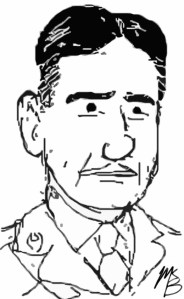
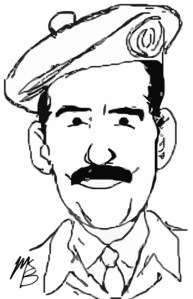
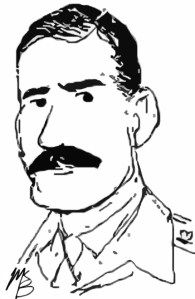
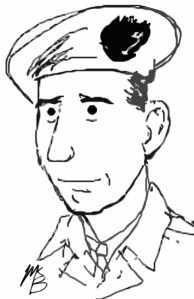
Lt-Col. B.A. Innes

Lieutenant-Colonel B.A. Innes
7th Battalion, Black Watch

The proposed Assembly will have 150 more Politicians and well over 1000 extra bureaucrats who will all have to be paid for out of the annal block grant. This can only mean less for essential services as above … The S.N.P. (or tartan socialists) like the other variety want to get at other men’s wealth.

(The Strathearn Herald, 24 Feb 1979, 6)

Born on 22 July 1904 in Dagshai, India, Berowald Alfred Innes was a commissioned officer with the Black Watch since completing Royal Military College, Sandhurst in 1924. He was promoted to captain in 1937 and made acting major one month after the outbreak of the Second World War. He was wounded in the Battle of France. His brother Flying Officer Herome Alexander Innes was killed in a training accident in 1940.

Continue reading

Lt-Col. G.D. Renny

Lieutenant-Colonel G. Douglas Renny
1st Battalion King’s Own Scottish Borderers
5th/7th Battalion, Gordon Highlanders

During this period, Capt. Renny worked day and night, with energy, and efficiency, completing with a difficult task having to deal with inexperienced and poorly trained Units. Toward the end of the period when fatigue was overcoming him, he struggled on, remaining cheerful and confident and showing a fine devotion to duty in spite of the difficulty of getting complicated orders for a withdrawal issued in very short time

(M.C. citation, 1940)

Born on 30 December 1908 in Punjab, India, George Douglas Renny was the son of a Royal Artillery colonel and the grandson of George Renny who earned the Victoria Cross during the Indian Mutiny. Following his family’s military tradition, the youngest Renny attended Sandhurst and took a commission with the King’s Own Scottish Borderers. In June 1940, he was assigned to be brigade major of the improvised “A” Brigade under Brigadier M.A. Green. After the retreat and evacuation, Green recommended him for the Military Cross, writing: “Capt. Renny himself had little experience and had not been under fire before. In view of all this I consider his work to have been of a high standard and his devotion to duty worthy of recognition.”

Continue reading

Lt-Col. J.E.G. Hay

Lieutenant-Colonel Scrappy Hay
5th/7th Battalion, Gordon Highlanders

Lt Col Hay commanding the bn, during the whole of this time was always where the fighting was at its thickest. With complete disregard to his own safety he moved from one defensive position to another under heavy fire extolling the men and encouraging them. During the whole of the time of the action which last 48 hours he had hardly any sleep at all.

(D.S.O. citation, 31 Aug 1944)

Born on 31 May 1912 Surrey, England, James Eric Goldwin Hay took a commission with the Gordon Highlanders after attending the Royal Military College at Sandhurst. He commanded a battle training school before the 51st Division embarked for North Africa. During the Second Battle of El Alamein on 25 October 1942, Hay took command of the 1st Gordon Highlanders when Lieutenant-Colonel Horatius Murray was put out of action and another major also named James Hay was badly wounded in a mine blast.

Continue reading

Lt-Col. J.C. Meiklejohn

Lieutenant-Colonel John Meiklejohn
7th Battalion, Argyll and Sutherland Highlanders

We spent the night in considerable trepidation. Three times the carriers tried to come up, but couldn’t manage it … Lieutenant “Sailor” Sills, of Stirling, my last remaining officer, said he would go direct them. They must have been German carriers. Anyway, the last we heard was a shout “Up the Argylls,” the roar of a grenade. He hasn’t been heard of since.

(Meiklejohn quoted in Richmond Times-Dispatch, 10 Jan 1943, 40)

Born on 28 March 1904 in Northwood, Middlesex, England, John Cusance Meiklejohn worked in the London officer for the Scottish Amicable Life Assurance Society. He belonged to the Territorial Army, serving as a captain with the Argyll and Sutherland Highlanders. He commanded a company in the 7th Battalion during the Second Battle of El Alamein. After securing his objective on 26 October 1942, he found the Germans now had his group surrounded. Meiklejohn gathered two hundred soldiers from other companies and held out for forty-eight hours. After rescue by British tanks, he remarked to the press, “I wouldn’t like to go through it again.”

Continue reading

Lt-Col. C.F. Cathcart

Lieutenant-Colonel C.F. Cathcart
7th Battalion, Black Watch

Lying flat on the hard gravelly desert, with shells falling all around and whizzing over one, was one of the nastiest sensations I have ever had. Never have I made myself so flat, never have I prayed so hard that one would not land on me.

(Quoted in Tess Monteith, “From the Moon to Kirkcaldy,” Red Hackle, 22)

Born on 26 March 1912 in Annan, Dumfries-shire, Scotland, Charles Frederick Cathcart was educated at Sedbergh School in Cumbria, North West England and commissioned in the Black Watch. His heroism at Second Battle of El Alamein in October earned a Distinguished Service Order although he was only an acting captain with the 7th Battalion. Leading two companies, Cathcart stormed Miteiriya Ridge and held the position despite heavy casualties and suffering terrible wounds himself. After being evacuated to hospital, he later reflected of the battle: “It’s a bit hard, having had three of the worst days of the battle, to miss the smashing up of the German army.”

Continue reading

Lt-Col. J.A. Hopwood

Lieutenant-Colonel John Hopwood
1st Battalion, Black Watch

I was standing there on top of this bloody tank and suddenly I felt a red hot pain in my chest and I was on the ground. Horrible noise. And I thought hell … I thought that’s the death rattle isn’t it [laughs] and I thought I was dead. And I felt very sorry for everybody at home, they’d miss me, that sort of thing. And then I realized I wasn’t dead, fortunately.

(J.A. Hopwood, interview, Feb 1987)

Born on 26 January 1910, John Adam Hopwood joined the Black Watch in 1930 after attending Eton College and Sandhurst. “I think I might have gone to the Royal Navy,” he later reflected, “but being me of course I put it off too late – procrastinated— so army was the next best thing.” He served as second-in-command of the 7th Battalion, Black Watch and earned the D.S.O. for heroism at Wadi Akarit in April 1943. When one company wavered after its officers were knocked out, Hopwood took charge of the advance. The citation credited his “actions which were carried out with the highest degree of resourcefulness, courage and determination were undoubtably responsible for the forward Coy reaching its objective.”

Continue reading

Lt-Col. G.W. Dunn

Lieutenant-Colonel George Dunn
2nd Battalion, Seaforth Highlanders

Major Dunn as Bn 2nd in command was with me at the former Bn HQ. As bn HQ was about to advance it was shelled and many personnel were casualties … I was wounded also. Maj. Dunn was a tower of strength during that crisis and throughout the rest of the night. He re-organised a scratch Bn HQ, re-organised communications, re-organised people to deal with casualties, and by his calmness and coolness in very difficult circumstances was of outstanding help in getting things going again.

(D.S.O. Bar citation, 21 Dec 1944)

Born in Lanarkshire on 27 March 1914, George Willoughby Dunn was a graduate of Glasgow University, a solicitor and Territorial Army officer, commissioned into Royal Scots Fusiliers in 1935. He served with the 5th Black Watch as a company commander in North Africa and was wounded at the Second Battle of El Alamein in October 1942. He then earned the Military Cross for leading an assault on a hill strongpoint at Wadi Akarit in April 1943: “He exposed himself continuously without fear for his own life and his complete disregard for his own safety made possible the taking and holding of this feature. Throughout Major Dunn has been an inspiration to all who serve under him.”

Continue reading

Lt-Col. H.A.C. Blair-Imrie

Lieutenant-Colonel Hew Blair-Imrie
5th/7th Battalion, Gordon Highlanders

… while a bevy of padres of various denominations descended on me and started being sympathetic. Actually what I wanted at that moment was not sympathy (although I quite like the wounded hero role!) but a stimulant … well I got my stimulant in the form of hot sweet tea!’

(Blair-Imrie to wife quoted in Jon Latimer, Alamein, 198)

Born on 24 July 1915 in Brecknock, Breconshire, Wales, Hew Angus Christopher Blair-Imrie was an officer in the 5th Black Watch, which his father had commanded during the First World War. The younger Blair-Imrie served as a company commander during the Second Battle of El Alamein where he was wounded and earned the Military Cross.

Continue reading

Lt-Col. M.A. Lindsay

Lieutenant-Colonel Martin Lindsay
9th Parachute Battalion
1st Battalion, Gordon Highlanders

I rise with trepidation and ask for the traditional indulgence of the House. In the course of the last 18 months I have had the honour of commanding an infantry battalion in sixteen operations, and anyone who has had that experience will be familiar with the agonies of apprehension before and after zero hour, but, Mr. Speaker, I am convinced that, for sheer misery, there is nothing to touch the suspense of waiting to catch your eye for the first time.

(Martin Lindsay, Hansard, 7 Nov 1945)

Born on 22 August 1905 in London, Martin Alexander Lindsay was a Scottish noble and explorer. After adventures to West Africa, the Congo, and the far North, he led the British Trans-Greenland Expedition in 1934. After attending Royal Military College, Sandhurst in 1925, he had been commissioned in Royal Scots Fusiliers but retired from the army in 1936 when named Conservative Party candidate for the riding of Brigg. The outbreak of the Second World War paused his political career, and he rejoined the army. Given his arctic experience, he served as a staff officer during the Norwegian campaign in April 1940.

Continue reading

Lt-Col. J.A. Grant-Peterkin

Lieutenant-Colonel J.A. Grant-Peterkin
15th Scottish Reconnaissance Regiment
1st Battalion, Gordon Highlanders

Grant-Peterkin is a tremendous success as C.O. He has personality, brains and charm, but above all, drive and enthusiasm. He is a tall, well-built man with sharp features and very blue eyes, clean-shaven, and fair hair brushed nearly straight back.

(Martin Lindsay, So Few Got Through, 148)

Born on 15 September 1909 in Kinloss, Moray, Scotland, James Alexander Grant-Peterkin was a cricket player and commissioned officer in the Queen’s Own Cameron Highlanders since 1929. He served as brigade major with 4th Infantry Brigade with the British Expeditionary Force in 1940 and was then posted as an instructor to the staff school at Camberley. He was appointed to command 15th Scottish Reconnaissance Regiment in February 1943.

Continue reading