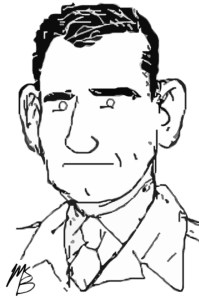
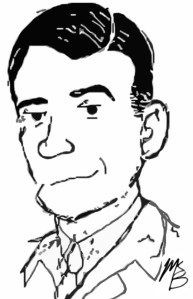
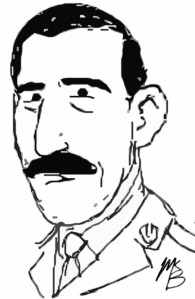
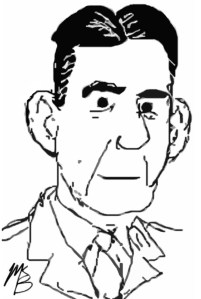
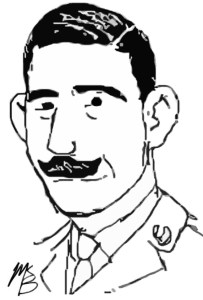
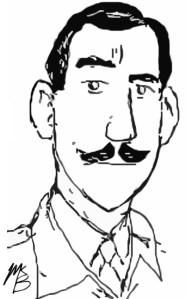
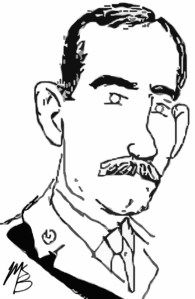
Lt-Col. C.D. Hamilton

Lieutenant-Colonel Denis Hamilton
11th Battalion, Durham Light Infantry
7th Battalion, Duke of Wellington’s Regiment

I can’t hide from myself the fact that on many occasions I was either uncertain of the outcome or plain scared. But as commanding officer you had to show yourself, and show yourself totally in command of yourself and the situation, for the troops instinctively get to feel whether the commanding officer is going to keep control or not. Quite a number of COs were removed, either because they lost their nerve through not being able to get enough sleep or clearly lost the confidence of the troops.

(Hamilton, Editor-in-Chief: The Fleet Street Memoirs, 39)

Born in South Shields, England on 6 December 1918, Charles Denis Hamilton was a former King’s Scout and newspaperman. Anticipating a future war and possible conscription, he joined the Territorial Army and took a commission with the Durham Light Infantry in 1937. He served during the evacuation from Dunkirk in June 1940, and then began training for defence of the anticipated German invasion. “We soon had a powerful battalion,” he wrote of the 11th DLI, “… I grew a moustache in the faint hope that I too might look older. I was never to shave it off.”

Continue reading

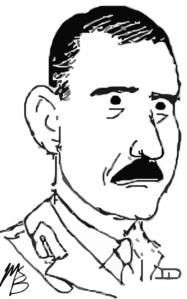
Lt-Col. A.J.D. Turner

Lieutenant-Colonel A.J.D. Turner
6th Battalion, Duke of Wellington’s Regiment

1st Battalion, Hampshire Regiment

Even excluding the question of nerves and morale 6DWR will not be fit to go back into the line until it is remobilised, reorganized, and to an extent retrained. It is no longer a battalion but a collection of individuals. There is naturally no espirit-de-corps for those who are frightened (as we all are to one degree or another) to fall back on. I have twice had to stand at the end of a track and draw my revolver on retreating men.

(Turner, Report on State of 6th Bn DWR, 30 June 1944)

Born on 19 September 1907 in Abbottabad, India, Antony James Dillon Turner was a one-time first-class cricket player and graduate of Royal Military College, Sandhurst. Commissioned with the Suffolk Regiment in 1928, he also served with the West African Frontier Force and in India. He attended staff college at Camberley in 1938 before being posted to the Aldershot Garrison as staff captain. With the outbreak of war in September 1939, Turner was appointed deputy assistant adjutant general with I Corps and participated in the evacuation at Dunkirk for which he earned the Military Cross.

Continue reading

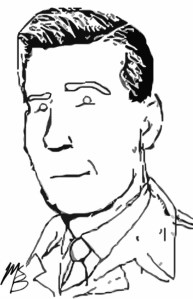
Lt-Col. T. Hart Dyke

Lieutenant-Colonel T. Hart Dyke
Hallamshire Battalion, York and Lancaster Regiment

It was now getting most difficult to find men to accept the added responsibility and danger of leadership. There was little to offer in return for what one asked of them. Rank and money meant little these days. A dozen times they had escaped improbably. Long ago the few surviving men in the rifle companies had been bound to realize the odds against them remaining unharmed. But the honour and good name of the battalion meant much to them.

(Hart Dyke, Normandy to Arnhem: A Story of the Infantry)

Born on 19 February 1905 in Chaman, British India, Trevor Hart Dyke attended Marlborough College then the Royal Military College at Sandhurst. He took a commission with Queen’s Royal Regiment in 1924 and served with the 2nd Battalion in India and the Sudan. He volunteered with the King’s African Rifles in the 1930s in Keyna and Uganda until he rejoined the Queen’s Regiment in 1936. Having completed staff college at Camberley, he held posts with the War Officer and staff assignments at brigade and division levels.

Continue reading

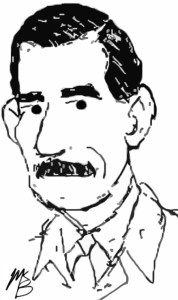
Lt-Col. A.W.H.J. Montgomery-Cuninghame

Lieutenant-Colonel A.W.H.J. Montgomery-Cuninghame
11th Battalion, Royal Scots Fusiliers

As the name ‘Big Monty’ might imply, Lt.-Col. Montgomery-Cuninghame was an awesome figure. Well over six feet tall and built like a giant, he was a forceful and thrusting leader of the Battalion … Of course, some of the methods he had formulated to attain the present discipline and dedication to the job in hand, had not always met with the instant approval of the rank and file.

(Kenneth West, An’ It’s Called a Tam-o’-shanter)

Born on 28 October 1905 in Chelsea, Middlesex, England, Alexander William Henry James Montgomery-Cuninghame was heir to Baronet of Corsehill. His father Sir Thomas (1877—1945), earned the Distinguished Service Order in the Boer War and his grandfather Sir William James (1834—1897), received the Victoria Cross in the Crimean War. Following the family’s military tradition, the younger Montgomery-Cuninghame took a commission in the Royal Scots Fusiliers.

Continue reading

Lt-Col. A.J.A. Arengo-Jones

Lieutenant-Colonel Tony Arengo-Jones
1/4th Battalion, King’s Own Yorkshire Light Infantry

Commanders at every level up to battalion will be required to pay attention to such tactical principles as the need to bring maximum, accurate fire on enemy positions from as many different directions as practicable; bold flanking and infiltration movements undertaken whenever the circumstances are propitious; reducing the risk of casualties by having as few men as possible moving in the attack at any one time, and the employment of deception to conceal the direction from which the final assault is launched

(Arengo-Jones, “An Exchange of Ideas,” Infantry, Sep-Oct 1966, 6)

Born on 17 August 1915 in Somerset, Gloucestershire, Anthony James Arengo Arengo-Jones was a graduate of Cheltenham College and rugby player. After attending Royal Military College, Sandhurst he took a commission with the Gloucestershire Regiment in 1936. He served at Dunkirk in command of an anti-tank company. He returned to France after the Normandy invasion as brigade major with the 160th Infantry Brigade.

Continue reading

Lt-Col. T.W.A.H. Harrison-Topham

Lieutenant-Colonel T.W.A.H. Harrison-Topham
1/4th Battalion, King’s Own Yorkshire Light Infantry

On New Year’s Day Lieut.-Colonel Harrison Topham, who had led the Battalion so gallantly from Normandy to Nijmegen, was unfortunately compelled to relinquish command owing to ill-health

(Harold Carmichael Wylly, History of the King’s Own Yorkshire Light Infantry, 156)

Born on 23 August 1903 in Greenwich, London, Thomas William Amyas Harrison Harrison-Topham was the son of Colonel Thomas Harrison-Topham who won the D.S.O. as a captain in Burma during the 1891-92 campaign. The younger Harrison-Topham took a commission with the King’s Own Yorkshire Light Infantry in 1924, served on the North West frontier in India, was promoted to captain in 1935. and became acting major in April 1940.

Continue reading

Lt-Col. E.D. Wardleworth

Lieutenant-Colonel E.D. Wardleworth
1/4th Battalion, King’s Own Yorkshire Light Infantry

Wuzzle Wardleworth had taken over as C.O. He was very good; why he was several times replaced after temporary command I shall never know. He moved the companies around fairly frequently in order to give everyone a turn in the comparatively quiet rear positions.

(Lewis Keeble, “A Worm’s Eye View: The 1/4 K e View: The 1/4 KOYLI in Normandy YLI in Normandy,” CMH, 6)

Edmund Douglas Wardleworth was born on 24 October 1914 in Sheringham, Norfolk, the same day his father, a Royal Army Medical Corps lieutenant, mysteriously drowned while on active service in France. The younger Wardleworth was commissioned into the King’s Own Yorkshire Light Infantry in 1935. He was aide-de-camp to the governor of Burma from 1938 to 1941. He fought as a company commander with the 2nd Battalion, KOYLI during the Japanese invasion of Burma in the 1941-42 campaign. When the commanding officer and second-in-command became casualties, Captain Wardleworth took over during fierce fighting in late February 1942.

Continue reading

Lt-Col. C.D. Barlow

Lieutenant-Colonel C.D. Barlow
1/4th Battalion, King’s Own Yorkshire Light Infantry

Colonel Barlow is personally responsible for the initiation and development of an entirely new form of warfare which may well play an important part in future campaigns … His own immediate military advancement may well have been prejudiced by the time he has devoted to this special subject, but he has never permitted personal considerations to stand in the way of bringing his organisation to fruition.

(OBE citation, 1944)

Born on 4 February 1905 in Somersham, Cambridgeshire, Cecil Disney Barlow was commissioned into Shropshire Light Infantry after graduating from Royal Military College, Sandhurst in 1925. While part of the Army of Occupation on the Rhine in Germany, he named in a divorce suit by a British colonel, who alleged that his wife had an affair with the young lieutenant. During the early 1930s, Barlow served with the King’s African Rifles in Kenya. He completed staff college at Camberley in 1939 just as the Second World War began.

Continue reading

Lt-Col. M.A.H. Butler

Lieutenant-Colonel Mervyn Butler
2nd Battalion, Essex Regiment
1st Battalion, South Lancashire Regiment

He never hesitated to go where he felt his duty called him and when he flew in some danger in a helicopter to make contact with the local authorities with whom he hoped he might organise a cease fire, but without avail … His Brigade has been completely cheerful and supremely confident and splendidly trained and his own inspiring efforts have shown him to be a leader second to none and in action upholding the very highest tradition of the British Army.”

(D.S.O. Bar, citation, 13 Jun 1957)

Born in Toronto, Ontario on 1 July 1913, Mervyn Andrew Haldane Butler was commissioned in the Prince of Wales’s Volunteers (South Lancashire Regiment) in 1933 after attending Royal Military College, Sandhurst. He served with the 1st Battalion during the Battle of France in 1940 and earned the Military Cross. Under heavy machine gun and mortar fire, he gathered as many soldiers as he could to drive the enemy out of their position. His name appeared in the newspapers again later that year when a British Army major sued his wife for divorce on the grounds of adultery with Butler, who later married the divorcee, Marjorie Millicent Dann, in 1941.

Continue reading

Lt-Col. F.P. Barclay

Lieutenant-Colonel Peter Barclay
4th Battalion, Lincolnshire Regiment
1st Battalion, Royal Norfolk Regiment

It was absolutely wonderful and a thrilling feeling to experience the spirit of the chaps who are with you—it is intangible—but its the most exhilarating, potent influence. It revives you, you can never feel tired, you never feel depressed when you have a spirit round you like the spirit we enjoyed. And the whole thing was treated as a jolly-well, worthwhile job that has to be done.

(Barclay, interview, 21 May 1984) https://www.iwm.org.uk/collections/item/object/80007993

Born in Cromer, Norfolk, England on 8 March 1909, Francis Peter Barclay was commissioned with the Norfolk Regiment in 1929 after attending Twyford School and Royal Military College, Sandhurst. Of his decision to join the army, he explained decades later, “I thought it was a wonderful life … and I never regret it from that day to this.” After service in India, he was posted with the 2nd Battalion to Gibraltar just before the outbreak of the war. He served as company commander when the battalions went to France in September 1939. He received the Military Cross for leading a three-man patrol into enemy lines on the night on 3/4 January 1940.

Continue reading