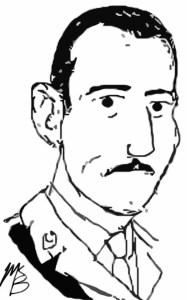
Lt-Col. J.G.M.B. Gough

Lieutenant-Colonel Kit Gough
1st Battalion, Suffolk Regiment (The Buffs)
The role of 1st Suffolk on D day was: 1st to capture a Battery of guns covering beach 2nd To clear the village of Coalville 3rd To capture strong point “Hillman.”

First two were easy, but “Hillman” proved difficult nut to crack, & was finally taken about 7 PM “D” day. The slowness has been the subject of severe criticism in the Book (forgotten name!) concerning the whole campaign in N.W. Europe. When I visited “Hillman” last year, (most of the concrete works remain) I pondered over the problem again, and realised what a tough egg it was.

(Gough questionnaire, Cornelius Ryan WWII papers, box 021, folder 04, 1958)

Born on 30 August 1907 in Pocklington, Yorkshire, James Gordon Milestone Boulter Gough was commissioned into the Lincolnshire Regiment in 1928. During the 1930s, he served overseas with the 1st Battalion in Gibraltar, Shanghai, Hong Kong, and India. He was a company commander with the 2nd Battalion during the Battle of France in 1940. Afterwards he became second-in-command, then at the end 1942 was instructor at the school of infantry. In October 1943, he was posted to the 1st Battalion, Suffolk Regiment as second-in-command.
Continue reading

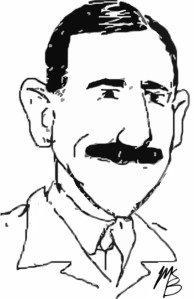
Lt-Col. R.E. Goodwin

Lieutenant-Colonel Dick Goodwin
1st Battalion, Suffolk Regiment (The Buffs)

I am just writing this letter to you before setting out on the great adventure … There is very little else to say as one can’t say much. I expect you will hear all about everything before you get this. Don’t worry too much because it won’t do anyone any good! … There will be much to tell you when I see you next.

(Goodwin to wife, 5 Jun 1944) https://ve-vjday80.gov.uk/letter/lt-col-dick-goodwin-to-anthea-goodwin/

Born on 17 August 1908 in London, Richard Elton Goodwin was commissioned with the Suffolk Regiment in 1928 after education at Cheltenham and Royal Military College, Sandhurst. While serving in India, he became aide-de-camp to the Governor of Madras in 1935. After the outbreak of war, Goodwin was second-in-command of 9th Battalion, Royal Warwickshire Regiment before returning to the Suffolks as commanding officer of the 1st Battalion in June 1943.

Continue reading

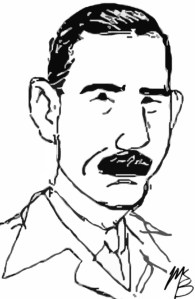
Lt-Col. M.A.H. Butler

Lieutenant-Colonel Mervyn Butler
2nd Battalion, Essex Regiment
1st Battalion, South Lancashire Regiment

He never hesitated to go where he felt his duty called him and when he flew in some danger in a helicopter to make contact with the local authorities with whom he hoped he might organise a cease fire, but without avail … His Brigade has been completely cheerful and supremely confident and splendidly trained and his own inspiring efforts have shown him to be a leader second to none and in action upholding the very highest tradition of the British Army.”

(D.S.O. Bar, citation, 13 Jun 1957)

Born in Toronto, Ontario on 1 July 1913, Mervyn Andrew Haldane Butler was commissioned in the Prince of Wales’s Volunteers (South Lancashire Regiment) in 1933 after attending Royal Military College, Sandhurst. He served with the 1st Battalion during the Battle of France in 1940 and earned the Military Cross. Under heavy machine gun and mortar fire, he gathered as many soldiers as he could to drive the enemy out of their position. His name appeared in the newspapers again later that year when a British Army major sued his wife for divorce on the grounds of adultery with Butler, who later married the divorcee, Marjorie Millicent Dann, in 1941.

Continue reading

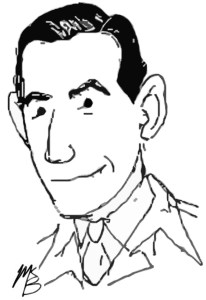
Lt-Col. F.P. Barclay

Lieutenant-Colonel Peter Barclay
4th Battalion, Lincolnshire Regiment
1st Battalion, Royal Norfolk Regiment

It was absolutely wonderful and a thrilling feeling to experience the spirit of the chaps who are with you—it is intangible—but its the most exhilarating, potent influence. It revives you, you can never feel tired, you never feel depressed when you have a spirit round you like the spirit we enjoyed. And the whole thing was treated as a jolly-well, worthwhile job that has to be done.

(Barclay, interview, 21 May 1984) https://www.iwm.org.uk/collections/item/object/80007993

Born in Cromer, Norfolk, England on 8 March 1909, Francis Peter Barclay was commissioned with the Norfolk Regiment in 1929 after attending Twyford School and Royal Military College, Sandhurst. Of his decision to join the army, he explained decades later, “I thought it was a wonderful life … and I never regret it from that day to this.” After service in India, he was posted with the 2nd Battalion to Gibraltar just before the outbreak of the war. He served as company commander when the battalions went to France in September 1939. He received the Military Cross for leading a three-man patrol into enemy lines on the night on 3/4 January 1940.

Continue reading