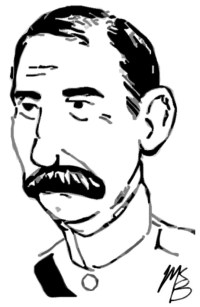
Lt-Col. H.W. Weldon

Lieutenant-Colonel Henry Weldon
2nd Bn., Leinster Regiment (Royal Canadians)
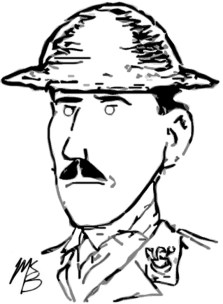
The Regiment has unfortunately lost some most valuable officers … all of whom had done splendid work, which would have brought recognition had they been fortunate enough to survive.

(Weldon to Maj. Gen. Prior in Whitton, The History of the Prince of Wales’s Leinster Regiment, vol. 2, 174)

Born in Dublin on 2 November 1878, Henry Walter Weldon was commissioned a lieutenant in 1900 and served in South Africa. He was adjutant for the 1st Leinsters and temporarily took command after Second Ypres following the death of Lieutenant-Colonel C. Conyers on 12 May 1915. He served with the battalion now under the command of Lieutenant-Colonel J.D. Mather on the Salonika front in 1916.
Continue reading

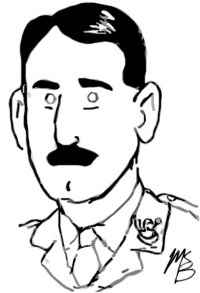
Maj. Frend

Major J.R. Frend
2nd Bn., Leinster Regiment (Royal Canadians)

Heavy hostile shelling of TEMPLEUX QUARRIES commenced about 11:30am until 12:30pm. Extremely accurate. Lt. Col. Murphy, DSO, MC [and others] were in HQ mess attending to wounded when a shell dropped right in their midst killing the CO … Shelling was kept up at intervals of 50 minutes throughout the day & night. Major J.R. Frend assumed command of Bn. at 1 pm.

(2nd Bn. Leinster Regiment War Diary, 6 Nov 1917)

Following the death of Lieutenant-Colonel A.D. Murphy, Major John Roberts Frend took command of the 2nd Leinsters. He was born on 7 February 1883 in Cloghjordan, Tipperary. He served in the Boer War and joined the Leinster Regiment before emigrating to Australia in 1909. On the outbreak of the Great War, he rejoined his old regiment and served with the 2nd Leinsters in France.

Continue reading

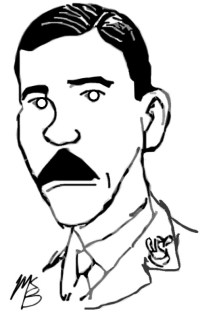
Lt-Col. Murphy

Lieutenant-Colonel A.D. Murphy
2nd Bn., Leinster Regiment (Royal Canadians)
Murphy

The commanding officer seemed to bear a charmed life, and it became a belief in the Battalion that he could not be killed. But he exposed himself fearlessly not because he was invulnerable but because he was brave. No braver man than Alfred Durham Murphy ever stepped on French soil.

(Witton, The History of the Prince of Wales’s Leinster Regiment, vol. 2, 244)

When Major Alfred Durham Murphy assumed command of the 2nd Leinsters in August 1916 at the age of twenty-six, he was one of the youngest battalion commanders on the Western Front. Born on 4 July 1890 in Southwark, Surrey, England, was the son of a retired Tipperary colonel and joined his father’s regiment in 1911. He went to France in September 1914 with the 2nd Leinsters as a junior lieutenant but by May 1916 was second-in-command.

Continue reading

Lt-Col. Orpen-Palmer

Lieutenant-Colonel R.A.H. Orpen-Palmer
2nd Bn., Leinster Regiment (Royal Canadians)
OrpenPalmer

Now that the actual disbandment of the Battalion is about to commence, I wish all ranks to know how proud I have been to command such a body of men. At Home and Abroad, in peace and in war, whether in France, Belgium, Colchester or Silesia, the Battalion has won a fine reputation second to none, a reputation acknowledged everywhere by Brigade and Divisional Commanders. It is a grief and more to all of us that we see our splendid Regiment destroyed; but it is through no fault of our own, and we as Irishmen have done our duty, to our Country and our Empire.

(Lt-Col. Orpen-Palmer, Part 1 Orders, 5 June 1922)

Born in Dublin on 26 December 1877, Reginald Arthur Herbert Orpen-Palmer was commissioned a second lieutenant with the Leinster Regiment in 1898 and served in the Boer War. All three of his brothers served as officers in the First World War, including one who lost an eye fighting with the Leinster Regiment in fall 1914. Initial news reports misidentified R.A.H. Orpen-Palmer as the wounded brother but was adjutant for the 5th (Extra Reserve) Battalion until he went to France in April 1915.

Continue reading

Lt-Col. Bullen-Smith

Lieutenant-Colonel G.M. Bullen-Smith
2nd Bn., Leinster Regiment (Royal Canadians)
BullenSmith

 his departure, followed by that of Lieutenant-Colonel Bullen-Smith, left scarcely any of the officer who had landed with the Battalion in September, 1914. Death had claimed his due as he had done from other units in the field; many had been so severely wounded as to be unfit for further service in the field; and the ever-growing national army drained off the few remaining Regular officers from their own units.

(Whitton, The History of the Prince of Wales’s Leinster Regiment, vol. 2, 224)

Born in India on 5 February 1870, George Moultrie Bullen-Smith attended Sandhurst and was commissioned a second lieutenant in 1891. He was appointed to The Black Watch before being exchanged for another officer in the Leinster Regiment in 1894. When the 2nd Leinsters went to France in September 1914, Bullen-Smith was second-in-command. He became acting battalion commander following the wounding of Lieutenant-Colonel W.T.M. Reeve on 19 November 1914.

Continue reading

Lt-Col. Reeve

Lieutenant-Colonel W.T.M. Reeve
2nd Bn., Leinster Regiment (Royal Canadians)
Reeve

“Terrier” Reeve was devoted to the Battalion in which he had done all his regimental service and of which he had been adjutant and commanding officer. After his severe wound in 1914 he could have secured a comfortable appointment at home but his high sense of duty urged him to beg to be sent to the front again.

(Whitton, The History of the Prince of Wales’s Leinster Regiment, vol. 2, 153)

Born in France on 29 June 1866, William Tankerville Moneypenny Reeve was the commanding officer of the 2nd Battalion, Leinster Regiment on the outbreak of the Great War. He had joined the 2nd Leinsters after graduating from Sandhurst in 1887. He went to Africa as part of the expeditionary force against the Ashanti Empire in 1900. He remained part of the West African Field Force and commanded the Gold Coast Regiment from 1909 to 1911.

Continue reading