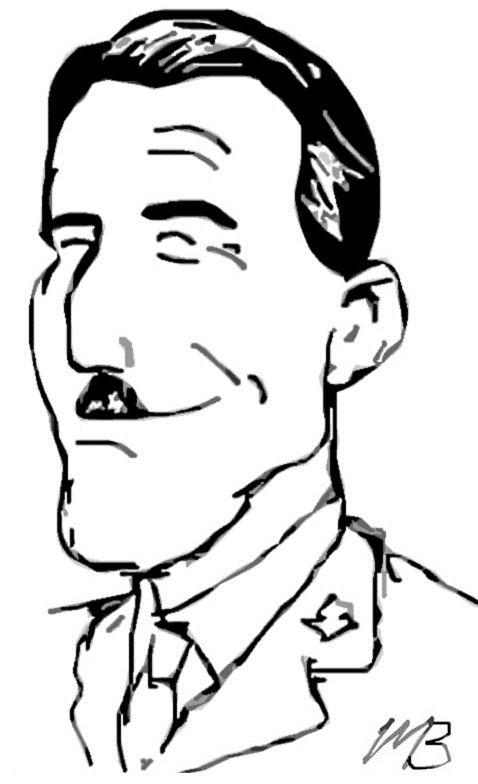
Brig. H. Sharp

Brigadier Harry Sharp
Regina Rifle Regiment
11th Infantry Brigade

… just because they have guts enough to step out and fight … Young lads who come of age and enlist here in December will be fighting in France by April. It makes no difference how many older men are taken. All the young fellows as they come of age will go into the firing line while men of 30, the ideal age for fighting, with years of training, hang back.

(Quoted in Saskatoon Star-Phoenix, 13 Nov 1944, 3)

Born on 30 April 1895 in Parry Sound, Ontario, Harry Sharp was principal of North Battleford Collegiate and a University of Saskatchewan graduate. As a student he had enlisted with the 152nd Battalion in November 1915 and reverted from the rank of sergeant to join a reinforcement draft to the 52nd Battalion in France a year later. He quick re-earned his stripes but was put out of action with a gunshot wound in May 1917. He received the Distinguished Conduct Medal and took a commission just before the end of the war.
Continue reading

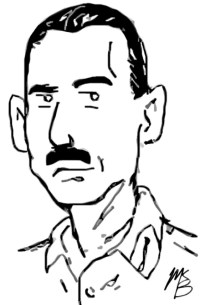
Maj-Gen. G. Kitching

Major-General George Kitching
Edmonton Regiment
11th Infantry Regiment

4th Canadian (Armoured) Division
Kitching

To command an infantry battalion must surely be the most rewarding command of any in the Army. It is the last time in the chain of command that you actually command men whose allegiance is to you because in our system the regiment or battalion is the cell on which brigades, division and corps are based. In the Army, loyalty is something that cannot be stretched too far. I do not think you can ask anyone to be “loyal” to a corps, division or brigade.

(Kitching, Mud and Green Fields, 130)

Born on 9 September 1910 in Guangzhour, Canton, China, George Kitching was a professional British Army officer and graduate of the Royal Military College at Sandhurst. Following Far East postings to Singapore and India with the Gloucestershire Regiment, Kitching suddenly resigned his commission and moved to Montreal in 1938. He joined the Royal Canadian Regiment on the outbreak of the Second World War and was attached with the 1st Canadian Division overseas as a staff officer.

Continue reading

Brig. I.S. Johnston

Brigadier Ian S. Johnston
48th Highlanders of Canada
11th Infantry Brigade
JohnstonIS

As a result of the courage and initiative shown by their Commanding Officer/Lt Col I.S. Johnston by his coolness under direct fire and his determination personally to lead his men. the 48th Highlanders of Canada succeeded in penetrating the enemy positions to a depth of one thousand yards, this making possible the further planned destruction of the enemy. By his conduct throughout his action Lt Col I.S. Johnston more than upheld the highest tradition of the Canadian Infantry.

 (D.S.O. citation, 18 December 1943)

Born in Toronto on 12 August 1908, Ian Strachan Johnston was a lawyer and graduate of the Royal Military College. A prewar member of the 48th Highlanders, he joined the 1st Battalion on mobilization and assumed command from fellow Toronto lawyer Lieutenant-Colonel J. Edwin Ganong in December 1942. One officer praised Johnston’s promotion, writing, “He is a wonderful man, grand to work for, a slave driver it is true, but he works himself twice as hard as anybody else.”

Continue reading

The Ambassador

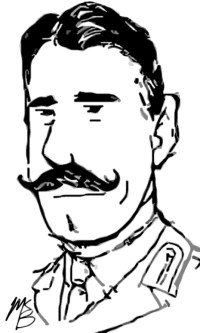
Brigadier General Victor Odlum 7th
(1st British Columbia) Battalion Odlum

Victor Wentworth Odlum was a curious specimen. Warfare fascinated him. It was said that he had taken to peacetime soldering because it presented an interesting problem, that he had set himself the task of mastering the psychology of war.

(Pierre Berton, Vimy, 1985, 114)

Victor Wentworth Odlum was a prominent journalist, businessman, diplomat and media tycoon. Born in Cobourg, Ontario on 21 October 1880, he moved to British Columbia as a young man to become a reporter and later editor for the Vancouver Daily World. A veteran of the Boer War and member 6th Regiment, he volunteered with the 7th Battalion in September 1914. He deployed to France as second-in-command.

Continue reading