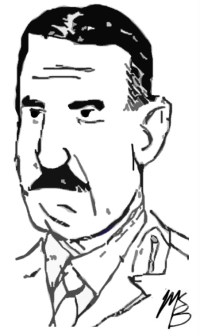
Lt. Col. W.H. Bell

Lieutenant Colonel Walker Bell, D.S.O.
3rd (Light) Tank Battalion
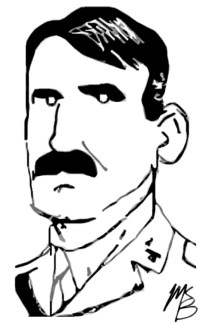
Bvt. Lt.-Colonel W.H. Bell is an able officer of sound judgement with decided personality and character. His knowledge of the application of tactical principles is sound as also are his views on matters connected with the training and administration of a Cavalry Regiment. In my opinion he is up to the standard of officers attending this school.

(Senior Officer School confidential report, 16 Aug 1924)

Walker Hardenbrook Bell was a Boer War veteran and Permanent Force member since 1906 when he was commissioned in the Royal Canadian Dragoons. He was born in St. John, New Brunswick on 28 December 1881. He served as second-in-command of the R.C.D. from July 1916 until January 1918, when he transferred to the British Army Tank Corps. His war service anticipated the eventual replacement of traditional cavalry with modern armour.
Continue reading

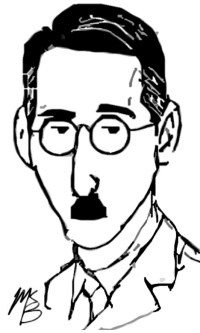
The Blue Bomber

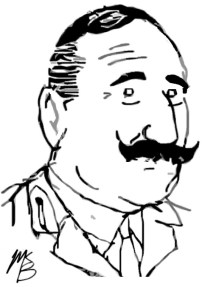
Lieutenant Colonel R.L. Denison
1st Canadian Tank Battalion
DenisonRL

He is very weak & debilitated. He suffers from insomnia & shock. The Board is of opinion that he will not be fit for any Service at home or even light-duty for nine months, & as he is a native of Canada he should be permitted to proceed home. He has also six bullet wounds in the left leg and four in the right

(Proceedings of Medical Board, 22 May 1915)

Born on 23 March 1889 in Minnedosa, Manitoba, Richard Lippincott Denison was a Winnipeg insurance manager and sportsman when commissioned as a lieutenant with the 8th Battalion in August 1914. He was put out of action when badly shot up and concussed in France in May 1915. Suffering from multiple bullet and shrapnel wounds as well as likely shell shock, he was found unfit for any duty and returned home. Six months later he enlisted as a major with the 90th Battalion.

Continue reading

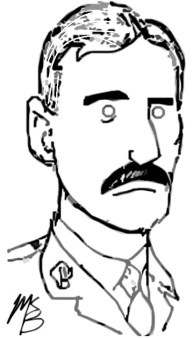
Lt. Col. Mills

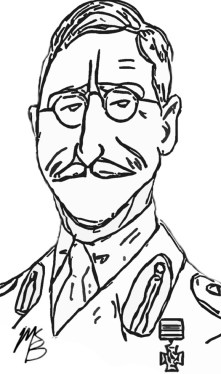
Lieutenant Colonel J.E. Mills, D.S.O.
1st Canadian Tank Battalion
Mills

It was while on this reorganization work that our O.C. conceived the idea of the Canadian Tank Corps. He is the father of the First Canadian Tank Battalion, and had it not been for the sudden cessation of hostilities, his claim that Canada could distinguish itself in the tank-field would have been justified.

(The Tank Tatler, Vol. 1, No. 4, 1919, 4)

By the end of the Great War, John Edgar Mills had been an artilleryman, staff officer, air force observer, gunnery school commandant, and tank battalion commander. He was born in Brantford, Ontario on 3 November 1878. Commissioned with the Permanent Force since 1903, he was an expert in artillery and chief gunnery instructor with the First Contingent. He served on the staff of the 1st Division and was attached to the Royal Flying Corps before transferring to the Royal Field Artillery as part of the Gallipoli campaign.

Continue reading

Maj. Gen. MacDougall

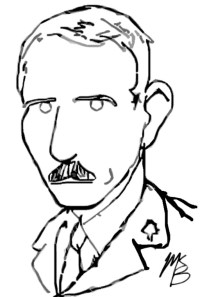
Major General J.C. MacDougall
Canadian Training Division
MacdougallJC

General MacDougall has, also, been very nasty with General Steele, as well as with General Carson … he puffed himself out and became most offensive until, as I once told you, I gave him to understand I would recall him promptly. I had a large gathering of senior Officers at Shorncliffe yesterday, some two or three hundred, and told them frankly and kindly that all this sort of rivalry and “monkeying” must cease.

  (Sam Hughes to Robert Borden, 24 Mar 1916)

Born in Toronto on 16 July 1863, James Charles MacDougall was a Royal Military College graduate, Boer War veteran, former commanding officer of the Royal Canadian Regiment, and a professional soldier for over thirty-years in the Permanent Force. Left behind when the 1st Canadian Division went to France in February 1915, MacDougall was placed in command of all Canadian troops in the United Kingdom.

Continue reading

Maj. Gen. Steele

Major General Sir Sam Steele
2nd Canadian Division
Steeke

Climbed the high hill to where the 19th, 20th [Bns.] and engineers were busy digging trenches and completing them. They are doing very well indeed, all hands working with a will, but I thought what an awful thing it is to be obliged to do this for the sake of our freedom, and to enable us to kill other men.

(Gen. Steele diary, 1 July 1915)

Born on 5 January 1848 in Medonte Township, Upper Canada, Samuel Benfield Steele was among the first officers of the North-West Mounted Police and the first commanding officer of the Lord Strathcona’s Horse in the Boer War. His leadership during the Klondike Gold Rush and his memoirs contributed to linking his name with the iconic image of the Mountie. As Canada’s most famous policeman and soldier, Steele received an appointment to command the 2nd Canadian Division in May 1915.

Continue reading

Lt. Col. Pragnell

Lieutenant Colonel G.S. Pragnell, D.S.O
1st Reserve Battalion

This officer does not complain of feeling of exhaustion he had when last boarded. He has been playing golf and can do 18 holes without feeling over tired. Has no feeling of nervousness as complained of in last board.

  (Proceedings of a Medical Board, 12 Feb 1918)

Born on 22 November 1880 in Hythe, England, George Seabrook Thomas Pragnell was a British Army officer and Boer War veteran who immigrated to Kamloops, British Columbia in 1908. He joined the 31st B.C. Horse under fellow British officer Lieutenant Colonel Charles Flick. Pragnall joined the 5th Battalion as a major when it deployed to France. In the confusion of the Second Battle of Ypres, he was mistakenly reported killed in action.

Continue reading

Lt. Gen. Turner

Lieutenant General Richard Turner, V.C.
2nd Canadian Division
Turner2

We are all very tired from days and nights of endless strain – with no sleep. I had men killed by enemy fire actually at the door of the house where my H.Q.’s was-to get to the Signal Dug Out-we knocked a hole in one side of the house, as it was too dangerous to pass outside.

  (Gen. Turner diary, 3 May 1915)

On 7 November 1900, Richard Ernest William Turner drove off an attack by Boer fighters near the Komati River. For his gallantry that day he was one of three Canadians to earn the Victoria Cross. Born in Quebec on 25 July 1871, Turner was the son of a Quebec politician and businessman. After his return from South Africa, Turner remained active in the Canadian militia until moving to the reserve list in 1912. At the outbreak of the Great War, he was recalled to service and appointed brigadier general.

Continue reading

The Scapegoat

Major H. LeRoy Shaw
87th (Grenadier Guards) BattalionShawHL

Major Shaw said that he was going overseas because he had no ties or obligations to hold him back, and that his spirit was only the same as many of his friends, and of many with whom he was not acquainted. With them, he said, it was a question of where their home and family duties ended and duty to their country began. 

(Maj. Shaw speech, Montreal Gazette, 14 Feb 1916, 14)

Born on 28 June 1878 in Prince Edward Island, Harold LeRoy Shaw was manager of the Montreal Imperial Life Assurance Company when he joined the 87th Battalion in September 1915. He went to France as a company commander in August 1916. He served as acting battalion commander between March and May 1917, and led the 87th through the Battle of Vimy Ridge.

Continue reading

The Vimy Pilgrim

Lieutenant Colonel D.E. Macintyre, D.S.O., M.C.
28th (Northwest) Battalion
Macintyre

At Vimy, Canadians for the first time during the war were a united body. They did what the French failed to do, what the British couldn’t do. They captured the ridge and did it in one jump, in such a manner that it shocked the Germans and caused their leader, Ludendorff, considerable dismay. The French today even are amazed that Canada did that, just as they are amazed that Canada sent 600,000 men to war when she didn’t have to.

(Lt. Col. Macintyre speech, Owen Sound Sun-Times, 9 Apr 1938, 11)

Born on 17 May 1885 in Montreal, Duncan Eberts Macintyre went west at the age of fifteen. He became, as he termed it “a Prairie storekeeper,” as well as land broker and insurance agent in Moose Jaw, Saskatchewan. He was commissioned as a lieutenant in the 28th Battalion in October 1914. He was promoted to captain shortly after the battalion deployed to France and by early 1916 was serving on the general staff with a series of Canadian brigades. He organized and led the 1936 Vimy Pilgrimage, and further helped to cement the battle in public consciousness with his 1967 book, Canada at Vimy

Continue reading

Lt. Col. Lalor

Lieutenant Colonel W.J.A. Lalor, M.C.
2nd Motor Machine Gun Brigade

This Officer gives a history of four years service in France, as a Machine Gun officer. Towards the end of his service, he states, he was developing symptoms of a fear neurosis, and this was finally precipitated by being blown up … There has been a strong tendency to repress his Overseas experiences, and towards self-reproach, as a result of his break-down. He states, now, he is afraid of the crowds, and cannot go to a Theatre. He is afraid to go over a bridge for fear that he will jump off. He has not made up his mind about his future.

 (Maj. A.A. Fletcher, Neurological Report, 13 Nov 1919)

Born in Muskoka, Ontario on 22 May 1878, William James Austin Lalor was a prospective homesteader in the west when the Great War broke out. He enlisted with the 1st Battalion in September 1914 and went to France in February 1915. Shortly thereafter he transferred to the Machine Gun Brigade, earning the Military Cross and a promotion to captain.

Continue reading