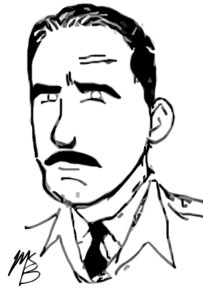
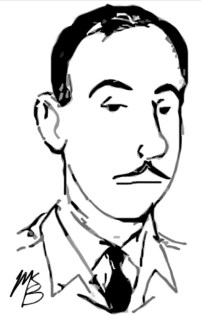
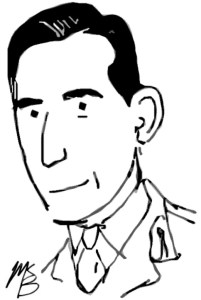
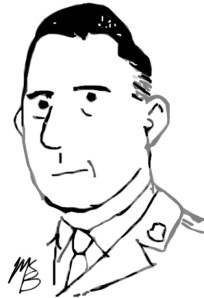
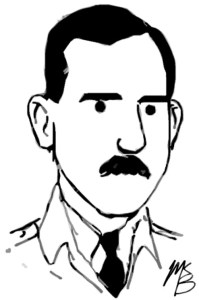
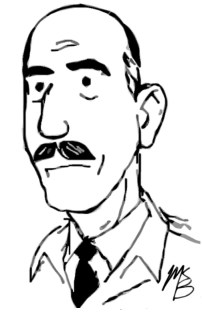
Maj. A.P. Ardagh

Major A.P. Ardagh
9th Armoured Regiment (British Columbia Dragoons)

Doc planned to go in for aviation, and received training at Camp Borden for two summers, but a “crack-up” cut short a very promising career in that line. Since then Doc has taken considerable interest in riding, besides various other activities, and no one was surprised to hear that he had decided to join the regular army as a cavalryman, in the Royal Canadian Dragoons. Doc will do well in the army—we expect to hear of his continued success, and we all wish him good billets and quick promotions.

(RMC Yearbook, 1931, 34)

Born on 30 March 1908 in Orillia, Ontario, Ainslie Power “Doc” Ardagh graduated from RMC in 1931 and joined the Royal Canadian Dragoons. He had showed an early interest in flying but a crash in 1929 put an end to a career in the air force. Following mobilization in 1940, he served overseas with the Dragoons at the rank of major and filled various staff positions with the Armoured Corps until January 1942 when recalled to Canada. Nine months later he returned to England and by January 1943 had become second-in-command of the 9th Armoured (British Columbia Dragoons) Regiment.

Continue reading

Brig. W.C. Murphy

Brigadier Bill Murphy
9th Armoured Regiment (British Columbia Dragoons)
1st Armoured Brigade
Murphy

While his Brigade was serving in a British Corps, in an Army largely American this officer displayed outstanding powers of command and leadership, maintaining morale at a very high peak and dealing effectively with all matters of purely Canadian nature with which he confronted.

(O.B.E. citation, 16 Apr 1945)

Born on 27 April 1905 in Ashcroft, British Columbia, William Cameron Murphy was son of a BC Supreme Court justice, a lawyer and long-time militia officer. He had first joined an artillery battery at fifteen in 1920 and was commissioned with the British Columbia Regiment in 1927. On mobilization in September 1939, he transferred to the PPCLI to go overseas as a company commander. Following a posting back in Vancouver for home defence, Murphy was attached to 5th Armoured Division as a staff officer.

Continue reading

Lt-Col. J.H. Larocque

Lieutenant-Colonel J.H. Larocque
9th Armoured Regiment (British Columbia Dragoons)
Larocque

He is conscientious and hard working but seems to lack zest in life and thinks slowly. He does not express himself … His views are usually sound when he has time to think them over and his written work is fair. He is easy to get on with and could fill a grade 2 appointment at Corps or higher level.

(Junior War Staff College report, 29 Nov 1944)

Born on 4 May 1909 in Montreal, John Howard Larocque graduated from RMC in 1931 and immediately joined the Royal Canadian Dragoons as a lieutenant. In 1936, he was one of the first officers attached to the Canadian Tank School and subsequently took courses with the Royal Tank Corps in the United Kingdom. In 1938, now a captain, he became gunnery instructor at the Canadian Armoured Fighting Vehicles School. He transferred to National Defence headquarters for special employment and general staff officer duties before returning to the RCD as a major in June 1941.

Continue reading

Lt-Col. G.C. Oswell

Lieutenant-Colonel G.C. Oswell
9th Armoured Regiment (British Columbia Dragoons)

Determined to show him that the cavalrymen of today are as bold and thorough as the cavalrymen of old, and that the cavalry is still an essential part of the forces being trained here in this Vernon camp for the defence of British Columbia … I met the C.O.—tall (six foot six) Lt.-Col. G.C. Oswell of the whipcord muscles and hawk-nose–beau ideal of the cavalryman.

(Vancouver Sun, 28 June 1940, 4)

Born on 10 August 1894 in Barton-on-Trent, Staffordshire, England Gordon Cecil Oswell had been one of the earliest volunteers with the Canadian Expeditionary Force in August 1914. He transferred from the British Columbia Horse to the Lord Strathcona’s Horse in September and went to France in May 1915. In early 1916, the six-foot-four, former rancher was selected for officer training.

Continue reading

Lt-Col. G.R.H. Ross

Lieutenant-Colonel G.R.H. Ross
5th Armoured Regiment (8th Princess Louise’s Hussars)
RossGRH

The success of a regiment is seldom accredited to its second-in-command, his job supposedly being whole administrative, but to Lt-Col Ross should go as much recognition as to any other who ever served with the unit … To the regiment Lt-Col. Ross has been more than just its second-in-command. He has been an integral part of the regiment that has profited so much by his judgement and decision and the regiment has been an integral part of him.

(The 8th Hussar, vol. 1, no. 2, Sept 1945, 11)

Born on 16 December 1904 in Woodstock, New Brunswick, George Robert Hay Ross was the long-serving second-in-command of the 5th Armoured Regiment. He had joined the Princess Louise’s Hussars in 1927, mobilized in July 1940 as second-in-command of “A” Squadron and became second-in-command of the regiment overseas in April 1942. Serving with the Hussars through the war, he finally took command in August 1945, succeeding Lieutenant-Colonel John W. Eaton.

Continue reading

Lt-Col. J.W. Eaton

Lieutenant-Colonel Jack Eaton
5th Armoured Regiment (8th Princess Louise’s Hussars)
Eaton

During the last 8 months I have had the privilege and high honour of commanding this regiment. Never in my 5 years in the army have I enjoyed myself so much. In the battles we have been in, never once was the result in doubt.

(Eaton farewell address, war diary, Aug 1945)

Born in Toronto on 4 September 1912, John Wallace Eaton was a member of the prominent department store family. A graduate of RMC and member of the militia since 1931, he joined the Governor General’s Horse Guards in 1940. His twin sister Colonel Margaret Eaton later served as director general of the Canadian Army Women’s Corps and his younger brother Captain Erskine Robert Eaton was killed in the Dieppe Raid.

Continue reading

Brig. G.W. Robinson

Brigadier G.W. Robinson
5th Armoured Regiment (8th Princess Louise’s Hussars)
2nd Armoured Brigade
Robinson

We were proud of his promotion, proud for him and proud for the Regiment. But an awful sense of loss went through all of us when we realized what it meant. He’d made us as a Regiment. He’d taken up there in England when we were far from ready and he’d turned us into a unit and a damn good unit. There is no doubt that his tough training saved us lives and casualties. He fought us well. You couldn’t have asked for a better man, anyway you want to look at it. We were awful, awful sorry to see him go.

(Quoted in Douglas How, The 8th Hussars, 288)

Born on 7 December 1907 in London, Ontario, George William Robinson was an insurance executive and squadron commander of the 1st Hussars when it mobilized for active service in summer 1940. Redesignated the 6th Canadian Armoured Regiment, it went overseas in October 1941 with Robinson rising to second-in-command. In May 1942, he replaced Lieutenant-Colonel H.S. Gamblin of the 5th Armoured (8th Princess Louise’s New Brunswick Hussars) Regiment.

Continue reading

Lt-Col. H.S. Gamblin

Lieutenant-Colonel H.S. Gamblin
5th Armoured Regiment (8th Princess Louise’s Hussars)
Gamblin

I was 17 years old at the time of my enlistment and therefore had to have the consent of my parents, which they reluctantly gave … I had discovered that anyone under the age of 18 would not be accepted for overseas duty. Therefore when the time came for my enlistment in the 4th Overseas Siege Battery, I gave my age as 18 and had no trouble about it.

(Gamblin interview, “Memories of WWI,” c. 1980)

Born on 21 December 1897 in Cody’s, New Brunswick, Harold Seymour Gamblin was a farmer, First World War veteran, and commanding officer of the 8th Princess Louise’s (New Brunswick) Hussars since 1938. He had served as a gunner and sergeant with an artillery battery in France until August 1918 when he was wounded by a shell explosion. After the war, he worked for the Soldier’s Settlement board and joined the militia.

Continue reading

Lt-Col. J.M. McAvity

Lieutenant-Colonel Jim McAvity
2nd Armoured Regiment (Lord Strathcona’s Horse)
McAvity

Throughout these operations and previously in the Italian theatre throughout the breaking of the Gothic Line in August 1944, the crossing of the River Conca, up to Coriano Ridge and the battles of the Po Plain the outstanding ability, enthusiasm and drive of this officer was undoubtedly of very great bearing on the successful completion of these operations.

(D.S.O. citation, 8 May 1945)

Born on 20 November 1909 in Montreal, James Malcolm McAvity was a tennis player and businessman. A graduate of RMC in 1931, he joined the army in 1940 and was one of a dozen officers to attend tank tactics training in England. He personally bought 18,000 acres of land for the Meaford tank range near Camp Borden. He went overseas with the Halifax Rifles in June 1943 and transferred to the Lord Strathcona’s Horse in August.

Continue reading

Lt-Col. P.G. Griffin

Lieutenant-Colonel Pat Grffin
2nd Armoured Regiment (Lord Strathcona’s Horse)
Griffin

Many orders may mean the sacrifice of life to gain an ultimate important objective such orders will not be given by the comd without a great deal of consideration and when given they must be obey instantly and implicitly.

(P.G. Griffin, LdSH War Diary, 28 Apr 1944)

Born in County Down, Ireland, on 8 March 1893, Philip (Patrick) George Griffin was an advertising manager in Toronto and a First World War veteran. He had joined the Royal Canadian Dragoons in 1913 and earned a commission with the Canadian Machine Gun Brigade at Vimy Ridge. He served the Lord Strathcona’s Horse until retirement in 1929 for health reasons. Ten years later he joined his old regiment as a captain and went overseas as second-in-command in November 1941.

Continue reading