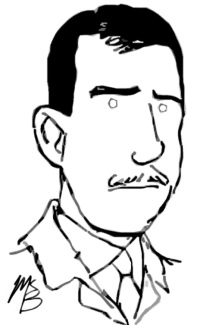
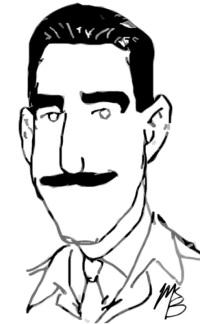
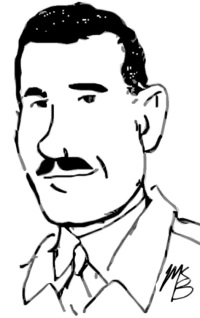
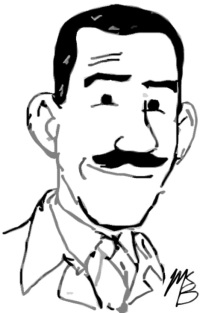
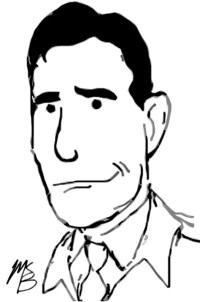
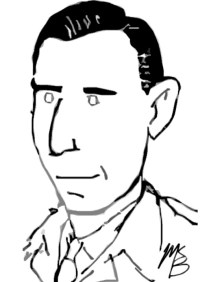
Lt-Col. A.C. Gostling

Lieutenant-Colonel Alf Gosling
Queen’s Own Cameron Highlanders
GostlingAC

He expresses himself quite well in his own particular style. He has plenty of common sense and is practical. He has not got a very active brain and is not able to grasp essentials easily. He would react well to severe physical and metal pressure and would not get easily rattled. His good humour and solidness would be an asset in a crisis.

(Report on Maj. Gostling, 11 Apr 1940)

Born on 18 August 1903 in Mitcheldean, Gloucestershire, England, Alfred Capel Gostling was a radiotrician and captain in the Winnipeg Grenadiers, having been commissioned in the militia since 1925. He went overseas as major in the 2nd Infantry Brigade in December 1939 and served as assistant adjutant and quartermaster for the 1st Canadian Division. In February 1942, he transferred to the Queen’s Own Cameron Highlanders, succeeding Lieutenant-Colonel Gil Dudley.

Continue reading

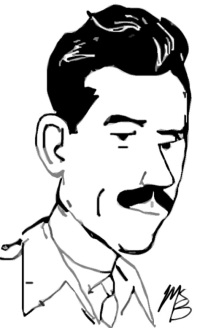
Lt-Col. G.F. Dudley

Lieutenant-Colonel Gil Dudley
Queen’s Own Cameron Highlanders
Dudley

It was a much different enemy the Canadians were facing in this war, he said. The Germans had studied the weaknesses which made them lose the last war, and were a much more efficient fighting force. However, the Canadian troops overseas had proven apt pupils, and now could teach the Germans a thing or two.

(quoted in Winnipeg Tribune, 6 Oct 1942, 18)

Born on 23 April 1885 in Dumfries, Scotland, Guildford Francis Dudley served with the 1st Royal Scots in the Boer War and moved to a ranch in Alberta in 1904. Having enlisted in the Fort Garry Horse in September 1914, he reverted from sergeant to the rank to join the 8th Battalion in France in August 1915. He earned the military medal and was subsequently commissioned in December 1916. He received the Military Cross in July 1917 and ended the war at the rank of captain. He served as commanding officer of the Winnipeg Rifles from 1927 to 1934.

Continue reading

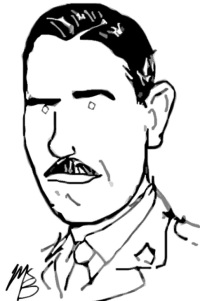
Lt-Col. H. Mackenzie

Lieutenant-Colonel Hugh Mackenzie
Queen’s Own Cameron Highlanders
Mackenzie

Hugh Mackenzie had kept the battalion together during peacetime, during rough times, leading up to war. He was the fellow who mobilized us, and sure why not give him his due of taking the battalion over than then sending him back. He had earned that many times over, one more bod on a troop ship with three or four thousand.

(Norman Ross, interview, 20 July 1979)

Born on 23 June 1884 in Castleton, Scotland, Hugh Mackenzie moved to Winnipeg several years after serving in the Boer War. He enlisted as a private in the 43rd Battalion in December 1914 and was promoted to regimental quartermaster sergeant by the time the unit deployed to France in February 1916. He received a commission six months later and by 1917 became honorary captain and quartermaster for the battalion. He assumed command of the Queen’s Own Cameron Highlanders of Canada in March 1938.

Continue reading

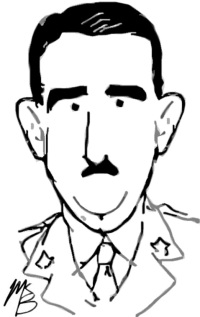
Lt-Col. W.D. Heyland

Lieutenant-Colonel Dalt Heyland
Calgary Highlanders
Heyland

His outstanding leadership and sound tactics were reflected in the continued successes of his battalion in battle. Major Heyland by his devotion to duty, vigorous enthusiasm and fearless bearing has earned for himself the admiration and respect of his entire unit and by his efforts has contributed very materially to the efficiency and the fine record of the Calgary Highlanders.

(D.S.O. citation, 10 Nov 1945)

Born on 31 October 1906 in Claresholm, Alberta, William Dalton Heyland commanded “B” Squadron in the 15th Alberta Horse, having belonged to the militia since 1930. He reverted to lieutenant on mobilization and joined the Calgary Highlanders as a platoon leader overseas by the end of 1940. He went overseas with his friend and fellow Alberta Horse member Lieutenant Ross Ellis. Another local friend wrote home from England that “Dalt is just as handsome as ever and it is a treat to watch the feminine eyes follow him down the street. We would say Claresholm is doing alright.”

Continue reading

Lt-Col. R.L. Ellis

Lieutenant-Colonel Ross Ellis
Calgary Highlanders
Ellis

This is quite a day in history, 5 years of war … Day by day doesn’t count anymore because so often there is no distinction between days and then a date catches up to me. I realize it as a date that brings me closer to you and that is what I am living and praying for.

(Ross Ellis to Marjorie Ellis, 3 Sept 1944)

Born on 15 June 1915 in High River, Alberta, Ross Laird Ellis was a sergeant in the 15th Alberta Horse before qualifying for a commission in August 1940. He joined the Calgary Highlanders in England as a platoon leader by the end of the year but was soon selected for training as an instructor. He was posted to Camp Vernon, British Columbia at the rank of major. He reverted to captain to return overseas and rejoin the Highlanders when they deployed to France in July 1944.

Continue reading

Lt-Col. D.G. MacLauchlan

Lieutenant-Colonel Don MacLauchlan
Calgary Highlanders
MacLauchlan

There is no doubt that MacLauchlan never succeeded in hiding his fears well enough to give his men the impression that he was courageous–a possible great failing in a field commander. He had voided the front even though, ironically, he found himself under fire, or close to it, several times … In later years [Brig] Megill would recall: ‘It was quite genuine battle exhaustion that knocked him out.

(Bercuson, Battalion of Heroes, 180)

Born on 19 July 1905 in Charlottetown, Prince Edward Island and raised in Alberta, Donald George MacLauchlan joined the Calgary Highlanders out of high school in 1921. His enthusiasm for soldiering and time devoted to militia training cost him his job as a newspaperman just a year before the outbreak of war. He went overseas as a company commander in August 1940 and became second-in-command in England. He succeeded Lieutenant-Colonel J. Fred Scott in February 1942, although his appointment appeared tenuous.

Continue reading

Lt-Col. J.F. Scott

Lieutenant-Colonel Fred Scott
Calgary Highlanders
Scott

Perhaps the person reading this Diary right now has become rather fed up with my constant reference to Battle Drill but perhaps if you continue on reading this Diary and come to the day, say a year or two from now, and read “The Calgary Highlanders captured an important enemy position by a machine-like pincer movement” you will see why I have stressed so much this type of training.

(War diary, 31 Dec 1941)

Born in Meaford, Ontario on 3 July 1892, James Fred Scott enlisted with the 89th Battalion in 1916 and served with the Royal Flying Corps before returning to the infantry with the 50th Battalion in France. He was struck off strength to Canada with a diagnosis of trench fever in summer 1917. Following demobilization, he completed a law degree in Toronto and passed the Alberta Bar. Commanding officer of the 15th Alberta Horse since 1936, in September 1939, he succeeded Lieutenant-Colonel H.H. Riley of the Calgary Highlanders, who had been declared medical unfit for active service.

Continue reading

Lt-Col. G.L. Lalonde

Lieutenant-Colonel Lucien Lalonde
Régiment de Maisonneuve
Lalonde

German officers are hypocrites and constitute a class that should be watched closely, especially when they appear submissive and eager to cooperate. Isms of any kind are no good for use. Those who preach them in Canada have never been to the countries they speak so glowingly about. In fact, they don’t know what they are talking about.

(Lalonde in Montreal Gazette, 15 Mar 1946, 2)

Born in Montreal on 14 December 1908, George Lucien Lalonde graduated from L’Assomption College in 1926 and the University of Montreal with a law degree in 1930. He mobilized as with the Régiment de Maisonneuve, and went overseas as a captain in August 1940. When Lieutenant-Colonel Robert Bourassa fell ill, Major-General Victor Odlum of the 2nd Division considered Lalonde for the appointment. It was, however, deemed inappropriate to promote a captain over the unit’s other senior officers. Instead, he went to the war staff college.

Continue reading

Lt-Col. J. Bibeau

Lieutenant-Colonel Julien Bibeau
Régiment de Maisonneuve
Bibeau

But impressive as this official recognition of its service undoubtedly is, glimpses more vivid and human into the quality of the regiment’s spirit are provided in certain recorded incidents. Such is the story of how Lt.-Col. Julien Bibeau won the D.S.O. at Calcar, when some members of the regiment had been surrounded by Nazi paratroopers, and he had led a party to their rescue shouting: “Follow me, we are not going to let our boys get killed like that!”

(Montreal Gazette, 29 Nov 1945, 8)

Born in Montreal in January 1908, Julien Bibeau was a graduate of the University of Montreal and sales manager for Maple Leaf Mills. Having belonged to the Cadet Officer Training Corps at university, he took a commission with the Régiment de Maisonneuve in 1937. He graduated from senior officer school in 1943, and by the time the regiment deployed to France after D-Day in July 1944, he served as second-in-command under Lieutenant-Colonel Lefort Bisaillon.

Continue reading

Lt-Col. H.L. Bisaillon

Lieutenant-Colonel H. Lefort Bisaillon
Régiment de Maisonneuve
Bisaillon

Not once, even when under exceedingly difficult situations, has he neglected doing the utmost for those under his command. His calmness and mastery of himself were a striking example to all ranks and whenever the battle was at its highest pitch he would go around to the coys to counsel and help them out.

(War diary, 18 Aug 1944)

Born in Quebec in 1907, Henri Lefort Bisaillon was the son of Colonel Pierre Bisaillon who had commanded the 85th Regiment from 1915 to 1920. He took a commission in his father’s old unit, now redesignated Régiment de Maisonneuve, in 1928. While stationed in the United Kingdom, in November 1942, he succeeded Lieutenant-Colonel M.L. de Rome and would lead the unit to France as part of the 5th Brigade, 2nd Division after D-Day.

Continue reading