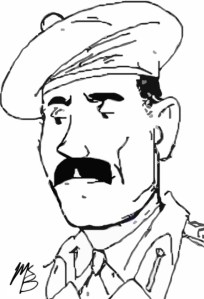
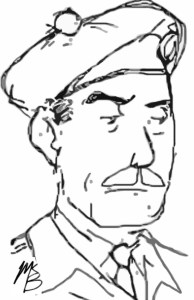
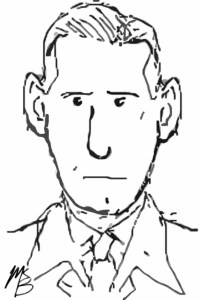
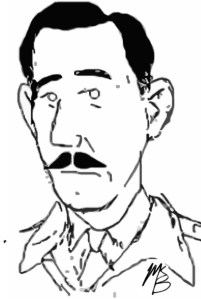
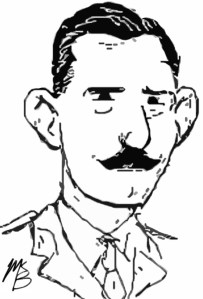
Lt-Col. F.F.S. Barlow

Lieutenant-Colonel F.F.S. Barlow
2nd Battalion, South Wales Borderers

This Officer’s service throughout the operation during some very intricate and difficult situation were of a very high order. By his calm courage, high sense of duty and imperturbability at all times, he has been a constant source of inspiration and example to his bn. I cannot speak too highly of the officer’s services to the Bn and Bde.

(D.S.O. recommendation, 26 Sep 1944)

Born on 8 June 1905 Parkstone, Dorset, Frank Frederick Stewart Barlow was a commissioned officer in the South Wales Borderers since 1924. Having served in India and Palestine during the 1930s, he mobilized with the 2nd Battalion in September 1940. He was promoted to second-in-command in October 1942. The battalion landed on Gold Beach on 6 June 1944, and after Lieutenant-Colonel R.W. Craddock was wounded two days later, Barlow assumed command of the 2nd South Wales Borders.

Continue reading

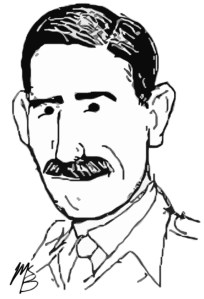
Lt-Col. C.E. Welby-Everard

Lieutenant-Colonel Chris Welby-Everard
2nd Battalion, Lincolnshire Regiment

But you have to get into that frame of mind where however tired you are, however exhausted you feel, you have just got to go on. Now that is a state of exhaustion that a great many of you, I am sure, have never experienced at all. I have only experienced it once, and that wasn’t really bad, but we shall really be up against the problem and we have just got to pull ourselves together. If you realise it beforehand it will be very much easier to compete with when the moment actually comes.

(Welby-Everand speech, war diary, June 1944)

Born on 9 August 1909 in Spalding, Lincolnshire, Christopher Earle Welby-Everard was a graduate of Corpus Christi College, Oxford and a Territorial Army officer. He was commissioned Lincolnshire Regiment in 1930 and served during Arab revolt in Palestine in 1936. He became battalion adjutant prior to war in September 1939, and afterwards completed staff college at Camberley. Following staff officer duties, in March 1944 he was promoted to lieutenant-colonel and took command of the 2nd Battalion, Lincolnshire Regiment.

Continue reading

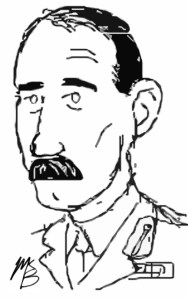
Lt-Col. J. Drummond

Lieutenant-Colonel John Drummond
2nd Battalion, Royal Ulster Regiment

The award of the Distinguished Service Order to Lt-Colonel Drummond was a fitting conclusion to such an enterprise. Since he had taken command, the Battalion’s chain of successes had been unbroken, and now the campaign had been wound up in really superb style. This last operation had been at once the most spectacular and the most difficult that the Battalion had undertaken, and, without doubt, the completeness of the triumph was due largely to his bold plan and resolute leadership.

(D.S.O. citation, 14 Feb 1945)

Born on 17 February 1910 in County Tipperary, Ireland, John Drummond was commissioned with the Royal Ulster Rifles in 1931 and had prewar service in Hong Kong and Egypt. He was adjutant for the 2nd Battalion in the Battle of France, and after the Dunkirk evacuation became GSO 3 for X Corps. He was subsequently posted to the 1st Battalion, RUR as second-in-command. As part of 6th Airlanding Brigade in the 6th Airborne Division, the unit landed in France during the D-Day invasion.

Continue reading

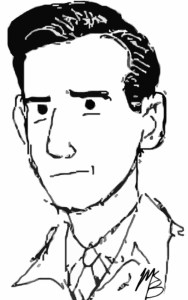
Lt-Col. I.C. Harris

Lieutenant-Colonel “Tommy” Harris
2nd Battalion, Royal Ulster Regiment

Lieutenant-Colonel Harris has commanded his battalion since D Day, His leadership, example, and coolness under fire have been a source of inspiration to his battalion. In the battles for Cambes, Caen, and Troarn, he was invariably to be found in the forefront of the battle encouraging his men in spite of the heavy fire through which the battalion had always to advance.

(D.S.O. citation, 14 Feb 1945)

Born on 7 July 1910 in County Tipperary, Ireland, Ian Cecil Harris was commissioned with the Royal Ulster Rifles in 1930 after attending Royal Military College, Sandhurst. He served with the 2nd Battalion in Sudan, and the 1st Battalion in Palestine, Egypt and Hong Kong. In the late 1930s, he was posted to Shanghai and then served in India on the North West Frontier. By 1941, he had complete staff college at Camberley and became brigade major for the 129th Infantry Brigade.

Continue reading

Lt-Col. R.H. Bellamy

Lieutenant-Colonel Hugh Bellamy
1st Battalion, Royal Norfolk Regiment

But his nickname among the men was ‘Claude’ because we thought he looked like Claude Dampier, the comedian. Mind you, Bellamy was no comedian. He was a tough, stern man, but fair, and a good Commanding Officer.

(Quoted in Thomas J. Bates, Search for Sidney, 34)

Born on 8 December 1910 in Westhampnett, Sussex, Robert Hugh Bellamy attended Sherborne School and the Royal Military College, Sandhurst, after which he was commissioned with Duke of Cornwall’s Light Infantry in 1930. He fought with the 2nd Battalion during the battle of France and was mentioned in dispatches. By September 1943, he was promoted to lieutenant-colonel in command of the 1st Battalion, Royal Norfolk Regiment.

Continue reading

Lt-Col. D.L.A. Gibbs

Lieutenant-Colonel D.L.A. Gibbs
1/6th Battalion, Queen’s Royal Regiment
2nd Battalion, Royal Warwickshire Regiment

I think this was one of the biggest shocks one sustained up to that period of the war. I had seen soldiers die and soldiers wounded; I had been at Dunkirk. I had amongst many, both military and civilian refugees, been the target of German dive-bombing, but, somehow, nothing had affected me so personally up till then as those one or two deaths in September 1942 at Deir-el-Munassib, perhaps, partly, because it was my ‘command,’ and the deaths within it were part of me.

(Quoted in Bryn Hammond, El Alamein, 2012, 145)

Born on 5 October 1905 in Abingdon, Berkshire, Denis Lucius Alban Gibbs was commissioned with the Queen’s Royal Regiment in 1926 after graduating from Royal Military College, Sandhurst. Following prewar overseas service in India and Sudan, he attended staff college and participated in the Dunkirk evacuation. In January 1942, he was promoted to lieutenant-colonel in command of 1/6th Battalion, Queen’s Royal Regiment.

Continue reading

Lt-Col. H.O.S. Herdon & Maj. R.G. Kreyer

Lieutenant-Colonel Hoss Herdon
&
Major R.G. Kreyer2nd Battalion, Royal Warwickshire Regiment

He was a well thought of chap. Hoss Herdon they called him, that was his name I think or his initials, I don’t know … I understand he’d been killed by machine gun fire … I think all the officers were very well respected. No question about that, I think. I think this was proof of maybe a regular battalion … more respect for their officers than the one that was sort of called up into active service.

(Russell King, IWM, 21 Sep 1998) https://www.iwm.org.uk/collections/item/object/80017285

Born in British India on 16 November 1905, Hugh Owen Seymour Herdon was the son of an Indian Army general and commissioned officer with Royal Warwickshire Regiment since 1925. He was promoted to captain in 1936 and then major in 1940. By 1941, he was a general staff officer with the War Office. He assumed command of the 2nd Battalion, Royal Warwickshire Regiment in September 1943.

Continue reading

Lt-Col. W.A. Waller

Lieutenant-Colonel “Swazi” Waller
1st Battalion, South Lancashire Regiment

He was gifted with extreme personal bravery, which proved a great inspiration to all the battalion. To see him walking about, as he frequently did, amongst the leading troops and forward positions, completely indifferent to the heaviest enemy fire, was a great morale-boost to all. In addition, whatever the circumstances and however great the demands of the situation, he was always carefully shaved and immaculately turned out.

(Lt. Eddie Jones quoted in Tony Colvin, The Noise of Battle, 440)

Born on 28 August 1909 in British India, William Augustine Waller enlisted with the Worchester Regiment before being admitted to Royal Military College, Sandhurst. He was commissioned in the Duke of Wellington’s Regiment (West Riding) in 1930 and served with the 2nd Battalion in India and fought on the North West Frontier. His nickname came from an Indian Army tune “Swazi wallah.” After seven years overseas, Waller returned to England in 1939 and joined the 1st Battalion as a company commander. He was badly wounded during the evacuation from Dunkirk and earned the Military Cross for “utter disregard for danger.”

Continue reading

Lt-Cols. G.H. Bolster & J.H. Orgill

Lieutenant-Colonel G.H. Bolster
&
Lieutenant-Colonel J.H. Orgill
1st Battalion, South Lancashire Regiment

The five years of war were for Geoffrey a period of unceasing labour, almost always in highly responsible and exacting staff appointments … There, at his urgent request, he was allowed to step down in rank to lieutenant-colonel so that he might command a battalion. After two months in the line with his new command, a battalion of The South Lancashire Regiment, he was mortally wounded while visiting his forward posts

(Quoted in The Iron Duke, Feb 1945, 50)

The high rate of officer causalities in the Normandy campaign resulted in a shortage of battalion commanders in the British Army. To find replacements, 21st Army Group headquarters often relied on older qualified senior officers previously stationed in the United Kingdom. When Lieutenant-Colonel Richard Burbury of the was killed on D-Day and second-in-command Major J.E.S. Stone was wounded at the end of June, the South Lancashire Regiment needed a new commanding officer.

Continue reading

Lt-Col. R.P.H. Burbury

Lieutenant-Colonel Richard Burbury
1st Battalion, South Lancashire Regiment

The colonel was such an obvious target—he had a flag in his hand in case there was going to be confusion and he could be rallied round, he waved his map as well. I think he was hit by a sniper. It happened several times actually. I served six commanding officers during the campaign. Two were killed, two were wounded …

(Arthur Rouse, IWM interview, 30 Jul 1994) journal, July 1944) https://www.iwm.org.uk/collections/item/object/80013951

Born on 1 April 1906 in Barnsley, South Yorkshire, Richard Percival Hawksley Burbury was educated at Ludgrove School and Eton College. He was commissioned with Duke of Cornwall’s Light Infantry in 1925 and served in India and Palestine before the war. He participated in the evacuation from Dunkirk in June 1940 and qualified for higher command. He was unit adjutant and briefly commanded the 2nd Battalion, DCLI from October to November 1942, when he relinquished the post due to ill-health. Nearly a year later, he became commanding officer of the 1st Battalion, South Lancashire Regiment.

Continue reading