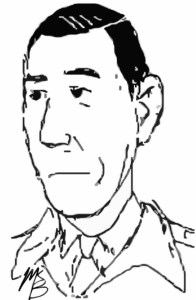
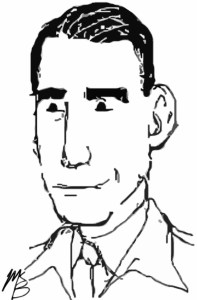
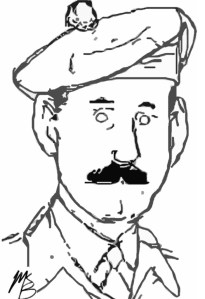
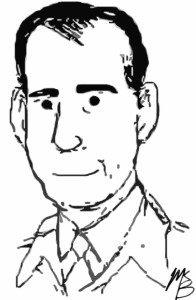
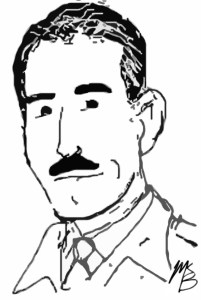
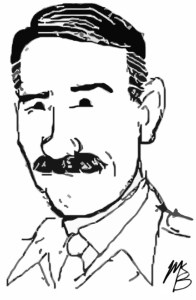
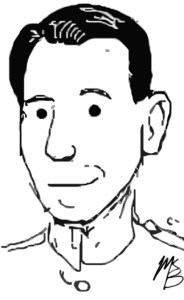
Lt-Col. W.R. Cox

Lieutenant-Colonel W.R. Cox
7th Battalion, Green Howards

During the whole of the action Lt-Col Cox has continually on the move under small arms and mortar fire. His complete disregard for his own safety at a critical period and the calm manner in which he moved about directing the attack and encouraging the Coys was a fine example and great inspiration to all ranks.

(D.S.O. citation, 1 Mar 1945)

Born on 13 June 1905 in Herefordshire, William Reginald Cox was commissioned with the King’s Shropshire Light Infantry after completing Royal Military College Sandhurst in 1925. He rose to captain and adjutant before attending staff college at Camberley in 1939. Following general staff officer appointments, he became commanding officer of 11th Battalion Worcestershire Regiment in July 1942. Six months later the unit was reconstituted as the 1st Battalion—the original had been destroyed after the surrender of Singapore.

Continue reading

Lt-Col. R.H.W.S. Hastings

Lieutenant-Colonel Robin Hastings
6th Battalion, Green Howards
2nd Battalion, King’s Royal Rifle Corps

I want it to be clearly understood that I, who was there and saw it, have nothing but admiration for the way the Bn fought yesterday afternoon. The withdrawal was given entirely on my order, it was carried out perfectly, and it was given chiefly because of the threat of tanks to our Lines of Communication. The men of the Bn deserve more credit for their performance yesterday than for many other battles for which we will have received more credit.

(Quoted in 6th Green Howards war diary, 12 Jun 1944)

Born on 16 January 1917 in Rugby, Warwickshire, Robin Hood William Stewart Hastings was an horse racer, a graduate of Christ Church, Oxford University and a commissioned officer in the King’s Royal Rifle Corps since 1938. In response to press criticism about “undergraduate hooliganism,” in 1937 he wrote a joint letter with George Haig, 2nd Earl Haig, to the Daily Telegraph, “Whereas our father sowed their wild oats in the comparatively secluded company of dons and tutors, our audience is only limited by the circulation of the daily papers … The public gaze is misdirected. The foundations of the Empire are hardly likely to be shaken by the hail of stones.” Hastings’ and Haig’s letter went on to claim the Empire was “however, threatened by the words and actions of those undergraduates whose principal diversion is to pass treasonable motions,” presumably a reference to radical, Communist, or pacifist elements at the university.

Continue reading

Lt-Col. T.G.L. Charles

Lieutenant-Colonel T.G.L. Charles
5th Battalion, East Yorkshire Regiment

Soon after landing and during the unsettled first few days, he had the machinery of comd excellently organised and fully under control, being quite indifferent to and in no way allowing enemy action or movements to interfere with the arrangements. The same zeal and marked efficiency characterised all Lt-Col Charles’ work when he too over comd of 5 E Yorks.

(D.S.O. citation, 21 Jun 1945)

Born on 12 November 1909 Eastbourne, Sussex, Thomas Leslie Gwyther Charles was commissioned into the Essex Regiment in 1930, and served in India and the Middle East. In July 1936, he was injured in a RAF bomber crash in Egypt that killed seven. At the outbreak of the Second World War, he mobilized as adjutant in the 2nd Battalion, Essex Regiment.

Continue reading

Lt-Col. G.W. White

Lieutenant-Colonel G.W. White
5th Battalion, East Yorkshire Regiment
12th Battalion, King’s Royal Rifle Corps

… continuous active operations almost always in contact with the enemy. He has done outstanding work for units and has made himself an excellent Staff Captain through his energy, resource and unruffled temperament. He refused to go sick in spite of ill-health during the Dec/Jan operations, when his determination kept him at duty.

(M.B.E. recommendation, 8 July 1941)

Born on 6 July 1912 in Farnham, Surrey, Gilbert William White was a cricket player and commissioned in the King’s Royal Rifle Corps since completing Royal Military College, Sandhurst in 1933. Following prewar service in Palestine fighting the Arab Revolt, White was posted to the newly formed 7th Armoured Division in 1940 as a staff officer. For “his energy, resource and unruffled temperament” during the Western Desert campaign, he was made Member of the Most Excellent Order of the British Empire in July 1941.

Continue reading

Lt-Col. G.G. Elliott

Lieutenant-Colonel G.G. Elliott
2nd Battalion, Essex Regiment

During his term of comd, the bn, in common with all other units, suffered heavy casualties. Its record can, however, bear comparison with any other during this period and throughout, the morale and fighting spirit of the men remained at a very high level despite constantly changing personnel within the Bn. For this, Lt Col Elliott mst be give almost sole credit for by his personal example in battle, by his tireless solving of all the problems presented to him, and by his faultless leadership, he ensured the success of all the operations in which his bn took part.

(D.S.O. citation, 24 Jan 1946)

Born on 21 November 1909 in Eastbourne, Sussex, Geoffrey Grahame Elliott was a commissioned officer in the Queen’s Own Royal West Kent Regiment since 1931. He was recognized for distinguished service as a brigade major in the Battle of France. He afterward worked on the War Office planning staff. By April 1944, he had been posted to the 2nd Battalion, Essex Regiment as second-in-command. Two months later, the battalion landed in Normandy with the 56th Independent Infantry Brigade.

Continue reading

Lt-Col. J.F. Higson

Lieutenant-Colonel J.F. Higson
2nd Battalion, Essex Regiment

This comparatively young officer, who has only 8 yrs service, was acting 2 i/c of the Bn during the operations on Ed Duda. Throughout the whole period of operations he was if the greatest value, both in the Bn HQ area … also in the forward areas he was of the greatest value, visiting and directing the work of forward Coys under fire, in organising the defences and co-ordinating the work of the various arms. All of this was done under considerable strain and with very little sleep.

(M.C. citation, 24 February 1942)

Born in Norwich, Norfolk on 21 November 1913, John Frederick Higson was a commissioned officer in the Essex Regiment since 1933. He served with the 1st Battalion in the Western Desert campaign and as second-in-command earned the Military Cross for “conspicuous gallantry” in late November 1941 at Ed Duda near Tobruk. In one instance, he attacked two enemy trucks but when his Bren gun jammed, “he jumped out of the carrier, rushed up alone, stopped one lorry and took the driver prisoner.”

Continue reading

Lt-Col. R.N.H.C. Bray

Lieutenant-Colonel Bobby Bray
2nd Battalion, Gloucestershire Regiment

Lieutenant-Colonel Bray was in a glider that crashed badly on landing. Though bruised and badly shaken, Lieutenant-Colonel Bray made his way to Divisional HQ. On the way he sustained further injuries owing to a fall which resulted in concussion. As soon as he recovered consciousness he continued on. Though in great pain he set to work when he arrived in a way which inspired all around him.

(D.S.O. citation, 31 August 1944)

Born on 14 June 1908, Decca, Bengal Presidency, Robert Napier Hubert Campbell Bray was commissioned in the Duke of Wellington’s (West Riding) Regiment following graduation from Royal Military Academy, Woolwich in 1929. In 1942, he became GSO 1 for the newly formed 6th Airborne Division. As chief-of-staff to Major-General Richard Nelson Gale, Bray helped to design the airborne operations for the Normandy invasion.

Continue reading

Lt-Col. F.W.A. Butterworth

Lieutenant-Colonel F.W.A. Butterworth
2nd Battalion, Gloucestershire Regiment

During the operation, his personal leadership was of a very high order and his presence on the battlefield at places where he was most … was an inspiration to all ranks. His personal attention to detail in the planning period and his drive, determination, and leadership during battle were responsible for the Bn seizing four important objectives almost entirely within the time laid down by Bde HQ.

(D.S.O. recommendation, 20 Sep 1944)

Born on 18 November 1906 in Headingley, Yorkshire, Francis Wyndham Arthur Butterworth was commissioned in the West Yorkshire Regiment (Prince of Wales’s Own) in 1925 after attending Royal Military College, Sandhurst. In 1936, he joined the Sudan Defence Force and served as second-in-command of the Equatorial Corps during the first phase of the Second World War. For his administrative and security work in Sudan, he awarded with Member of the Most Excellent Order of the British Empire (MBE) in 1942.

Continue reading

Lt-Col. D.R. Wilson

Lieutenant-Colonel D.R. Wilson
2nd Battalion, Lincolnshire Regiment
7th Battalion, Green Howards
2nd Battalion, South Wales Borderers

He has throughout combined a high sense of duty with a humane understanding of the many factors affecting the morale of the soldier, and his work has been of a constantly high standard.

(O.B.E. citation, 1 Jan 1957)

Born on 15 January 1912 in Portsmouth, Hampshire, Douglas Richard Wilson attended Radley College and Royal Military College, Sandhurst before being commissioned into the Lincolnshire Regiment in 1932. His father Colonel Richard Henry George Wilson (1874–1944) had commanded the 8th, 1st, and 1/5th Battalions during the First World War. Following overseas service with the 1st Battalion in Hong Kong and India in the 1930s, the younger Wilson was attached the headquarters staff of the 9th Infantry Brigade during the battle of France.

Continue reading

Lt-Col. R.B. James

Lieutenant-Colonel R.B. James
5th Battalion, East Yorkshire Regiment

It was a severe blow to hear from 5 E Yorks that Lt Col R.B., DSO, had been killed by shellfire. No one was with him at the time, but he was killed instantaneously … It would not be fitting here to attempt an expression of what the E Yorks must be feeling, or of their admiration of Col. James.

(HQ 69 Inf Bde Information Bulletin No. 31, 3 Aug 44)

Born in October 1912 in Gainsborough, Lincolnshire, Robert Brian James was a commissioned officer in the Essex Regiment since 1932. Before the Second World War, he had served in Palestine and later earned a Distinguished Service Order for bravery during the Anglo-Iraqi War in May 1941. Within two years, he would be awarded a pair of D.S.O. Bars for skillful leadership commanding the 5th East Yorks in North Africa and Sicily.

Continue reading