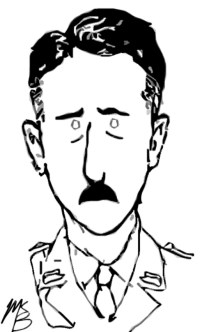
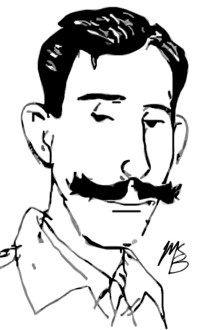
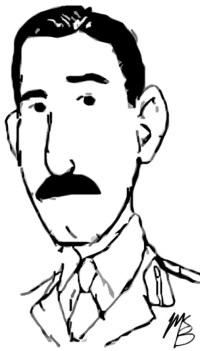
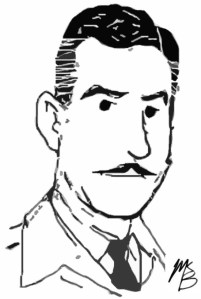
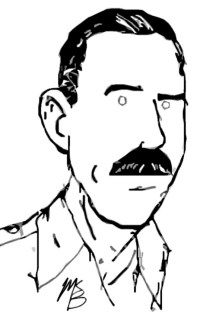
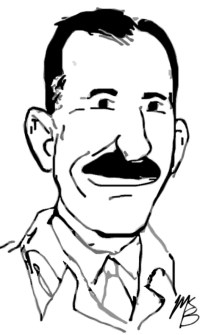
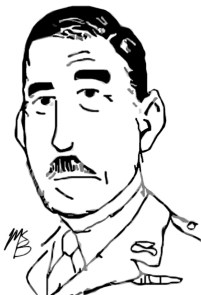
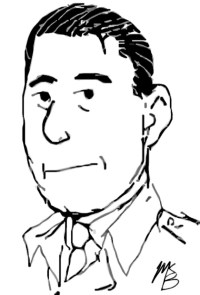
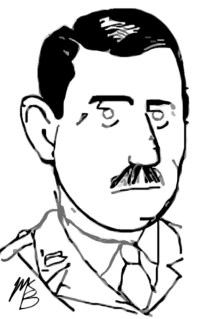
Maj. F.G.C. Darton

Major Frank Darton
Royal Canadian Regiment
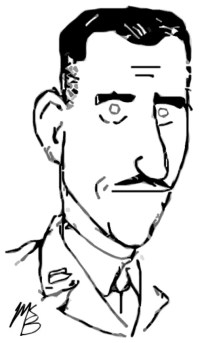
Darton

Frank is the best argument I know for those who doubt the quality of Canada’s peacetime soldiers as compared to the gallant amateurs they trained and led into battle.

(Rev. Rusty Wilkies quoted in G.W.S. Brodsky, God’s Dodger, 271)

Born in Kent, England on 29 November 1904, Frank Graham Chalklen Darton had been belonged to the RCR since 1922 and served as regimental sergeant-major on mobilization. Following instructional duties in Canada he received a commission and later a promotion to major overseas. He commanded the headquarters company and filled in as acting commanding officer of the regiment at times in the Italian theatre.
Continue reading

Lt-Col. W.W. Reid

Lieutenant-Colonel Bill Reid
Perth Regiment
Royal Canadian Regiment
ReidWW

Bill Reid proved to everyone in the regiment that he wasn’t the kind of battalion commander who directs his men from well out of the line of fire. He was up there on the crest, right in the thick of it with the rest … For his bold and determined leadership for the regiment’s unexcelled performance in the Gothic Line, Reid won for himself and the regiment the second highest battlefield award, the Distinguished Service Order. We were pretty damn proud of him, and pretty damn proud of ourselves too, for what we’d accomplished.

(Stanley Scislowski, Not All of Us Were Brave, 271)

Born in Charlottetown, PEI on 1 February 1913, William Wright Reid was an all-round sportsman and militia officer with the PEI Highlanders. He transferred to the Princess Louise Fusiliers in July 1942 to be second-in-command and succeeded Lieutenant-Colonel H.S. Robinson in July 1943. The motorized infantry battalion was then re-designated 11th Infy Bde Support Group which deployed to Italy alongside the 5th Armoured Division in late 1943.

Continue reading

Lt-Col. J.W. Ritchie

Lieutenant-Colonel Jim Ritchie
Royal Canadian Regiment
RitchieJW

I do hope that this miserable Canadian conscription business will not affect your fighting strength … the fighting on all our fronts looks pretty sticky just now … I have called you Jim because I feel that your father would wish it and because I have called practically every C.O. by their Christian name since I left the Regiment.

(Col. C.H. Hill to Ritchie, 4 Dec 1944)

Born in Toronto on 8 July 1908, James Weldon Ritchie was commissioned with the RCR in 1935 and served on the Royal Military College staff. After going overseas in 1941, he attended the War Staff College at Camberley, England and joined the Staff Officers Training School. Promoted to lieutenant-colonel in August 1943, he received an opportunity for frontline command in Italy when he replaced Lieutenant-Colonel W.W. Mathers of the RCR in June 1944.

Continue reading

Lt-Col. W.W. Mathers

Lieutenant-Colonel Bill Mathers
Royal Canadian Regiment
Mathers

… when Bill Mathers got wounded an amusing situation developed. Mathers was standing out in the open pointing here and there as he gave out some orders. Sandy cautioned him about snipers, but he took no notice. All of sudden, Wham! and he got the slug through the upper right arm. Fortunately he had just turned on his heel at the time or he would probably have got it through the heart.

(Strome Galloway, Some Died at Ortona, 193)

Born in New Westminster, British Columbia on 11 October 1910, William Whelan Mathers was a University of British Columbia graduate and Permanent Force officer, commissioned with the RCR in 1936. He went overseas with the regiment in December 1939 but immediately transferred to staff and instructional duties in England. Having belonged to the Officers’ Training Corps at UBC, Mathers became chief instructor at the Officer Cadet Training Unit (OCTU) in Camp Bordon, Sussex.

Continue reading

Maj. A.S.A. Galloway

Major Strome Galloway
Royal Canadian Regiment
Galloway

By then, many more Royal Canadians had learned how to die; but fortunately many others, including myself, had learned how to live—or at least how to reduce the odds on dying. Sicily wasn’t all death in the sun, but it was an adventure for all. For me, it was my second campaign. Except for the CO, whose untimely death removed him from the scene 14 days after the landing, I was the only member of the battalion who had been in a battle.

 (Strome Galloway, The General Who Never Was, 143)

An exceptionally courageous infantry officer, a prolific and opinionated writer, and a stylish moustache aficionado, Andrew Strome Ayers Carmichael Galloway was perhaps the most interesting and colourful character in the Canadian Army during the Second World War. Born in Humboldt, Saskatchewan, on 29 November 1915, he was a prewar militiaman, amateur poet, and newspaper editor. Having joined the RCR just before the start of the war, he went overseas in December 1939.

Continue reading

Maj-Gen. D.C. Spry

Major-General Dan Spry
Royal Canadian Regiment
1st & 12th Infantry Brigades
3rd Canadian Division

During the war, one of the big lessons I learned was that it was possible to bring together soldiers or sailors or airmen from every part of Canada, from every walk of life, every religion, every political viewpoint, and make them over into platoons, divisions, and corps, etc., and somehow or other, under proper leadership, they would fight as well as any other soldiers anywhere at any time. Perhaps we were all striving for something, some common objective.

(Maj-Gen. Spry to Boy Scouts’ Canadian General Council, June 1946)

Born in Winnipeg on 4 February 1913, Daniel Charles Spry was the son of a First World War colonel and the prewar army director of personnel. After dropping out of Dalhousie University, he followed his father in a Permanent Force career in 1933 and earned a commission in the RCR. On mobilization in September 1939, Spry was promoted captain and soon became the regimental adjutant. After two years in England, aside from the brief foray to France in June 1940, Spry left the RCR to the staff of 1st Canadian Division headquarters.

Continue reading

Maj. T.M. Powers

Major Tommy Powers
Royal Canadian Regiment

Lieutenant-Colonel Crowe and his party walked right into the enemy area. The Battalion Commander, a corporal and two privates were some distance ahead of the rest of the party when the Germans opened fire. Calling out “RCR,” Lieutenant-Colonel Crowe pressed on hoping to reach his troops. An enemy machine gun then opened fire and wounded him. He proceeded, however, to engage the enemy with a signaller’s rifle, but was killed by another enemy bullet.

 (Maj. T.M. Powers, “The RCR in Sicily,” 79)

Born in Saint John, New Brunswick on 28 October 1911, Thomas Millidge Powers graduated from RMC in 1933 and served in the RCMP marine section until September 1939, when he enlisted in the army. He was commissioned a lieutenant in the RCR, rising to the rank of major. Known in the battalion as “Pappy Powers,” he led the first company to land in Sicily on 10 July 1943.

Continue reading

Lt-Col. R.M. Crowe

Lieutenant-Colonel Ralph Crowe
Royal Canadian Regiment
Crowe

That evening, when our battalion rested, the CO, Ralph Crowe, another would-be Cavalier, with tears in his eyes reminded his senior subordinates that Billy’s [Major Pope] death should never have been; that it was an object lesson for all of us. We were not to expose ourselves needlessly. The Second-in-Command had no business stalking enemy armour and we, the company commanders, had even less business putting ourselves in positions of great danger when our men were supposed to be properly led by the sound application of our tactical training and by accepted techniques of command and control. He was so very right.

(Strome Galloway, The General Who Never Was, 142)

Born on 2 October 1911 in Guelph, Ontario, Ralph Marston Crowe was an instructor at the Royal Military College, having also graduated there in 1933. He was commissioned in the RCR and served two years with the Indian Army on the Northwest frontier in 1936-37. He left the staff of RMC to go overseas in December 1939. Following a posting to the 1st Canadian Division headquarters, in February 1940, he transferred to the Hastings and Prince Edward Regiment as a major.

Continue reading

Brig. T.E. Snow

Brigadier T. Eric Snow
Royal Canadian Regiment
11th Infantry Brigade
Snow

Under no circumstances must I nag or hound my Bn. Comds while they are conducting their battle even though I am being pressed by my own comd … To hound Bn. Comds when they are doing their best and things are going well will only cause disorganization and perhaps adversely affect the results of the battle.

(Brig. Snow, 11 Cdn Inf Bde Report on the Battle of the Liri Valley, May 1944)

Born on 15 January 1905 in Kimberley, South Africa, Thomas Eric D’Oyly Snow was the son of a British Army officer who emigrated to Canada in 1907. The family settled in New Brunswick and Snow followed his father in an army career. He joined the St. John Fusiliers and qualified as a lieutenant in 1924. With fifteen years in the Permanent Force, he went overseas with the RCR in December 1939. Following the brief service in France in June 1940, Snow held an equally brief temporary command of the regiment from 21 October to 30 November 1940.

Continue reading

Lt-Col. M.K. Greene

Lieutenant-Colonel M.K. Greene
Royal Canadian Regiment
Greene

Now, after only two months of being commanded by Murray Green [sic], it had slipped badly and discipline was suffering. Green did not appear to be interested in the welfare of the men. I told the General that, according to reports from the Regiment, Murray Green went up to London almost every night, leaving his driver outside in the army station wagon during the air raids, and did not leave London until about 2:00 am.

(Kitching, Mud and Green Fields, 107)

Born in Montreal on 17 February 1888, Murray Kirk Greene was an RMC graduate, First World War veteran, and former commanding officer of the RCR from 1935 to 1938. He had been commissioned in the Permanent Force in 1910 and served as a staff officer during the war. He relinquished command of the RCR to Lieutenant-Colonel K.M. Holloway on appointment to Military District No. 13. In this position he organized mobilization efforts in Alberta at the start of the Second World War.

Continue reading