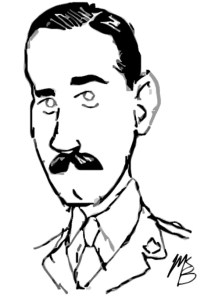
Lt-Col. S.M. Lett

Lieutenant-Colonel Steve Lett
Queen’s Own Rifles

Sleep is the thing we run short of most. The actual fighting isn’t so bad … we can all take that … but it’s being in before your own guns that’s tough. When they fire—and they’re firing a lot of the time—they practically blow you our of your own slit trenches. That’s not conducive to sleep, this moaning, whining and roaring which at times never ends. But the lads are in good spirits.

(Quoted in Toronto Star, 14 Jul 1944, 2)

Born on 27 July 1909 in Cobourg, Ontario, Stephen MacLeod Lett worked in the lumber industry in Toronto and Northern Ontario. He served as second-in-command of the Queen’s Own Rifles at D-Day and succeeded Lieutenant-Colonel Jock Spragge on his promotion to brigadier at the end of August 1944. He would be one of the few infantry commanding officers to remain in command through the latter phase of the Northwest Europe campaign from the end of the Normandy operation to the surrender of Germany.
Continue reading

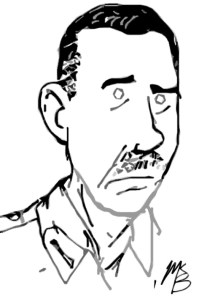
Brig. J.G. Spragge

Brigadier Jock Spragge
Queen’s Own Rifles
7th Infantry Brigade

Then I saw it was the Colonel. I gave him plain hell … I told him he should be back at Battalion HQ, not up at the front with us—the last line between our forces and the enemy. He was too good and too necessary to be killed or wounded … [he] said ‘Charlie, it’s such a sad day. We’ve lost so many good me.’ He said goodnight and turned away, but not before I saw the tears in his eyes. Jock Spragge was all man. He was not one of the spit’n’polish professional types, but as a fighter he was the best.

(C.C. Martin, Battle Diary, 15-16)

Born on 20 May 1907 in Ottawa, John Godfrey Spragge was a sportsman, former Toronto banker, industrialist, and businessman in London, Ontario. He had joined the Queen’s Own Rifles as a private in 1925 and took a commission a year later. He returned to Toronto with the outbreak of the war when the regiment mobilized for active service. Before the QOR went overseas in July 1941, Spragge became second-in-command and succeeded Lieutenant-Colonel Harry Mackendrick in April 1942.

Continue reading

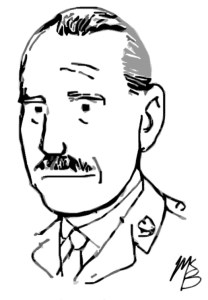
Lt-Col. H.C. Mackendrick

Lieutenant-Colonel Harry Mackendrick
Queen’s Own Rifles

This Officer was gassed with enemy gas while in support near Lens at 2 am on 5.9.17. He suffered from vomiting, blepharitis & conjunctivitis, sore throat, constriction of chest & cough … Sleep is greatly disturbed, waking with terrors; is nervous & has trembling spells & slight tremor.

(Personnel file, medical report, 1917)

Born on 30 August 1895 in Galt, Ontario, Harry Crane Mackendrick was a University of Toronto graduate and First World War veteran. He was commissioned with the UofT officer training corps and joined the 111th Battalion in January 1916. He went to France as a reinforcement officer for the 4th Battalion but suffered mustard gas burns in September 1917. He was admitted to a casualty clearing station where his father, a doctor attached to with the Royal Army Medical Corps, happened to be stationed.

Continue reading

Lt-Col. I.M. Macdonell

Lieutenant-Colonel Ian Macdonell
Queen’s Own Rifles

I don’t propose to be an alarmist … we must admit there is no point in us being ostriches. We are not preparing for what the Germans might do but for what we know they can do. Until we get organized there is no use in even giving an alarm, for nothing can be done.

(Kingston Whig-Standard, 29 Apr 1943, 2)

Born on 8 August 1895 in Toronto, Ian McLean Macdonell was a lawyer, former city alderman, and judge of the County Court of York. He was commissioned with the 41st Battery in December 1915 and deployed to France with the 11th Brigade, Canadian Field Artillery in July 1916. He was wounded in December 1917 and ended the war as staff captain with the 1st Canadian Division. He began a law practice in Toronto in 1920 and joined the Queen’s Own Rifles. After rising through the commissioned ranks, became commanding officer in April 1939.

Continue reading