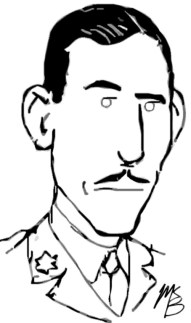
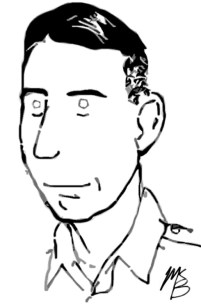
Lt-Col. M.W. Andrew

Lieutenant-Colonel M.W. Andrew
Perth Regiment
Andrew

This trial is unique in the history of British law. Brigadeführer Kurt Meyer, Commander of the 12th SS Panzer Division, and at one time Commander of the 25th Panzer Grenadier Regiment, appears before you on five charges under the War Crimes Regulations, Canada, upon any one of which, if convicted, he may suffer death or such less punishment as set out in the Regulations, as this Court may deem proper to pass upon him.

(Andrew defence summation, Trial of Kurt Meter, Dec 1945)

Born in Kitchener, Ontario 28 December 1904, Maurice William Andrew was a University of Toronto graduate and Stratford lawyer, having been called to the Bar in 1931. As a prewar captain in the Perth Regiment, he assumed recruiting duties on mobilization in September 1939. Overseas, he served as second-in-command under four different commanding officers before taking over the regiment during the Italian campaign. He would be most notable as the defence counsel assigned to Kurt Meyer during his war crime trial for his role in the murder of Canadian prisoners-of-war in the Ardenne Abbey massacre.
Continue reading

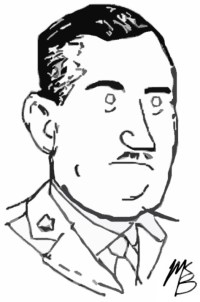
Lt-Col. W.S. Rutherford

Lieutenant-Colonel W.S. Rutherford
Stormont, Dundas and Glengarry Highlanders
Perth Regiment
Rutherford

The first act was a burlesque skit, most certainly not appropriate for Christmas, in which a bid randy lumberjack in this case none other than Lieutenant-Colonel Rutherford himself, rode into town to get himself laid. And who would his ravishing partner be but none other than the best female impersonator in the whole damn Canadian Army … As for the skit, it really wasn’t all that much in the way of a professional burlesque, or acting ability, but it sure did bring on the laughs.

(Stanley Scislowski, Not All of Us Were Brave, 101)

Born in Toronto on 26 September 1907, William Samuel Rutherford was a University of Toronto graduate, Shell Oil employee, and militia officer with the Toronto Scottish Regiment since 1929. He went overseas in December 1939 but returned to Canada later the next year when posted to the 9th Infantry Brigade as brigade major. The brigade, as part of the 3rd Canadian Division, departed for the United Kingdom in July 1941. By the end of the year Rutherford had become acting general staff officer with the division.

Continue reading

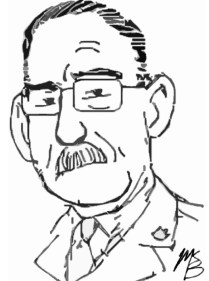
Lt-Col. H.E.T. Doucet

Lieutenant-Colonel Pot Doucet
Perth Regiment
Doucet

Immediately on the Canadian Army becoming operational, we began to get briefings twice a day at H.Q. about progress of the fighting on our own front and the other Allied fronts in France. Our briefing officer was Lieutenant-Colonel H.E.T. (“Pot”) Doucet of Montreal. “Pot” Doucet was the most able briefing officer any correspondents had helping them in France. Personally I have never known a better one anywhere.

(Ross Munro, Gauntlet to Overlord, 68)

Born in Montreal in 1907, Herbert Emile Theodore Pothier (Pot) Doucet was an engineer, Royal Military College graduate and militia officer with Royal Highlanders of Canada (The Black Watch) since 1929. He attended the staff college at Camberley, England in 1940 before returning as tactics instructor at RMC. He went overseas in October 1942 to serve as brigade major with the 1st Infantry Brigade.

Continue reading

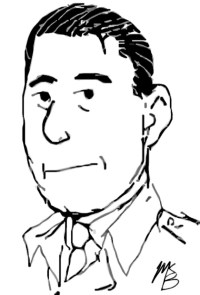
Brig. J.S.H. Lind

Brigadier J.S.H. Lind
Perth Regiment
12th Infantry Brigade

… one of the figures in the lead carrier was none other than the CO himself, Lieutenant-Colonel Lind. That a man of his rank should be right up at the sharp end was a welcome surprise … Later when we were in Army Reserve at Caiazzo, he had pinned to his tunic, the medal and ribbon of the [D.S.O.]. awarded for his leadership of the regiment in this action. In effect, we the ordinary guys in the ranks won it for him. But what was there for us to show for these efforts? Not a damn thing!

(Stanley Scislowski, Not All of Us Were Brave, 220)

Born in Owen Sound, Ontario on 17 November 1908, John Skiffington Heming Lind was a cement company executive and member of the St. Marys town council. A graduate of the Royal Military College, he had belonged to the militia since 1932. He relinquished his position as second-in-command of the Perth Regiment to attend the staff college at Camberley, England in 1940. By the time the regiment departed for England, Lind had been appointed a brigade major overseas.

Continue reading

Lt-Col. G.W. Little

Lieutenant-Colonel G. W. Little
Princess Patricia’s Canadian Light Infantry
Perth Regiment
Little GW

My Brigadier, the son of a bitch, is still alive— I’ll kill him.

(G. W. Little on Brig. Gen. J. A. Clark, CBC Interview, 1964)

George Wilfrid Little was born on 1 November 1891 in London, Ontario. A graduate of University of Toronto and Western University, he originally enlisted with 5th University Company as a lieutenant in December 1916 before transferring to the PPCLI on the Western Front. Promoted to captain in August 1917, he became acting commanding officer on 28 September 1918 when all senior ranks had been put out of action.

Continue reading

Lt-Col. S.H. McComb

Lieutenant-Colonel S.H. McComb
Perth Regiment
McCombe

He had served during most of the Great War, and wanted to go again. Hadn’t he gone over with the “Old 34th” as a buck private, and hadn’t he earned promotions in the field, until he returned on demobilization with a commission?

(Windsor Star, 6 Jun 1940, 28)

Born on 29 August 1891 in Palmerston, Ontario, Samuel Herbert McComb was a brakeman for the Canadian National Railway and a First World War veteran. He enlisted with the 18th Battalion, which deployed to France in September 1915 and suffered shell shock at the Somme in 1916. He took a commission in the Perth Regiment after the war, rising to the rank of major.

Continue reading

Lt-Col. W.W. Reid

Lieutenant-Colonel Bill Reid
Perth Regiment
Royal Canadian Regiment
ReidWW

Bill Reid proved to everyone in the regiment that he wasn’t the kind of battalion commander who directs his men from well out of the line of fire. He was up there on the crest, right in the thick of it with the rest … For his bold and determined leadership for the regiment’s unexcelled performance in the Gothic Line, Reid won for himself and the regiment the second highest battlefield award, the Distinguished Service Order. We were pretty damn proud of him, and pretty damn proud of ourselves too, for what we’d accomplished.

(Stanley Scislowski, Not All of Us Were Brave, 271)

Born in Charlottetown, PEI on 1 February 1913, William Wright Reid was an all-round sportsman and militia officer with the PEI Highlanders. He transferred to the Princess Louise Fusiliers in July 1942 to be second-in-command and succeeded Lieutenant-Colonel H.S. Robinson in July 1943. The motorized infantry battalion was then re-designated 11th Infy Bde Support Group which deployed to Italy alongside the 5th Armoured Division in late 1943.

Continue reading