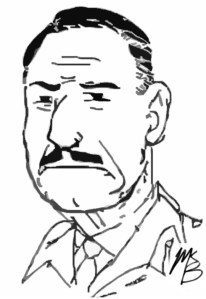
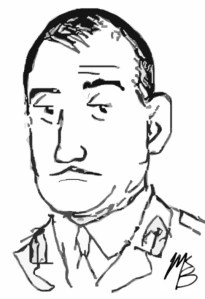
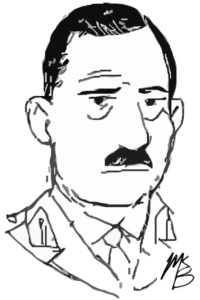
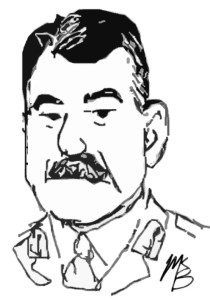
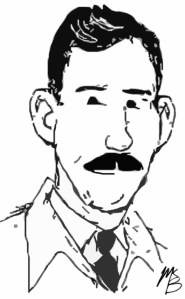
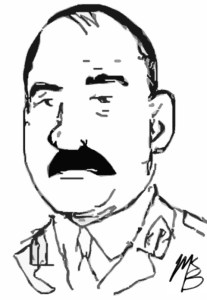
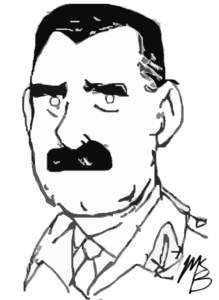
Brig. H.A. Young

Brigadier Hugh Young
6th Infantry Brigade
I have only been on the ranges twice and have never had a musketry course. Previous to enlisting I was going to high school in Winnipeg. I have always lived in the city and had no experience whatever with firearms. This was my first trip in the line and I was very nervous, being anxious to conduct myself properly. Thus, in the hurry and excitement of an ordered stand to, I had the accident … I deeply regret the accident.

(FGCM of Pte. H.A. Young, 27 Feb 1918)

Born on 3 April 1898 in Winnipeg, Hugh Andrew Young enlisted in the 251st Battalion in November 1916 and joined the 44th Battalion on the front in January 1918. Within two months, he was court martialled for negligently wounding a comrade, Private Ralph Thorpe, who died weeks later. Although his platoon sergeant testified that the shooting was “purely accidental” when Young was cleaning his rifle, the nineteen-year-old was sentenced to forty-two days field punishment No. 1.
Continue reading

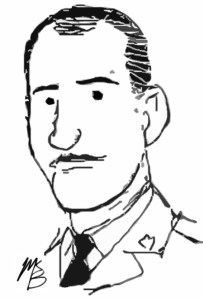
Brig. R.A. Wyman

Brigadier Bob Wyman
1st & 2nd Armoured Brigades

Everything I have seen since I have arrived home gives new reason for this fight. There is freedom here and greener fields and even fatter cattle. You notice these things after being in Britain and they are not imaginary. They are the things we hold dear and things that most Britons cannot enjoy under war conditions.

(Quoted in Edmonton Journal, 18 Jun 1941, 1)

Born to Canadian parents in Philadelphia on 23 February 1904, Robert Andrew Wyman was a Canadian Nation Railway statistician in Edmonton and a militia officer since 1923. He mobilized as commanding officer of an artillery regiment and went overseas with the 1st Canadian Division in December 1939. After a promotion to brigadier in May 1941, he returned to Canada to organize the 1st Canadian Support Group.

Continue reading

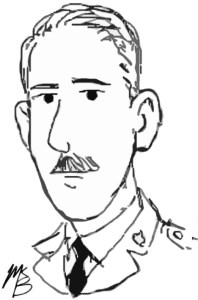
Lt-Gen. C. Foulkes

Lieutenant-General Charlie Foulkes
3rd Infantry Brigade
2nd Canadian Division
II Canadian Corps

I have come to the conclusion that attempts to limit the use of force by banning certain types of weapons or by partial disarmament including all types of nuclear weapons, does not appear to be the right answer to this dilemma. I take issue with those who say let us go back to conventional weapons, as if it was all right to settle disputes by conventional means when only soldiery get killed but the world is saved from destruction.

(National Post, 9 Mar 1963, 6)

Born on 3 January 1903 in Stockton-on-Tees, England, Charles Foulkes grew up in London, Ontario and joined the Royal Canadian Regiment after graduating from Western University in 1926. Following staff posts to militia district headquarters in Toronto and Kingston, he attended staff college at Camberley, England. At the outbreak of war in 1939, he was appointed brigade major when the 1st Division went overseas in December 1939. By September 1940, he was back in Canada as general staff officer for the newly formed 3rd Canadian Division.

Continue reading

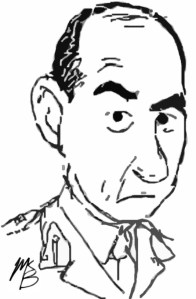
Lt-Gen. E.L.M. Burns

Lieutenant-General Tommy Burns
4th Armoured Brigade
2nd & 5th Canadian Divisions
II
Canadian Corps

Having thus confronted death, and learned that its presence does not paralyze, and having known that while fear may clutch, it does not necessarily strangle, I feel that I am a happier man. I reason (perhaps fatuously), What am I likely to experience that will be harder to bear than that which I have borne?

(Arlington B. Conway, “In Praise of War,” 1927, 391)

Born in Montreal on 17 June 1897, Eedson Louis Millard Burns graduated from the Royal Military College in 1914 and took a commission in the Canadian Engineers. He served as a staff officer in the 3rd Division in France where he was twice wounded and earned the Military Cross. In the 1920s, he worked as an instructor at RMC while continuing his own professional staff officer education. During the interwar, he wrote several articles on military science and defence issues as well as contributions to American Mercury under a pen name, “Arlington B. Conway.”

Continue reading

Lt-Gen. E.W. Sansom

Lieutenant-General E.W. Sansom
3rd & 5th Canadian Divisions
II Canadian Corps

We’ve all seen those supposedly terrifying pictures of grim German soldiers. We can beat those unsmiling automatons. We are going to lick them with cheerful young Canadians, quick thinking lads who know how to take it. The accent is on youth.

(Quoted in Star Weekly, 18 Oct 1941, 28)

Born on 18 December 1890 in New Brunswick, Ernest William Sansom was a First World War veteran and professional army officer. Serving in the Canadian Machine Gun Corps, and earning the D.S.O., he commanded the 2nd Battalion for the final month of the war and then the 1st Battalion until demobilization in 1919. He joined the Permanent Force in 1920 and by the start of the Second World War was director of military training.

Continue reading

Brig. M.H.S. Penhale

Brigadier Matthew Penhale
4th & 3rd Infantry Brigades

[On nuclear attack] Surely it is better to tell the people everything than to withhold information they must have to ensure survival.

(Quoted in Star-Phoenix, 16 Jan 1960, 5)

Born in Sherbrooke, Quebec on 13 February 1895, Matthew Howard Somers Penhale enlisted with the Royal Canadian Horse Artillery in 1915 after graduation from RMC. He was wounded at Cambrai in 1917 and made a professional career in the army after the First World War. After the outbreak of war in 1939, Penhale served as assistant adjunct general of Canadian Military headquarters in London before returning to Canada to head the directorate of staff duties at National Defence Headquarters.

Continue reading

Maj-Gen. J.H. Roberts

Major-General Ham Roberts
1st Infantry Brigade
2nd Canadian Division

I consider Dieppe was well worthwhile, as we learned a lot about what not to do. Out later successful landings in North Africa, Italy, etc. could scarcely have been carried out without it. Had we been allowed to have two old battleships or cruisers, Dieppe might have been a very different story.

(Quoted in Brantford Expositor, 17 Dec 1962, 1)

Born in Pipestone, Manitoba on 21 December 1891, John Hamilton Roberts was an RMC graduate, First World War veteran, and long-serving artillery officer. He was commissioned with the Royal Canadian Horse Artillery in August 1915 and went to France two months later. He earned the Military Cross and was wounded in March 1918. After the outbreak of the Second World War, he was appointed commanding officer of 1st Field Regiment, RCA.

Continue reading

Maj. J.P. Gauthier

Major Jean Gauthier
Royal Canadian Dragoons

By his quick decisions, initiative and skillful handling of his Sqn he achieved results against the enemy in captured materials and prisoners of war out of all proportion to the size of his own forces. His personal bravery, determination and devotion to duty was an inspiring example to his men enabling them to secure a key objective to permit the regiment to advance with all possible speed.

(D.S.O. citation, 13 May 1945)

Born in Montreal on 21 March 1917, Jean Prosper Gautier enlisted for active service in 1940 and rose to be squadron commander in the Royal Canadian Dragoons. It served as the armoured car regiment for I Canadian Corps before a reorganization of the formation in July 1944. The RCD was attached to 1st Canadian Division as the reconnaissance regiment in the place of the Princess Louise Dragoon Guards which had converted to infantry with the 12th Brigade, 5th Division.

Continue reading

Lt-Col. J.N. Medhurst

Lieutenant-Colonel Jim Medhurst
New Brunswick Rangers
4th Battalion, Queen’s Own Rifles

During the operations October 21st to October 27th 1917. For bravery, endurance and control of the men during six days of very hard fighting. His work was invaluable. Ge continually visited all the forward posts, even during the most intense phases of the enemy bombardment, cheering the men and steadying them to resist the enemy counter attack which was to follow.

(M.M. citation, 30 Nov 1917)

Born on 26 July 1899 in Toronto, James Nahor Medhurst was a First World War veteran and militia staff officer. Although only 15, as a Queen’s Own Rifles cadet, he had lied about his age to enlist in the 20th Battalion in April 1915. He was wounded after Vimy Ridge in May 1917 and then joined the Royal Canadian Dragoons. Medhurst received a militia commission in 1925. By the start of the Second World War, he served as general staff officer at Military District No. 2 in Toronto and then transferred to Atlantic Command in 1940.

Continue reading

Lt-Col. T.B. Nash

Lieutenant-Colonel Darby Nash
29th Armoured Regiment (South Alberta Regiment)

Westerners have more initiative than easterners and it shows up on the battlefield.

(Edmonton Bulletin, 19 Jan 1946)

Born in Montreal on 23 December 1909, Thomas Boyd “Darby” Nash was a land inspector for the National Trust Company in Edmonton. A prewar member of the 19th Dragoons, he mobilized for active service with the South Alberta Regiment in 1940 and went overseas in August 1942. During the Falaise campaign, he served as HQ Squadron commander until August 1944, when he took over “B” Squadron from Major R.A. Bradburn, who had been appointed to command the Algonquin Regiment.

Continue reading