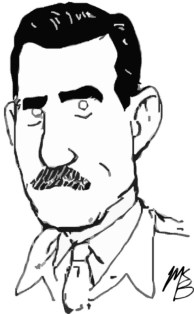
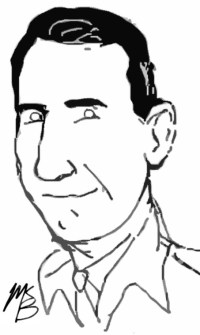
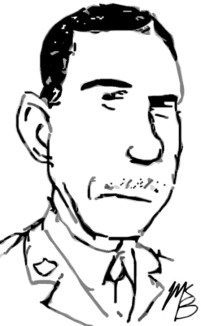
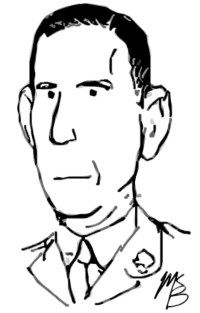
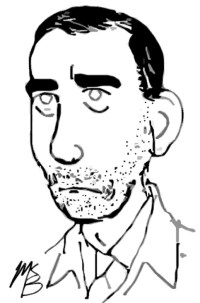
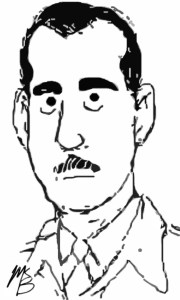
Brig. I.H. Cumberland

Brigadier I.H. Cumberland
Governor General’s Horse Guards
5th Armoured Brigade
Cumberland

Swotty is one of those quiet unassuming lads who always seem to get there–where? oh, always near the top when exam results come out … It seems that Swotty was born with a rifle in his hands, for he is an excellent shot.

(RMC Yearbook, 1927, 34)

Born on 10 July 1906 in Port Hope, Ontario, Ian Hugh Cumberland (Wotherspoon) was an RMC graduate, businessman, and member of the Governor General’s Horse Guards since 1927. He had his name legally changed in the 1930s, dropping his father’s surname Wotherspoon. Following mobilization, he first served as adjutant with the GGHG and then second-in-command when the now redesignated 3rd Armoured Regiment when overseas in October 1941.
Continue reading

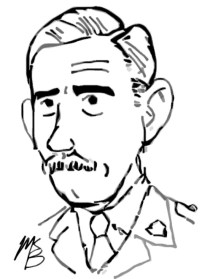
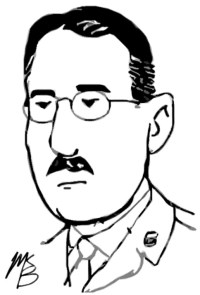
Lt-Cols. R.P. Locke & H.M. Sharp

Lieutenant-Colonel R.P. Locke
Locke
&
Lieutenant-Colonel H.M. Sharp
Governor General’s Horse Guards
SharpHM

We have lost a man of wide experience and sympathy, a good soldier and a man and have gained a worthy successor. There is one human touch to be noted: just as soon as the C.O., his 2 i/c and adjutant had passed the saluting base, Col. Locke half turned to Maj. Sharp and said “It’s all yours now, Buff” and from then on we were Buff Sharp’s command.

(GGHG war diary, 28 Sept 1941)

Born on September 2 November 1888 in Sarnia, Ontario, Russell Pierce Locke was a Toronto barrister commissioned with the Canadian Army Service Corps during the First World War. He served with the Fort Garry Horse in France just before the armistice. In April 1939, he took command of the Governor General’s Horse Guards, which mobilized as the 2nd Motorcycle Regiment in July 1940. By February 1941 it had been converted to the 3rd Armoured Regiment.

Continue reading

Lt-Col. C. Petch

Lieutenant-Colonel Charlie Petch
North Nova Scotia Highlanders
4th Princess Louise Dragoon Guards

France was tough from D-Day for a couple of months. Tough as you know what. But it was not Italy. Italy was a different show. In France we had the armor and the transport and the men and power. We drove and conquered. But in Italy it was a case of bracing the enemy and then when he gave, driving through.

(Ottawa Citizen, 4 Oct 1945, 13)

Born on 18 December 1904 in Manchester, Lancashire, England, Charles Petch came to Canada with his family as an infant. He graduated with a degree in commerce from McGill University and worked as an investment banker while also a militia officer with The Black Watch. He transferred to the 8th Reconnaissance Regiment as second-in-command in 1941. Following a series of promotions and senior officer courses, he was appointed commanding officer of the North Nova Scotia Highlanders in September 1942.

Continue reading

Lt-Col. W.W.D. Darling

Lieutenant-Colonel Bill Darling
4th Princess Louise Dragoon Guards
Darling

Little can be said about the C.O. that would do justice to a great leader, a wonderful Colonel. Certainly his departure leaves a gaping wound in our hearts, that nothing can ever heal. The C.O. had been with this Regt ever since its conception, and had come up through the various ranks until he became the Commanding Officer, and led this Regiment in all of its battles as an Infantry Unit.

(PLDG war diary, 8 Dec 1944)

Born on 19 April 1906 in Toronto, Warren William Gibson Darling was the son of the former commanding officer of the 48th Highlanders and joined the regiment himself in 1929. He went overseas in December 1939 and participated in the regiment’s short-lived deployment to France in June 1940. Darling helped to commandeer the French train which allowed the Canadians to escape German encirclement and return back to England.

Continue reading

Lt-Col. F.D. Adams

Lieutenant-Colonel Fred Adams
4th Princess Louise Dragoon Guards
AdamsFD

The manner in which Lt.-Col. Adams handled his Regiment in this very difficult operation is worthy of the highest praise and had a large share in the success achieved by the operations of 22 and 23 May when the defences were breached and further advance made possible.

(D.S.O. citation, 20 Jul 1944)

Born on 16 June 1907 in Calgary, Fred Dean Adams belonged to the Calgary (Tank) Regiment before the war, transferred to the Calgary Highlanders on mobilization then the Edmonton Regiment, and became second-in-command of the 4th Princess Louise Dragoon Guards in January 1941. He succeeded Lieutenant-Colonel Harry Foster of the re-designated 4th Reconnaissance Battalion on his appointment to general staff of the 1st Canadian Division in August 1942.

Continue reading

Maj-Gen. H.W. Foster

Major-General Harry Foster
4th Princess Louise Dragoon Guards
Highland Light Infantry of Canada
13th & 7th Infantry Brigades
4th & 1st Canadian Divisions
Foster

He was just as guilty of murder as I was at the time … or any other senior officer in the field during a battle. The difference between us was that I was on the winning side. That makes a big difference.

— Gen. Foster on Kurt Meyer

(Quoted in Tony Foster, Meeting of Generals, 1988)

Born on 2 April 1904 in Halifax, Nova Scotia, Harry Wickwire Foster left Royal Military College the in 1924 to take a commission with the Lord Strathcona’s Horse. His father, Major-General Gilbert Lafayette Foster, had been director of medical services for the Canadian army during the First World War. With the outbreak of Second World War in September 1939, Foster was appointed brigade major of the 1st Canadian Brigade in England.

Continue reading

Lt-Col. W.H. Buchanan

Lieutenant-Colonel Bill Buchanan
Lanark and Renfrew Scottish
BuchananWH

Give them our best wishes and tell them that this famous old Regiment has been revived again in a new blaze of glory and every time we look at the new shoulder flash we will think of the wonderful example of courage they showed. Everybody has heard of the Lanark and Renfrews now and are greatly interested in the new flash because of the way the boys put it right on the map of the world again.”

(Buchanan quoted by Padre C.M. MacLean, 15 Jan 1945)

In July 1944, Allied military leaders in Italy had decided to add a new infantry brigade to the 5th Armoured Division in addition to the 11th Infantry Brigade. The 1st Canadian Light Anti-Aircraft Regiment converted from artillery to infantry as part of the newly formed 12th Infantry Brigade under Major-General Dan Spry. At the end of August 1944, Major William Herbert Buchanan transferred from the Seaforth Highlanders to become second-in-command to Lieutenant-Colonel W.C. Dick, the officer assigned to reorganize the anti-aircraft unit. Born on 5 August 1913 in Medicine Hat, Alberta, Buchanan was a fireman who had originally joined the Calgary Highlanders.

Continue reading

Lt-Col. W.C. Dick

Lieutenant-Colonel W.C. Dick
Lanark and Renfrew Scottish
Dick

By his untiring efforts he obtained the necessary extra officers from infantry units throughout the Corps, personally selected all key personnel from the reinforcement unit and arranged special training for the unit’s reinforcements … The organization and training of a Battalion in forty-one days, in addition to services previously mentioned, adequately demonstrate qualities which are deserving of the highest recognition.

 (O.B.E. citation, 28 Apr 1945)

In July 1944, Allied military leaders in Italy decided that the 5th Armoured Division required additional infantry regiments beyond the 11th Infantry Brigade. As the Allies had achieved air superiority, the 1st Canadian Light Anti-Aircraft Regiment was converted from artillery to infantry as part of the newly formed 12th Infantry Brigade. On 20 July, Lieutenant-Colonel William Clement Dick arrived as replacement for Lieutenant-Colonel F.J. Thorne. Born on 10 December 1912 in Toronto, Dick had fought at Dieppe and briefly served as brigade major for the 2nd Canadian Infantry Brigade in Italy.

Continue reading

Lt-Col. G.C. Corbould

Lieutenant-Colonel Gordon Corbould
Westminster Regiment
Corbould

Lt.-Col. Corbould was chief umpire for the army-air force scheme … “Someone has to run a show like this,” Lt.-Col. Corbould remarked dourly. “Otherwise it becomes just another game of cowboys and Indians, with people running around shouting ‘Bang! You’re dead!.’”

(Edmonton Journal, 15 Feb 1958, 23)

Born on 2 June 1909 in New Westminster, British Columbia, Gordon Charleson Corbould became the fourth generation of his family to hold the rank of colonel in the Canadian Army. A member of the militia since 1927, he went overseas as a lieutenant with the Westminster Regiment in 1941. He later transferred to the Irish Regiment as second-in-command under fellow British Columbian Lieutenant-Colonel R.C. Clark.

Continue reading

Lt-Col. R.L. Tindall

Lieutenant-Colonel R.L. Tindall
The Perth Regiment
Westminster Regiment

Considering this officer’s age, I do not believe that he would be able to command a motor battalion successfully under the conditions of intense and prolonged strain involved in mobile operations of an armd formation.

(Confidential report by Maj-Gen. E.L.M. Burns, 5 Feb 1944)

Born on 28 September 1899 in Lennoxville Quebec, Ralph Lockhart Tindall had enlisted as a sixteen-year-old in April 1917 and transferred to the Boy’s Battalion once overseas. By 1918, he had joined the Royal Air Force and was appointed flight cadet a month before the armistice. Back in civilian life, he took out a patent on an early automobile turn signal device and started work for the Imperial Tobacco Company in Montreal in 1932. Commissioned with the Royal Canadian Hussars since 1932, he became second-in-command of the Perth Regiment after mobilization in 1940.

Continue reading