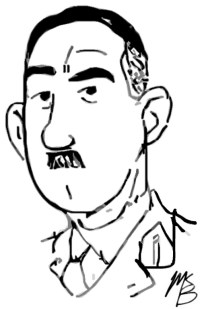
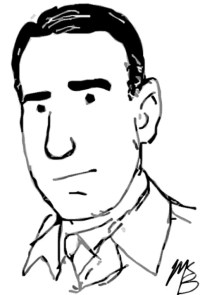
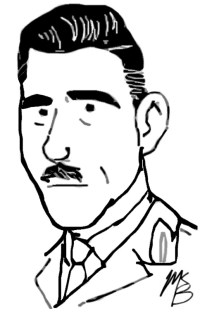
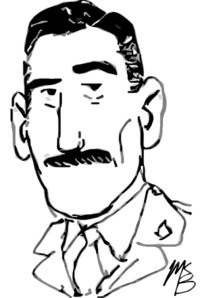
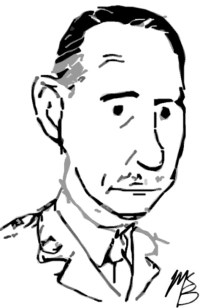
Lt-Col. W.D. Brooks

Lieutenant-Colonel W.D. Brooks
6th Armoured (1st Hussars) Regiment

Major Brooks displayed outstanding leadership and inspiration to his squadron and is responsible for having placed a large proportion of his special assault tanks on the beach despite all hazards of weather, beach obstacles and enemy action. He immediately attacked the beach defences with great courage and skill which made it possible for the assault infantry to land on the beach and go forward to gain their objectives.

(D.S.O. citation, 31 Aug 1944)

Born on 2 June 1908 in Brantford, Ontario, William Dudley Brooks commanded “A” squadron of the 1st Hussars on D-Day. Launching experimental DD or Duplex Drive tanks proved a serious challenge for the squadron under difficult weather conditions and rough seas. Despite a late landing and several sunk tanks, Brooks directed seven DD tanks in support of the Royal Winnipeg Rifles, earning a D.S.O.: “The action and leadership of this officer largely influenced the success of the assault landing and the gaining of the beach head.”
Continue reading

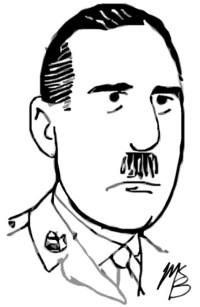
Lt-Col. F.E. White

Lieutenant-Colonel Frank White
6th Armoured (1st Hussars) Regiment
White

When he landed on the beach on D-day between Courseulles-sur-Mer and Bernières-sur-Mer no exits had been completed and the beach was under heavy enemy mortar and machine gun fire and traffic was piling up. He got out of his tank and walked calmly up and down the beach endeavouring to find an exit. His example of complete coolness at that critical time was an inspiration to the officers and men of the regiment. His actions since D-day have continued to be outstanding to the highest degree.

(D.S.O. citation, 19 Apr 1945)

Born on 24 May 1909 in St-Faustin, Quebec, Franklyn Everhart White was the son of General John Burton White, head of the Canadian Forestry Corps. In the last war the elder White had commanded the 242nd Battalion and then served as Director of Timber Operations in the Canadian Forestry Corps. Following his father’s military service, Frank White graduated from RMC and joined the Permanent Force, taking a commission with the Lord Strathcona’s Horse in Winnipeg.

Continue reading

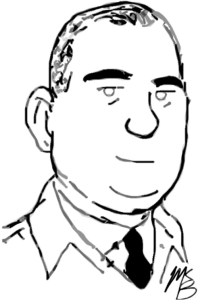
Lt-Col. R.J. Colwell

Lieutenant-Colonel Ray Colwell
Halifax Rifles
6th Armoured (1st Hussars) Regiment
Colwell

During this action Lt-Col Colwell organized and fought his Regiment with great determination and courage. His own tank was shot from under him, so he continued to direct from on foot … By his courage and determination he set an excellent example to all rank and fostered the fighting spirit of his Regiment.

(D.S.O. citation, 12 Jul 1944)

Born on 11 August 1899 in Halifax, Nova Scotia, Ray John Colwell was a businessman, retail clothier, and a former rugby and hockey player. He had joined the Halifax Rifles in 1917 and during the final stage of the First World War went to France just after the armistice as a lieutenant in the Canadian Machine Gun Corps. As commanding officer of the Halifax Rifles in September 1939, Colwell organized the mobilization of the regiment, and remained in command almost the next four years.

Continue reading

Lt-Col. R.H.F. Back

Lieutenant-Colonel R.H.F. Back
6th Armoured (1st Hussars) Regiment
Back

We’re playing for keeps and we have to be a crack outfit. We know what those German panzers can do and we’ve been training ourselves accordingly. I’ve been to England. I’ve seen the Canadian troops in England and I would say this armored division won’t take second place to any of them.

(Ottawa Citizen, 24 Nov 1941, 24)

Born in London, Ontario on 27 May 1905, Ronald Henry Franklin Back was commissioned in the 1st Hussars in 1927 and promoted to major in 1938. After a six month attachment to the British Armoured Corps for training, he returned to Canada in March 1941. The next month he assumed command of the 6th Armoured Regiment, which had been redesignated from the 1st Hussars. He replaced Lieutenant-Colonel A.C. Spender on his promotion to command the 2nd Army Tank Brigade.

Continue reading

Brig. A.C. Spencer

Brigadier A.C. Spencer
1st Canadian Cavalry (1st Hussars) Regiment
2nd Army Tank Brigade
Spencer

This officer has made a noteworthy contribution in the development and administration of this large camp and particularly in training of Armoured Corps personnel. His services in all regards have been outstanding and he is worthy of high recognition.

(C.M.E. citation, 10 Jun 1944)

Born in London, Ontario on 19 November 1887, Alexander Charles Spencer was a mechanical engineer who had been commissioned in the 1st Hussars in 1911. In the Frist World War, he enlisted with the 7th Canadian Mounted Rifles as a lieutenant in March 1915 and served in the field with the Canadian Light Horse as paymaster and quartermaster. After the war he became a lieutenant-colonel in the Canadian Engineers and retired to the reserve list in 1937.

Continue reading

Lt-Col. K.D. Landell

Lieutenant-Colonel K.D. Landell
Royal Canadian Dragoons
Landell

These incidents are just two of many by which Lieutenant-Colonel Landell, by his inspiring and cheerful leadership, his example and his disregard for his own safety, has been largely responsible for the successful operation of his regiment. As a result the morale and performance of his troops have been of the highest standard for the whole of his ten months tenure of command.

(D.S.O. citation, 4 Apr 1945)

Born in Toronto on 2 November 1913, Keith Dalhousie Landell was a graduate of the University of Toronto and commissioned with the McGill Canadian Officer Training Corps. He mobilized with the Royal Canadian Dragoons and went overseas in 1941. By the time the unit deployed to Sicily in November 1943, had become second-in-command.

Continue reading

Brig. J.D.B. Smith

Brigadier Des Smith
Royal Canadian Dragoons
4th & 5th Armoured Brigades
DesSmith

As you all know, the majority of my soldering during this war has been spent with armour and when my appointment came through to comd 5 Cdn Armd Bde it was the happiest thing that had happened to me during this war … it has been my good fortune to be with the Bde when it went into action for the first time as a Bde. That first action, which has just been completed, is one of the finest battles that Cdn tps have fought in this war.

(J.D.B. Smith to 5th Armd Bde, 4 Jun 1944)

Born in Ottawa on 2 October 1911, James Desmond Blaise Smith, graduated from RMC in 1933 and took a commission with the Royal Canadian Dragoons. He served as a staff officer with 1st Canadian Division in 1940 and brigade major of 2nd Canadian Armoured Brigade from May 1941 to February 1942, when he succeeded Lieutenant-Colonel W.E. Gillespie as commanding officer of the 1st Canadian Armoured Car Regiment (RCD).

Continue reading

Lt-Col. W.E. Gillespie

Lieutenant-Colonel W.E. Gillespie
Royal Canadian Dragoons
Gillespie

I knew the hero of my youth, Walter Gillespie, whom I had worshipped as a very young boy at Jackson’s Point, was now the second in command of the [RCD] …Thus I became an armoured car officer, because Walter Gillespie was the only senior officer I knew.

(J.A. Roberts, The Canadian Summer, 34-35)

Born in Toronto 10 Feb 1901 Toronto, Walter Edmund Gillespie was a Permanent Force officer and graduate of the Royal Military College. He became second-in-command of the Royal Canadian Dragoons, when it mobilized as 1st Canadian Armoured Car Regiment (RCD) in September 1940. He helped to secure the transfer to the unit of Lieutenant James Alan Roberts, who would go on to command 8th Infantry Brigade in Northwest Europe. Roberts predicted Gillespie would lead the RCD overseas.

Continue reading

Lt-Col. E.L. Caldwell

Lieutenant-Colonel E.L. Caldwell
Royal Canadian Dragoons
Caldwell

I’m afraid we follow a rather colorless routine here … to disseminate and inculcate sound administrative principles as laid down in official manuals and regulations, thereby ensuring uniformity of method in their application throughout the Canadian army … and for that matter throughout the Commonwealth forces.

(Victoria Daily Times, 25 Oct 1941, 9)

Born on 30 June 1886 in Massachusetts, Eugene Lloyd Caldwell was a long-time Royal Canadian Dragoon, and commanding officer of the regiment since 1936. He joined the Canadian militia in 1905, was commissioned with the Corps of Guides in 1908, joined the RCD in 1911 and embarked for France in 1915. He served throughout the First World War, earning a promotion to captain and a mention in despatches. He graduated from the staff college at Camberley in 1919.

Continue reading

Lt-Col. A.K. Jordan

Lieutenant-Colonel Kitch Jordan
Governor General’s Horse Guards
Jordan

Behind the footlights of the 1926 Cake-walk, Kitch set a new standard of pulchritude for chorus girls; since then his moustache has been second to none throughout the College. Born with a slide rule in one hand and a squash racquet in the other, he is a deadly shot with either of these weapons.

(RMC Yearbook, 1929, 34)

Born on 9 February 1908 in Meaford, Ontario, Alan Kitchener Jordan was an RMC graduate and mining company salesman in Toronto. He went overseas with the Governor General’s Horse Guards as a captain and served as second-in-command of the re-designated 3rd Armoured Reconnaissance Regiment in Italy. He succeeded Lieutenant-Colonel Ian Cumberland in June 1944 on his promotion to brigadier of the 5th Armoured Brigade.

Continue reading