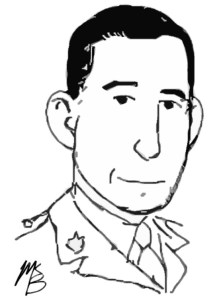
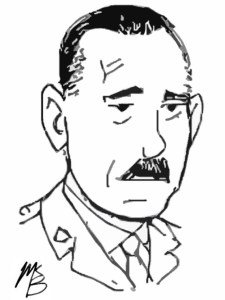
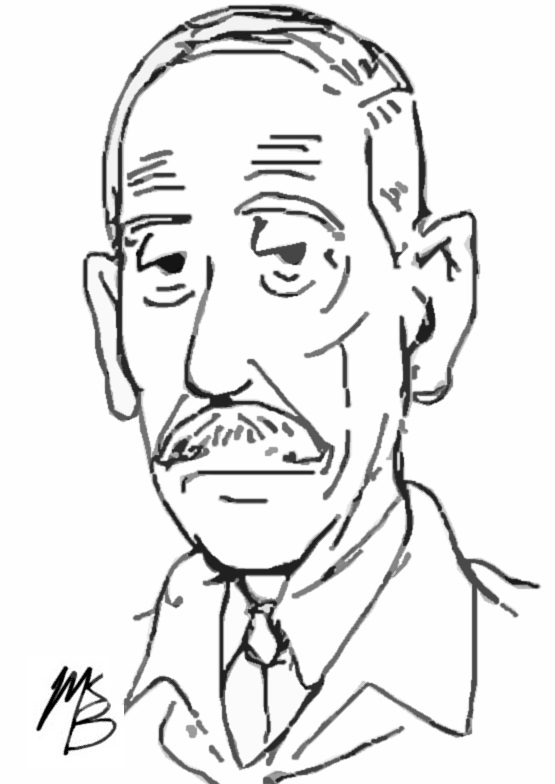
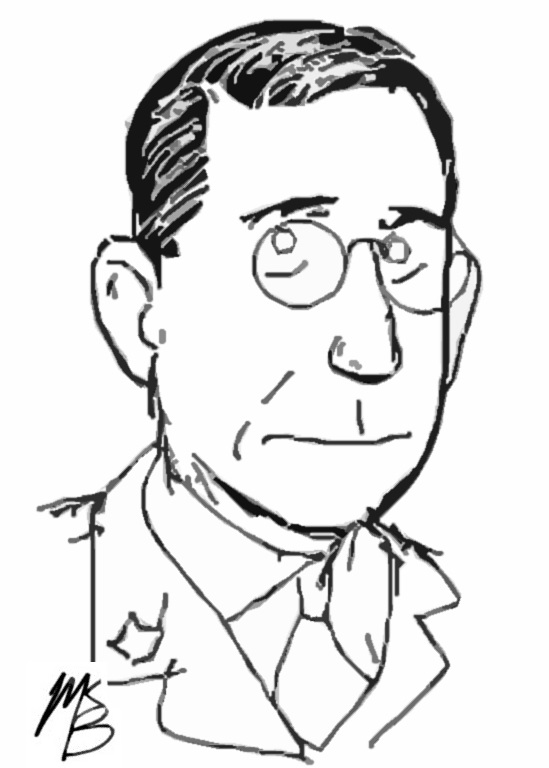
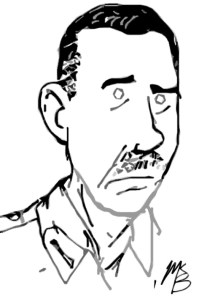
Lt-Col. J.F. L’Espérance

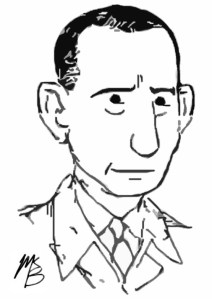
Lieutenant-Colonel J.F. L’Espérance
Régiment de la Chaudière
Men, we are back home, let us give thanks to God and pray for those who will never return. We left here Catholics and we have returned Catholics. Our first action home was to attend mass here.

(Montreal Gazette, 31 Dec 1945, 16)

Born In Montreal on 16 September 1913, Jean Fernand L’Espérance was a graduate of the University of Montreal and joined le Régiment de la Chaudière in 1932. He was commissioned two yeas later and served as a company commander on mobilization in 1940. He went to North Africa in January 1943 to gain combat experience while attached to the First British Army. He command “B” Company when the battalion landed on D-Day.
Continue reading

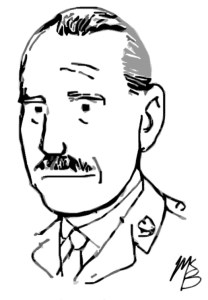
Lt-Col. G. Taschereau

Lieutenant-Colonel  Gus Taschereau
Régiment de la Chaudière

Gus was a rugged Quebecois, excellent in both English and French and very proud of his French heritage. I remember he was carrying four mills grenades in his battledress pockets and had two pistols!

(George Kitching, Mud and Green Fields, 95)

Born on 1 September 1907 in Quebec City, Gustave-Olivier Taschereau was Permanent Force officer with the Royal Canadian Regiment. He served as a company commander during the short-lived second British Expeditionary Force in June 1940 just before the fall of France. Fellow RCR officer George Kitching recalled on seeing French troops waiting to surrender, “Gus Taschereau was absolutely made with rage and if he had had a machine-gun I think he would have turned it loose on them. I can remember his anger. He was descended from these people and had been proud of it, but from now one he swore he would never speak to a French bastard again!”

Continue reading

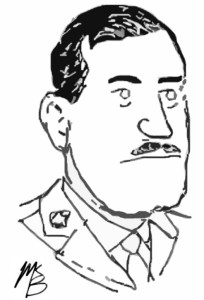
Lt-Col. P. Mathieu

Lieutenant-Colonel Paul Mathieu
Régiment de la Chaudière

Constantly in action, this officer has been an outstanding example of determination, courage and coolness to his troops. His tactical knowledge has proven to be sound and its practical application a source of confidence to those serving under him.

(D.S.O. citation, 27 Nov 1944)

Born on 1 September 1907 in Quebec City, Joseph Etienne Gerard Paul Mathieu graduated from Laval University and worked for the Royal Trust Company. “I didn’t choose that particular occupation,” he recalled, “so much as go where people were prepared to give me a job.” He joined le Régiment de Dorchester et Beauce in 1925 before it amalgamated to create le Régiment de la Chaudière in 1936. He served as second-in-command before succeeding Lieutenant-Colonel Gavan Power, who had stepped aside due to ill health in February 1943.

Continue reading

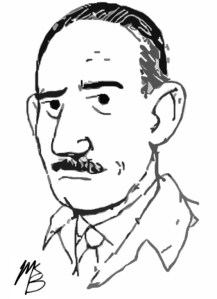
Lt-Col. J.G. Power

Lieutenant-Colonel Gavan Power
Régiment de la Chaudière

Une maladie qui ne pardonne pas vient de briser mes rêves: combattre sur le champ de bataille avec vous jusqu’au bout; rentrer un jour au pays en triomphe avec vous. C’est avec cette ambition que j’ai travaillé avec ardeur … depuis les premiers jours de 1939. Avec orgueil j’ai vu grandir notre régiment et aujourd’hui il occupe dans l’Armée canadienne une place enviable.

(Quoted in Castonguay, Le Régiment de la Chaudière, 201)

Born on 20 March 1908 in Pacome, Quebec, Joseph Gavan Power was a Laval University-educated lawyer and nephew of Liberal MP and Air Minister Chubby Power. An original officer of les Régiment de la Chaudière, he served as second-in-command following mobilization in 1940. The battalion went overseas in July 1941, and Power succeeded Lieutenant-Colonel J.J. Chouinard in March 1942.

Continue reading

Lt-Col. J.J. Chouinard

Lieutenant-Colonel J.J. Chouinard
Voltigeurs de Québec
Régiment de la Chaudière

A very good little chap who commands his Bn. in his own queer way … Training ability and knowledge—practically nil. Goal teachable. If now given firm guidance, and kept on the nails, will produce a good show. But will have to be supervised carefully.

(Gen. Montgomery, “Notes on Inf. Bdes of Canadian Corps,” 29 Jan 1942)

Born in Quebec City on 19 March 1894, Joseph Julien Chouinard worked in insurance and was a veteran of the Siberian Expeditionary Force. In 1940, he became commanding officer of les Voltigeurs de Québec, which served home defence. In January 1941, General Thomas Tremblay described Chouinard as “an intelligent Officer, full of initiative. He has done very well since assuming command a few months ago. He has the qualities to make a good O.C. but requires a lot of military training before being classed as competent for Active Service.” Despite lack of training and experience, he was nonetheless appointed commanding officer of Régiment de la Chaudière the next month.

Continue reading

Lt-Col. G-R. Bouchard

Lieutenant-Colonel G-R. Bouchard
Régiment de la Chaudière
Bouchard

Je lui ai dit que j’étais apte physiquement et que je croyais avoir l’expérience nécessaire pour organiser, instruire et conduire le régiment au combat, et que j’étais prêt à accepter le commandement séance tenante à cette seule condition. Je demandais que l’on me permette au moins de me rendre sur un théâtre de guerre pour y goûter la satisfaction et en avoir l’honneur, et non pas me laisser avec tous les ennuis de la préparation pour le service actif et ensuite envoyer l’unité à l’étranger sous le commandement d’un autre, et me laisser croupir au pays.

(Quoted in Castonguay, Le Régiment de la Chaudière, 123)

Born in Montreal on 22 June 1883, Georges-Rodolphe Bouchard was a retired Permanent Force officer. He joined the militia as a private in 1898 and took a commission with the Royal Canadian Regiment in 1911. He was wounded and gassed at Passchendaele and retired from the army as a lieutenant-colonel in 1935. He was recalled to duty and took command of Régiment de la Chaudière from Lieutenant-Colonel John L. Reiman in January 1940.

Continue reading

Lt-Col. J.L. Reiman

Lieutenant-Colonel John L. Reiman
Régiment de la Chaudière
Reiman

Il se mérita des promotions et finalement parvint au commandement du nouveau régiment qui devait peu de temps après se couvrir de gloire dans la guerre qui vit durant la campagne allemande contre les Pays-Bas la destruction des derniers membres de la  famille Reiman qui étaient restés sur le vieux continent.

(Le Guide, 11 Mar 1958, 2)

Born on 8 March 1886 in Montreal to a Dutch father and Belgian mother, Jan (John) Louis Reiman grew up in Holland. He moved back to Canada after the First World War and worked in New Brunswick before settling in Lac-Mégantic, Quebec. He worked in the paper and pulp industry and joined the Canadian militia. In December 1936, he founded Le Régiment de la Chaudière and served as the first commanding officer. The unit mobilized as a machine gun battalion following the outbreak of the Second World War.

Continue reading

Lt-Col. S.M. Lett

Lieutenant-Colonel Steve Lett
Queen’s Own Rifles

Sleep is the thing we run short of most. The actual fighting isn’t so bad … we can all take that … but it’s being in before your own guns that’s tough. When they fire—and they’re firing a lot of the time—they practically blow you our of your own slit trenches. That’s not conducive to sleep, this moaning, whining and roaring which at times never ends. But the lads are in good spirits.

(Quoted in Toronto Star, 14 Jul 1944, 2)

Born on 27 July 1909 in Cobourg, Ontario, Stephen MacLeod Lett worked in the lumber industry in Toronto and Northern Ontario. He served as second-in-command of the Queen’s Own Rifles at D-Day and succeeded Lieutenant-Colonel Jock Spragge on his promotion to brigadier at the end of August 1944. He would be one of the few infantry commanding officers to remain in command through the latter phase of the Northwest Europe campaign from the end of the Normandy operation to the surrender of Germany.

Continue reading

Brig. J.G. Spragge

Brigadier Jock Spragge
Queen’s Own Rifles
7th Infantry Brigade

Then I saw it was the Colonel. I gave him plain hell … I told him he should be back at Battalion HQ, not up at the front with us—the last line between our forces and the enemy. He was too good and too necessary to be killed or wounded … [he] said ‘Charlie, it’s such a sad day. We’ve lost so many good me.’ He said goodnight and turned away, but not before I saw the tears in his eyes. Jock Spragge was all man. He was not one of the spit’n’polish professional types, but as a fighter he was the best.

(C.C. Martin, Battle Diary, 15-16)

Born on 20 May 1907 in Ottawa, John Godfrey Spragge was a sportsman, former Toronto banker, industrialist, and businessman in London, Ontario. He had joined the Queen’s Own Rifles as a private in 1925 and took a commission a year later. He returned to Toronto with the outbreak of the war when the regiment mobilized for active service. Before the QOR went overseas in July 1941, Spragge became second-in-command and succeeded Lieutenant-Colonel Harry Mackendrick in April 1942.

Continue reading

Lt-Col. H.C. Mackendrick

Lieutenant-Colonel Harry Mackendrick
Queen’s Own Rifles

This Officer was gassed with enemy gas while in support near Lens at 2 am on 5.9.17. He suffered from vomiting, blepharitis & conjunctivitis, sore throat, constriction of chest & cough … Sleep is greatly disturbed, waking with terrors; is nervous & has trembling spells & slight tremor.

(Personnel file, medical report, 1917)

Born on 30 August 1895 in Galt, Ontario, Harry Crane Mackendrick was a University of Toronto graduate and First World War veteran. He was commissioned with the UofT officer training corps and joined the 111th Battalion in January 1916. He went to France as a reinforcement officer for the 4th Battalion but suffered mustard gas burns in September 1917. He was admitted to a casualty clearing station where his father, a doctor attached to with the Royal Army Medical Corps, happened to be stationed.

Continue reading