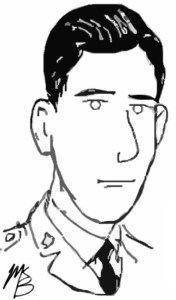
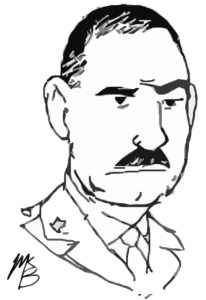
Lt-Col. G.F. Eadie

Lieutenant-Colonel Fraser Eadie
1st Canadian Parachute Battalion
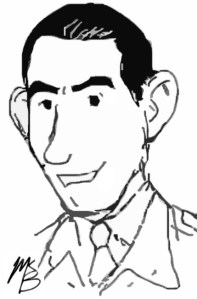
I always believed that I must lead them or I couldn’t live with myself. The only way to be promoted was if I was held in good esteem by my men. I never asked them to do anything I wouldn’t do myself.

(Quoted in Bernd Horn, Intrepid Warriors, 245)

Born in Winnipeg on 20 July 1917, George Fraser Eadie worked for the Ford Motor Company and played hockey before enlisting with the Royal Winnipeg Rifles as a second lieutenant in 1940. He had joined the army rather than pursue an opportunity to play for the Chicago Black Hawks. After advancing to captain and then major, he qualified as a paratrooper and volunteered for the newly formed 1st Canadian Parachute Battalion in 1942.
Continue reading

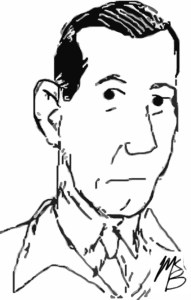
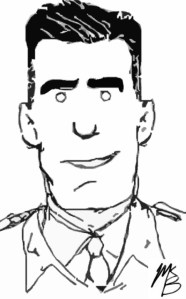
Lt-Col. J.A. Nicklin

Lieutenant-Colonel Jeff Nicklin
1st Canadian Parachute Battalion

Colonel Nicklin was a by the book commander, absolutely no quarter given and he had no compassion for defences that were mounted … the number of soldiers punished severely for what might be minor infractions gave the colonel the un-kind title of ‘Tyrant.’”

(Quoted in Bernd Horn, Intrepid Warriors, 240)

Born in Winnipeg on 10 December 1914, Jevon Albert Nicklin was a football player for Winnipeg Blue Bombers and won the Grey Cup with the team in 1935 and 1939. He was commissioned second lieutenant in August 1940 and joined the Royal Winnipeg Rifles before volunteering to be a paratrooper two years later. He became second-in-command of the 1st Canadian Parachute Battalion where he earned a reputation as a disciplinarian, “tough as hell”

Continue reading

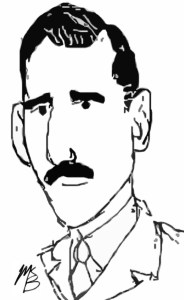
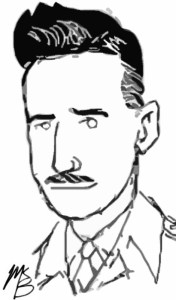
Lt-Col. G.F.P. Bradbrooke

Lieutenant-Colonel G.F.P. Bradbrooke
1st Canadian Parachute Battalion

No matter how many jumps a fellow makes, he’s scared. He jumps from a height of 400 feet, and has about nine seconds to reach the ground. There isn’t time to make mistakes.

(Quoted in Star Phoenix, 25 Sep 1942, 3)

Born in Yorkton, Saskatchewan on 14 March 1912, George Frederick Preston Bradbrooke was a graduate of the University of Saskatchewan and an accountant in Regina. The son of a First World War colonel, he was also nephew of Brigadier G.R. Bradbrooke of 5th Armoured Brigade. He mobilized with the Saskatoon Light Infantry in 1939 and participated in the bloodless Spitzbergen raid of August-September 1941.

Continue reading

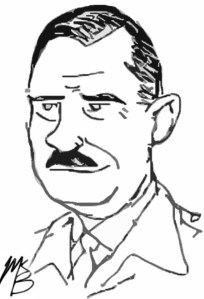
Maj. H.D. Proctor

Major Hilton D. Proctor
1st Canadian Parachute Battalion

The training is very interesting now, and today I took my first jump from the 250-foot tower. It was a grand sensation and I landed very gently. Friday, we pack our own chutes and Monday we jump from the aircraft. I am looking forward to it and so are all the others.

I am taking an evening off and going into Columbus to see ‘Ship Ahoy.’ I believe it is a comedy and I need a laugh.

(Proctor letter 1 Sep 1942, quoted in Ottawa Citizen, 9 Sep 1942, 1)

Born in County Down, Ireland on 20 August 1911, Hilton David Proctor was a graduate of the University of Ottawa, a Bell Telephone engineer and member of the Royal Canadian Corps of Signals since 1927. He mobilized as a captain in August 1940 and advanced to major in May 1942. In July, he assumed command of the nucleus for the newly formed 1st Canadian Parachute Battalion which was sent for training in Fort Benning, Georgia.

Continue reading

Lt-Col. P.C.R. Black

Lieutenant-Colonel Pat Black
12th Manitoba Dragoons

 As a result of your training, teamwork, loyalty and fine qualities as soldiers, you have established the Regiment. We cannot look into the future of the months to come, nor will I try to predict what it holds for us. Wherever we may be, whatever the task, whatever the conditions, I know you will live up to the highest expectations.

(The Staghound, 8 Dec 1945)

Born in Ottawa on 26 August 1915, Patrick Cameron Rooke Black graduated from Queen’s University and joined the permanent force shortly before the outbreak of the Second World War. In 1943, he transferred from the Royal Canadian Dragoons to the 18th Armoured Car Regiment (12th Manitoba Dragoons) under command of former RCD officer, Lieutenant-Colonel J.A. Roberts. As part of II Canadian Corps, the Dragoons deployed to Normandy in July 1944 with Black as second-in-command.

Continue reading

Lt-Col. L.J. St. Laurent

Lieutenant-Colonel L.J. St. Laurent
Régiment de Hull

We are endeavouring to “sell Canada,” to instill and awaken patriotism and a sense of duty to our native land … We haven’t even a national flag to wave proudly in front of the men. The cowardly sins of omission are bearing fruit. We have not developed a true and strong sense of nationhood. Physically we are a mighty nation, nationally we are children.

(St. Laurent to Brig. Macklin, May 1944)

Born in Ottawa on 25 July 1903, Lucien Joseph St. Laurent was a graduate of the University of Ottawa and worked as a clerk for the city’s electric company. Commissioned with le Régiment de Hull in 1926, he was promoted to captain in 1933 and served as battalion adjutant. He went overseas as a staff officer with 1st Division headquarters in December 1939. He returned home two years later at the rank of major.

Continue reading

Lt-Col. M.C. Grison

Lieutenant-Colonel M.C. Grison
Régiment de Hull

It is important that Canadians should have an appreciation of the physical magnitude of their country, It is more important, too, if we are to overcome tendencies to sectionalism, that Canadians as individuals and groups should get to know and understand one another.

(Victoria Daily Times, 7 Apr 1943)

Born in Ottawa on 11 September 1899, Marcel Charles Grison was a graduate of the University of Ottawa and owner of a moving and storage company. Commissioned with le Régiment de Hull since 1923, he had been appointed commanding officer in July 1939. The battalion mobilized in 1941 but was assigned to home defence duty.

Continue reading

Lt-Col. C.M. MacMillan

Lieutenant-Colonel C.M. MacMillan
Canadian Fusiliers (City of London)

A smart clean-cut off[ice]r, who doe not look his age of 40 years, alert, of good personality, fairly aggressive, is intelligent, capable, responsible and conscientious.

Reports are scanty in this officer’s file but those available show his work to be satisfactory; a good CO, has commanded his bn successfully under difficult circumstances.

(Officer Survey and Classification Board, 15 Dec 1944)

Born in Scotland on 9 May 1904, Charles Malcolm MacMillan was a militia officer with the Canadian Fusiliers since 1927. He was promoted to major in 1940 and became second-in-command in February 1942. Before the battalion landed on the island of Kiska, believed to be occupied by Japanese forces, MacMillan remarked, “Some of the boys were pretty tense and we all figured we were in for a full-scale scrap. But every man from the commanding officer down to the privates was ready to go.”

Continue reading

Brig. R.H. Beattie

Brigadier R.H. Beattie
Canadian Fusiliers (City of London)
13th & 14th Infantry Brigades

Whilst leading his company he was held up by an enemy machine-gun post. He, with a section, outflanked the post and then personally with great courage rushed it, shooting one of the enemy, taking prisoner another, and capturing a gun.

(M.C. citation, 3 Oct 1918)

Born on 30 September 1895 in London, Ontario, Russell Hilton Beattie was a decorated First World War veteran and militia officer. He went overseas as a lieutenant in the 135th Battalion and transferred to the 20th Battalion in France in February 1918. He was wounded in action during the Hundred Days’ Offensive but earned the Military Cross for conspicuous gallantry. After mobilization in September 1939, he served as chief recruiting officer for No. 1 Military District Southwestern Ontario) and barracks commandant in Windsor before taking a senior officers’ course at RMC.

Continue reading

Lt-Col. R.E. Bricker

Lieutenant-Colonel R.E. Bricker
Canadian Fusiliers (City of London)
Midland Regiment (Northumberland and Durham)

Of medium height and build, neat clean-cut appearance and smart mil bearing. This offr is a forceful, aggressive, conscientious and vigorous type with a good fighting heart. Appears somewhat intolerant and rather abrupt.

(Officer Survey and Classification Board, 26 Feb 1945)

Born on 27 August 1901 in Glen Allen, Ontario, Rance Ephriam Bricker was a militia officer with Scots Fusiliers of Canada since 1924. In 1940, he transferred to the Highland Light Infantry and served in England as second-in-command. During his inspection tour of the battalion in February 1942, General Bernard Montgomery found Bricker lacked the necessary character and drive. He was soon replaced and sent back to Canada as a prisoner-of-war escort.

Continue reading