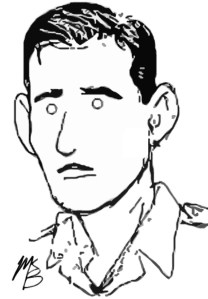
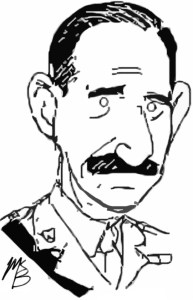
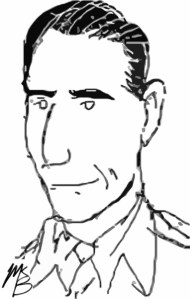
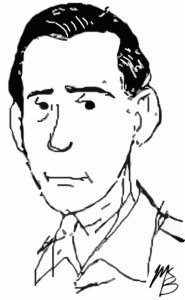
Lt-Col. H.C.H.T. Cumming-Bruce

Lieutenant-Colonel Harry Cumming-Bruce 
1st Battalion, Gordon Highlanders

He seems a charming chap; perhaps a slightly unorthodox military figure with his rather old-fashioned curly moustache, white framed horn-rimmed spectacles and slight stoop … I hope to God he knows his job.

(Martin Lindsay, So Few Got Through, 12)

Born on 29 May 1910 in Barnet, Hertfordshire, England, Henry Charles Hovell-Thurlow-Cumming-Bruce was the heir to Baron Thurlow. He attended Eton College and Royal Military College, Sandhurst before taking a commission with the Seaforth Highlanders in 1930. In the mid 30s, he served as aide-de-camp to the British High Commissioner for Palestine and Transjordan and held posts in the Middle East during the early phase of the Second World War.

Continue reading

Lt-Col. W.A. Stevenson

Lieutenant-Colonel W.A. Stevenson
1st Battalion, Gordon Highlanders

During the whole of these operations the personal example of cheerfulness of the C.O. and his obvious control of every situation was mainly responsible in keeping the battalion steady and intact. A remark made by one of the men illustrates this. When the C.O. seized a bren gun to cover the withdrawal of “S” Coy HQ a soldier was heard to say “There goes the mobile reserve: now we are all right.”

(D.S.O. citation, 31 Aug 1944)

Born in Guildford, Surrey on 7 September 1912, William Alexander Stevenson was the son of Major-General Alexander Gavin Stevenson, (1871—1939), a veteran of the Egyptian Army, the Boer War and First World War. The oldest son, W.A. Stevenson, belonged to the Queen’s Own Cameron Highlanders and was stationed in India at the outbreak of the Second World War. His younger brother, Wing Commander Michael Gavin Stevenson died on active service in Egypt on 29 November 1942.

Continue reading

Maj. H.W. Cairns

Major Hugh Cairns
5th Battalion, Queen’s Own Cameron Highlanders

Members of the Battalion at this time will remember Colonel Cairns sitting out under an apple tree in an orchard in Battalion H.Q.’s area behind the “‘Triangle,’ quite impervious to the sniping self-propelled gun, which dropped many shells into this area at unpredictable moments, with generally unpleasant results: his gallantry and example at Ste Honorine will not easily be forgotten.

(Historical Records of the Queen’s Own Cameron Highlanders 1932-1948, 103)

Born on 27 Jan 1911 Dalkeith, Midlothian, Scotland, Hugh William Cairns was a grandson of Lord Chancellor Hugh Cairns, 1st Earl Cairns (1819—1885). Cairns was commissioned in the Cameron the Highlanders and served in India before the outbreak of the Second World War. He joined the 5th Battalion in May 1944 and led C Company on landing in France a month later.

Continue reading

Lt-Col. B.C. Bradford

Lieutenant-Colonel Bill Bradford
5th Battalion, The Black Watch

Owing to severe casualties in past fighting the bn under Lt Col Bradford’s comd has los most of its key personnel and a great deal of extra work descended on him. The fact that his bn carried out its tasks so brilliantly is entirely due to the able leadership and energy of Lt Col Bradford who was at all times an inspiration and example to his officers and men.

(D.S.O. citation, 2 Sep 1944)

Born on 15 October 1912 in London, Berenger Colborne Bradford was educated at Eton College and the Royal Military College at Sandhurst. He was commissioned with the Black Watch (Royal Highland Regiment) in 1932, later serving in India and the Sudan. As a captain and adjutant with the 1st Battalion, he was taken prisoner along with the rest of the 51st Division when surrounded by German forces at St Valéry on 12 June 1940. He slipped away from the prisoner-of-war march a week later.

Continue reading

Lt-Col. C.N. Thomson

Lieutenant-Colonel Chick Thomson
5th Battalion, The Black Watch

Thomson was in a dreadful state. He came back the following day and I had to get the doctor and the padre to keep him for a few hours. And there he was a D.S.O., he got two or three D.S.O.s altogether; it was too much. It wasn’t their fault. They had been fighting in the desert. They’d been sitting around north London or wherever it was they sat without being properly trained, and they were thrown into this bocage country with Germans popping out. 

(Lt-Col. Terence Otway, interview, 1989)

Born on 17 January 1907 in Monifieth, Angus, Scotland, Charles Newbigging Thomson was a Territorial Army officer with the 4/5th Battalion, Black Watch. He became captain in 1932 and served during the Battle of France in 1940. When the 5th Black Watch embarked for Egypt in June 1942, Thomson served as second-in-command under Lieutenant-Colonel T.G. Rennie. Wounded during the Battle of El Alamein, Thomson returned to the unit in December 1942, succeeding Rennie who had been promoted to 154th Infantry Brigade.

Continue reading

Lt-Col. D.B. Lang

Lieutenant-Colonel Derek Lang
5th Battalion, Queen’s Own Cameron Highlanders

I can well understand why long-term prisoners feel reluctant to face the world again when finally they come to the end of their sentences and are released. Although I had fretted during the long weeks when we had been confined, now that the moment had come for action I shrank from it with something very like fear. Suddenly the big, square house seemed terribly safe, comfortable and infinitely desirable. Outside was the unknown, perilous and menacing.

(Derek Lang, Return to St Valéry, 110)

Born on 7 October 1913 in Guildford, Surrey, England, Derek Boileau Lang took a commission with Queen’s Own Cameron Highlanders in 1933 after attending Wellington College, Berkshire and the Royal Military College, Sandhurst. He served with the 2nd Battalion in the Middle East in the 1930s and was adjutant for the 4th Battalion at the outbreak of the Second World War. He was wounded and taken prisoner during the Battle of France in June 1940 but managed a remarkable escape across multiple countries and eventually rejoined the army.

Continue reading

Lt-Col. J.M. Sym

Lieutenant-Colonel John Sym
5th Battalion, Seaforth Highlanders

I rather prided myself, at the time, on my ability at aircraft recognition and reassured the Brigadier, who was regarding them rather apprehensively, that they were Kittihawks. A moment later we were throwing ourselves on our faces as their bombs crashed uncomfortably near us. I still think they were Kittihawks but, although they turned back and headed for home over our lines, my reputation was lost.

(J.M. Sym, Personal Account of El Alamein) https://51hd.co.uk/accounts/colonel_john_sym_dso

Born in Edinburgh on 10 October 1907, John Munro Sym attended Loretto School and graduated from Royal Military College, Sandhurst. He was commissioned with the Seaforth Highlanders in 1927. During the 1930s, he served with the 2nd Battalion on the North West Frontier in India and in Palestine and then with the 1st Battalion in Egypt. He was posted to the British Military Mission in Iraq in 1939 prior to the outbreak of the Second World War.

Continue reading

Lt-Col. J.H. Walford

Lieutenant-Colonel Jack Walford
5th Battalion, Seaforth Highlanders

It is the custom in the army for the commander of an infantry battalion to complete an active tour of duty of a limited period, the idea being that if he has been doing his job properly and by some happy chance still remains alive at the end of it, the strain will have been so great that a fresh man should succeed him. Colonel Walford appeared to be made entirely of indiarubber and strong springs he had not been visibly affected by the rigours of leading the Battalion in every action from Alamein to Venlo; but his time was more than up, and he had to go.

(Alastair Borthwick, Sans Peur: The History of the 5th (Caithness and Sutherland), 297)

Born in Kensington, Middlesex on 4 May 1900, John Herbert Walford was commissioned in 1920 and became a lieutenant in the King’s Royal Rifle Corps before joining the Seaforth Highlanders. He was wounded and concussed while fighting during the Battle of France in June 1940. Scottish author Alastair Borthwick who served as intelligence officer with the 5th Battalion, would later write few could have foreseen “that quiet Major Walford was to lead the Battalion with such success in battle after battle that by the end of the war he would be a legend.”

Continue reading

Lt-Col. G.L.W. Andrews

Lieutenant-Colonel Geordie Andrews
2nd Battalion, Seaforth Highlanders

We saw each other at the same moment and, thinking it wise to seize the initiative, I let fly at him with my new Walther. Needless to say, I missed him. I was not too sorry, as I bore the fellow no particular malice—at least I had joined that surprisingly small circle of officers who had actually fired their pistols in anger.

(Quoted in Andrew Todd, The Elephant at War, 102)

Born in Cockermouth, Cumberland on 1 July 1910, George Lewis Williams Andrews was a graduate of Haileybury College and Royal Military College, Sandhurst. He was commissioned into the Seaforth Highlanders in 1929, and served with the 1st Battalion in Palestine in the 1930s. After the outbreak of the Second World War, he served on staff with 17th Infantry Brigade headquarters and completed staff college.

Continue reading