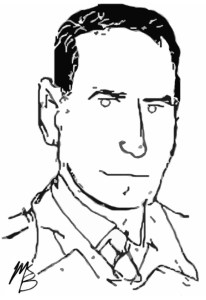
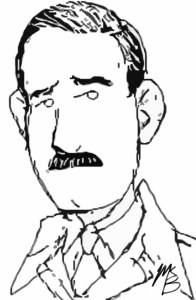
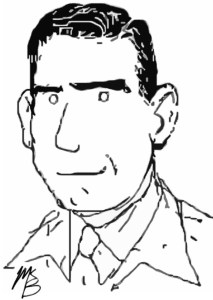
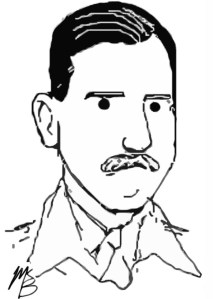
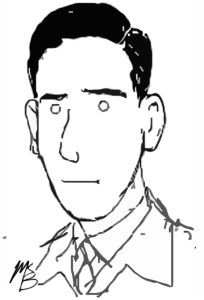
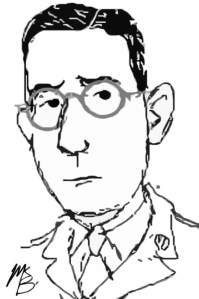
Lt-Col. M.C.K. Halford

Lieutenant-Colonel Mike Halford
Hallamshire Battalion, York and Lancaster Regiment

The battalion did the work, and I got the DSO.

(Quoted in Daily Telegraph, 21 Jan 1999, 29)

Born on 28 October 1914 in Yateley, Hampshire, Michael Charles Kirkpatrick Halford was a graduate of Trinity College, Cambridge and commissioned in the York and Lancaster Regiment, which had been commanded by father and maternal grandfather. He served during the Arab Revolt in Palestine 1936 and became adjutant for the Hallamshire Battalion in 1939.

Continue reading

Lt-Col. P.R. Ashburner

Lieutenant-Colonel P.R. Ashburner
4th Battalion, Lincolnshire Regiment

He has always worked hard and has had on many occasions to do much more than is own work owing to battle casualties among the other officers at Brigade Headquarters–through the many changes of personnel including the Commander; carried through every action, he has remained the cheerful, confidant personality on which the Brigade has come to rely for the continuity of its success in fighting the Germans.”

(Military Cross citation, 29 Mar 1945)

Born on 18 July 1910. In Mount Abu, India, Peter Robert Ashburner was the son of a British Army brigadier and polo player. After graduating from Royal Military College, Sandhurst, he was commissioned into his father’s regiment Royal Fusiliers (City of London Regiment) in 1930. His served in Normandy and North West Europe as brigade major for 71st Infantry Brigade, for which he received the Military Cross:

Continue reading

Lt-Col. J.E.B. Freeman

Lieutenant-Colonel J.E.B. Freeman
4th Battalion, Lincolnshire Regiment

His cool and cheerful bearing as he moved from platoon to platoon, often under heavy fire, had a most heartening effect while the information he was able to obtain was of the greatest use to his CO in the conduct of the operation. Again during the very bitter fighting … Lt Col. Freeman showed courage of a very high order in moving forward in a confused situation to a company temporarily cut off by enemy infiltration.

(Chevalier of the Order of the Crown, citation, 10 Oct 1945)

Born on 14 May 1913 in Hertfordshire, John Edward Broke Freeman was a lawyer and Territorial Army officer, commissioned with the Oxford and Buckingham Light Infantry in 1935. He was promoted to temporary captain in January 1940 and made acting major six months later. He participated in the planning for the Normandy invasion as brigade major for 146th Infantry Brigade.

Continue reading

Lt-Col. R.J. German & Maj. I.D.M. Liddell

Lieutenant-Colonel John German
&
Major Ian Liddell

1st Battalion, Leicestershire Regiment

Had it been our fate to have gone into battle together, I think there is no man that we would rather have had by us in a time of hardship and danger than John German. I am told that he was killed by a sniper’s bullet outside Le Havre, when standing in the open, encouraging his men. We can all picture him doing that.

(Quoted in Burton Observer and Chronicle, 26 Oct 1944, 2)

Born on 28 August 1908 in Ashby-de-la-Zouch, Leicestershire, Raymond Johnston German was a long serving Territorial Officer and a land agent. He joined the 5th Battalion, Leicestershire Regiment in 1925—his father served as honorary colonel from 1927 to 1938. He mobilized as a company commander in the 1/5th Battalion commanded by his older brother, Lieutenant-Colonel Guy German. The unit deployed to Norway in April 1940. While John made it back to England, Guy would spend the rest of the war as a prisoner-of-war.

Continue reading

Lt-Col. A.L. Novis

Lieutenant-Colonel Tony Novis
1st Battalion, Leicestershire Regiment

I hope A. L. Novis will be available by the time International Matches come along—how superbly he played in the Irish match at Twickenham! Those two tries of his—one scored on the wing by sheer determination, the other when he moved into the centre and went like a snipe through the defence—those two tries, to my mind, put the whole standard of International Rugby up a notch or two, for when such things are possible, we still have true descendants of the Golden Age.

(Howard Marshall, The Bystander, 27 Sep 1933, 566)

Born on 22 September 1906 in Malabar Hill, British India, Anthony Leslie Novis was a rugby union international player and captained the English national team in 1933. He was educated at Oxford University. He played for numerous rugby teams including Leicestershire FC, Blackheath, and the Army as a commissioned officer in the Leicestershire Regiment since 1929. After prewar service in Palestine, he served as a company commander with the 2nd Battalion in the Western Desert.

Continue reading

Lt-Col. F.F.S. Barlow

Lieutenant-Colonel F.F.S. Barlow
2nd Battalion, South Wales Borderers

This Officer’s service throughout the operation during some very intricate and difficult situation were of a very high order. By his calm courage, high sense of duty and imperturbability at all times, he has been a constant source of inspiration and example to his bn. I cannot speak too highly of the officer’s services to the Bn and Bde.

(D.S.O. recommendation, 26 Sep 1944)

Born on 8 June 1905 Parkstone, Dorset, Frank Frederick Stewart Barlow was a commissioned officer in the South Wales Borderers since 1924. Having served in India and Palestine during the 1930s, he mobilized with the 2nd Battalion in September 1940. He was promoted to second-in-command in October 1942. The battalion landed on Gold Beach on 6 June 1944, and after Lieutenant-Colonel R.W. Craddock was wounded two days later, Barlow assumed command of the 2nd South Wales Borders.

Continue reading

Lt-Col. R.W.M. De Winton

Lieutenant-Colonel R.W.M. De Winton
5th/7th Battalion, Gordon Highlanders
1st Battalion, Tyneside Scottish
2nd Battalion, Gordon Highlanders

I did not mean to hit the man or the uniform. I wanted to hit only the major representatives of the Big Four at Pola. Unfortunately he was a man and a soldier. If I had had the occasion, I would have hit the Big Four—as a symbol of the injustice to my country.

(Maria Pasquinelli in Associated Press, 19 Mar 1947)

Born on 16 September 1908 in Edinburgh, Scotland, Robert William Michael De Winton was a graduate of Royal Military College, Sandhurst and a commissioned officer in the Gordon Highlanders since 1932. He temporarily took over 5/7th Battalion in Sicily in August 1943 and then commanded 1st Battalion, Tyneside Scottish from January 1944 until it deployed to France after D-Day.

Continue reading

Lt-Col. R.K. Exham

Lieutenant-Colonel Roy Exham
6th Battalion, Duke of Wellington’s Regiment
6th Battalion, Green Howards

I will not attempt to describe another action which we fought as all I can remember is a bloody time when three soldiers were killed at my side. Again we captured our objective. It was an unpleasant time and my sympathies went to the forward companies, which were dug in close to the Germans and could not see anything, were unable to move and were shelled most of the time. There was a wondaful feeling of relief when at last we were on the move.

(Exham quoted in Mike Morgan, D-Day Hero)

Born on 25 January 1907 in Readlynch, Wiltshire, Robert Kenah Exham took as commission in the Duke of Wellington’s Regiment (West Riding) in 1926 after graduating from Royal Military College, Sandhurst. He served on the North West Frontier in India before the Second World War. As a staff officer with 3rd Infantry Brigade in June 1940, he earned the Military Cross for invaluable assistance during the evacuation from Dunkirk.

Continue reading

Lt-Col. F.W. Sanders

Lieutenant-Colonel F.W. Sandars
11th & 10th Battalions, Durham Light Infantry
1st Battalion, Leicestershire Regiment

Throughout Lt. Col. Sandars displayed outstanding devotion to duty and disregard for his personal safety. His HQ and the whole Bn area was frequently under heavy arty fire. This officer moved about the Bn area to carry out a recce, make a plan, and issue orders.

(D.S.O. citation, 21 Dec 1944)

Born on 18 April 1903 Egremont, Cheshire, England, Francis Wyld Sandars attended Wellington College and Royal Military College, Sandhurst before taking a commission with the Durham Light Infantry in 1923. He served with the 2nd Battalion in India, Shanghai, and Waziristan. Back in the United Kingdom during the 1930s, he completed Staff College at Camberley and held general staff appointments in the UK after the outbreak of the Second World War. In January 1942, he returned to the Durham Light Infantry on appointment to command the 11th Battalion.

Continue reading

Lt-Col. J.H.O. Wilsey

Lieutenant-Colonel Felix Wilsey
7th Battalion, Duke of Wellington’s Regiment

The commanding officer with whom I most frequently discussed matters affecting morale was my friend. Felix Wilsey. He made a point of chatting with his soldiers during the tense times before battle, admitting that it was natural to feel jittery admitting that it was natural to feel jittery and jumpy at such times, as he himself well knew. Did they feel at all like that? Well, they could take it from him that it would all be forgotten once the real action began, when no one would have time to be jumpy, and so on.

(Frank M. Richardson, Fighting Spirit: A Study of Psychological Factors in War, 118)

Born on 29 November 1904 in Camberley, Surrey, John Harold Owen Wilsey graduated from Haileybury and Imperial Service College and later attended the Royal Military College, Sandhurst. He took a commission with the Dorset Regiment in 1924 and transferred to the Worcestershire Regiment in 1936. Following general staff duties at the start of the war, he took command of the 9th Battalion, Worcestershire Regiment in January 1943.

Continue reading