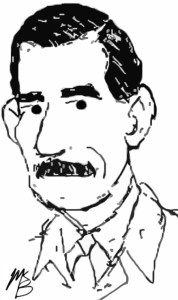
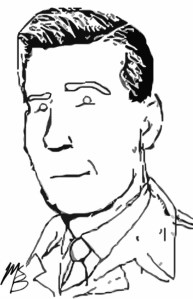
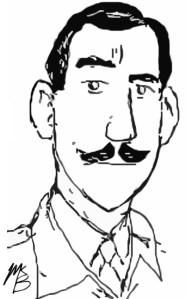
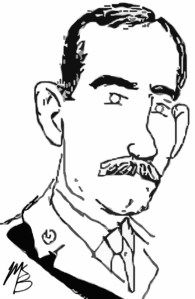
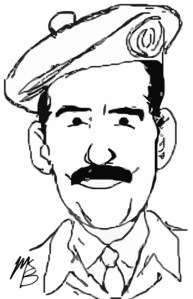
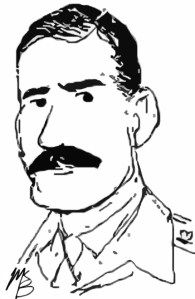
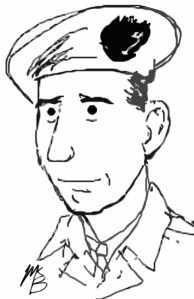
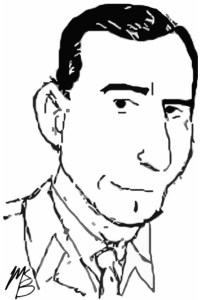
Lt-Col. D.B. Lang

Lieutenant-Colonel Derek Lang
5th Battalion, Queen’s Own Cameron Highlanders

I can well understand why long-term prisoners feel reluctant to face the world again when finally they come to the end of their sentences and are released. Although I had fretted during the long weeks when we had been confined, now that the moment had come for action I shrank from it with something very like fear. Suddenly the big, square house seemed terribly safe, comfortable and infinitely desirable. Outside was the unknown, perilous and menacing.

(Derek Lang, Return to St Valéry, 110)

Born on 7 October 1913 in Guildford, Surrey, England, Derek Boileau Lang took a commission with Queen’s Own Cameron Highlanders in 1933 after attending Wellington College, Berkshire and the Royal Military College, Sandhurst. He served with the 2nd Battalion in the Middle East in the 1930s and was adjutant for the 4th Battalion at the outbreak of the Second World War. He was wounded and taken prisoner during the Battle of France in June 1940 but managed a remarkable escape across multiple countries and eventually rejoined the army.

Continue reading

Lt-Col. J.M. Sym

Lieutenant-Colonel John Sym
5th Battalion, Seaforth Highlanders

I rather prided myself, at the time, on my ability at aircraft recognition and reassured the Brigadier, who was regarding them rather apprehensively, that they were Kittihawks. A moment later we were throwing ourselves on our faces as their bombs crashed uncomfortably near us. I still think they were Kittihawks but, although they turned back and headed for home over our lines, my reputation was lost.

(J.M. Sym, Personal Account of El Alamein) https://51hd.co.uk/accounts/colonel_john_sym_dso

Born in Edinburgh on 10 October 1907, John Munro Sym attended Loretto School and graduated from Royal Military College, Sandhurst. He was commissioned with the Seaforth Highlanders in 1927. During the 1930s, he served with the 2nd Battalion on the North West Frontier in India and in Palestine and then with the 1st Battalion in Egypt. He was posted to the British Military Mission in Iraq in 1939 prior to the outbreak of the Second World War.

Continue reading

Lt-Col. J.H. Walford

Lieutenant-Colonel Jack Walford
5th Battalion, Seaforth Highlanders

It is the custom in the army for the commander of an infantry battalion to complete an active tour of duty of a limited period, the idea being that if he has been doing his job properly and by some happy chance still remains alive at the end of it, the strain will have been so great that a fresh man should succeed him. Colonel Walford appeared to be made entirely of indiarubber and strong springs he had not been visibly affected by the rigours of leading the Battalion in every action from Alamein to Venlo; but his time was more than up, and he had to go.

(Alastair Borthwick, Sans Peur: The History of the 5th (Caithness and Sutherland), 297)

Born in Kensington, Middlesex on 4 May 1900, John Herbert Walford was commissioned in 1920 and became a lieutenant in the King’s Royal Rifle Corps before joining the Seaforth Highlanders. He was wounded and concussed while fighting during the Battle of France in June 1940. Scottish author Alastair Borthwick who served as intelligence officer with the 5th Battalion, would later write few could have foreseen “that quiet Major Walford was to lead the Battalion with such success in battle after battle that by the end of the war he would be a legend.”

Continue reading

Lt-Col. G.L.W. Andrews

Lieutenant-Colonel Geordie Andrews
2nd Battalion, Seaforth Highlanders

We saw each other at the same moment and, thinking it wise to seize the initiative, I let fly at him with my new Walther. Needless to say, I missed him. I was not too sorry, as I bore the fellow no particular malice—at least I had joined that surprisingly small circle of officers who had actually fired their pistols in anger.

(Quoted in Andrew Todd, The Elephant at War, 102)

Born in Cockermouth, Cumberland on 1 July 1910, George Lewis Williams Andrews was a graduate of Haileybury College and Royal Military College, Sandhurst. He was commissioned into the Seaforth Highlanders in 1929, and served with the 1st Battalion in Palestine in the 1930s. After the outbreak of the Second World War, he served on staff with 17th Infantry Brigade headquarters and completed staff college.

Continue reading

Col. F. Skibiński

Colonel Franciszek Skibiński
3rd Rifle Brigade
10th Armored Cavalry Brigade

Well, just the liberation of the concentration camp—well, it was a discovery [of] Papenburg. It was the first camp I saw in my life. I heard the stories about how this camp were [sic] looking. But to see heaps of terribly lean naked bodies lying … Well, it was a very shocking sight. And it shocked me and my soldiers, as well, very, very deeply. I do remember this moment.

(Interview, October 1981, https://collections.ushmm.org/search/catalog/irn513325)

Born on 15 August 1899 in Munich, Germany, Franciszek Maria Maksymilian Skibiński served with the Puławy Legion during the First World War and joined the secret Polish Military Organization in 1918. He served with the Polish Army during the wars of independence and was commissioned a second lieutenant in 1920. Although reprimanded by an officers’ court of honour for an incident of disturbing the peace in 1925 and arrested for firing a gun allegedly while intoxicated in 1927, he continued to advance through the ranks, rising to a major by the September 1939 campaign.

Continue reading

Col. M. Wieroński

Colonel Marian Wieroński
3rd Rifle Brigade (Poland)

I made personnel changes to the more important positions. Current suitability for combat was the decisive factor … Colonel Wieroński was a very good infantryman, decorated by me with the Virtuti Militari Order for the Battle of Potigny on 15 August; however, he had not taken to the particular nature of combat … and thought that someone else would be better in this position.

 —General Stanisław Maczek

(Quoted in Jenny Grant, Price of Victory)

Born on 2 August 1896 in Krakow, Marian Stanisław Wieroński was a long-serving infantry officer in the Polish Army. After a series of promotions and postings, he had advanced to lieutenant-colonel by March 1937. He commanded the 3rd Rifle Battalion during the invasion of Poland in September 1939. He escaped to France where he commanded the 9th Infantry Regiment before the fall and occupation of the country to German forces.

Continue reading

Col. T. Majewski

Colonel Tadeusz Majewski
10th Armoured Cavalry Brigade (Poland)

Poland did not capitulate after the fall of France, and the Poles by various stages crossed to Great Britain, that last fortress of freedom, so that finally, together with the forces of the great British Empire, they might match themselves against those of our enemies.

(Quoted in Blairgowrie Advertiser and East Perthshire News-Review, 3 Apr 1942, 6)

Born on 26 August 1899 in Lwów, Poland, Tadeusz Adam Feliks Majewski served in the Polish Legions before being conscripted into the Austro-Hungarian Army on the Italian Front in 1918. At the end of the First World War, he joined the Blue Army formed by Polish soldiers in France. He advanced in the Polish Army through the interwar years, rising to lieutenant-colonel by March 1939. Six months later, he escaped to France following the invasion and occupation of Poland.

Continue reading

Lt-Col. Z. Szydłowski

Lieutenant-Colonel Zdzislaw Szydłowski
9th Flemish Rifle Battalion (Poland)

My father, who finally was in command at Maczuga, told me of the feelings of the men. They were not beaten, but they were in a serious position. I have the impression that General Maczek was surprised they hung on, but they would not give up. The Polish soldiers were happy to meet the Canadians on that hill. The biggest emotion was relief and also it was pride that the cork stayed. That was the impact of the whole action. Pride overruled fear.

(Chris Szydłowski quoted in Whitaker, Normandy, 293)

Born on 21 September 1900 in Lwów, Poland, Zdzisław Mateusz Lubicz-Szydłowski was a soldier and scientist, having received a doctorate in biology from Poznair University in 1928. After Poland’s independence in November 1918, he served in the army during the Polish-Ukrainian War then the Polish-Soviet War and took a commission in 1923. In 1929, he had a duel with fellow officer and medical doctor Alojzy Pawelek. The next year, Szydłowski shot and killed Pawelek in his office after a violent argument. Szydłowski was arrested and briefly imprisoned but resumed his military career.

Continue reading

Lt-Col. W. Zgorzelski

Lieutenant-Colonel Władysław Zgorzelski
10th Dragoons Regiment (Poland)

There’s no better mentor than Col. Zgorzelski who coached the Irish Olympic team in 1960 and who coached the Argentine team for nine years. He’s a dapper little man who is stern when sternness is needed, who seems to have a deeply rooted belief that most American instructors push their pupils too quickly … and who is man enough to diplomatically handle even the most difficult problems between pupil, horse and instructor.

(Washington Evening Star, 19 May 1963, 60)

Born on 20 February 1901, Żytomierz, Russian Empire, Władysław Zgorzelski was a member of the secret Polish Military Organization and joined the newly formed Polish Army in November 1918. He was commissioned in 1922. In addition to his military career, he was a champion equestrian and participated in competitions worldwide during the interwar period.

Continue reading

Lt-Col. F.P. Barclay

Lieutenant-Colonel Peter Barclay
4th Battalion, Lincolnshire Regiment
1st Battalion, Royal Norfolk Regiment

It was absolutely wonderful and a thrilling feeling to experience the spirit of the chaps who are with you—it is intangible—but its the most exhilarating, potent influence. It revives you, you can never feel tired, you never feel depressed when you have a spirit round you like the spirit we enjoyed. And the whole thing was treated as a jolly-well, worthwhile job that has to be done.

(Barclay, interview, 21 May 1984) https://www.iwm.org.uk/collections/item/object/80007993

Born in Cromer, Norfolk, England on 8 March 1909, Francis Peter Barclay was commissioned with the Norfolk Regiment in 1929 after attending Twyford School and Royal Military College, Sandhurst. Of his decision to join the army, he explained decades later, “I thought it was a wonderful life … and I never regret it from that day to this.” After service in India, he was posted with the 2nd Battalion to Gibraltar just before the outbreak of the war. He served as company commander when the battalions went to France in September 1939. He received the Military Cross for leading a three-man patrol into enemy lines on the night on 3/4 January 1940.

Continue reading