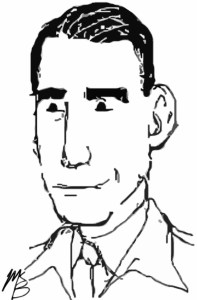
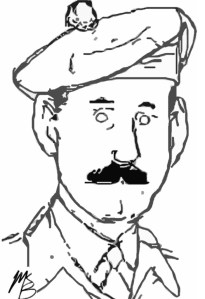
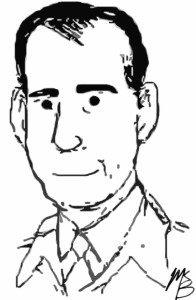
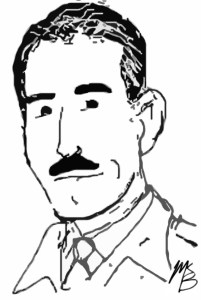
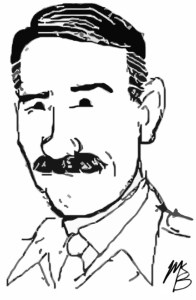
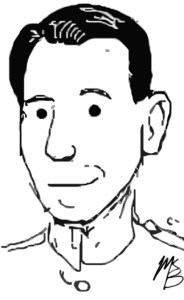
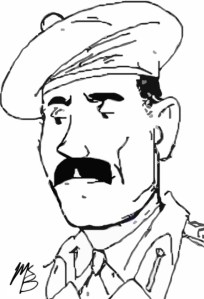
Lt-Col. P.H. Richardson

Lieutenant-Colonel P.H. Richardson
7th Battalion, Green Howards
2/6th Battalion, Queen’s Royal Regiment

For some reason I don’t know why neither B or D boys seem to possess any means of dealing with the tanks though the M10’s did knock out one and I think I got the commander of one myself with a Bren. We suffered quite a few casualties and bit by bit parties got put in the bag … If I had only had tanks myself or more PIATs things might have been different. I could have knocked out three tanks myself if I had only been carrying a PIAT at 30-50 yds range.

(Lt-Col. P.H. Richardson, 10 Aug 1944, war diary appendix)

Born on 23 July 1909 in British, India, Philip Herbert Richardson was a commissioned officer in the Queen’s Royal Regiment since 1930. Following prewar service in China and India, he attended Staff College, Camberley in 1941. Following a posting as brigade major, he served as second-in-command of the 2/5th Battalion, Queen’s Royal Regiment in North Africa, and next transferred to the 6th Battalion, Durham Light Infantry in Sicily.

Continue reading

Lt-Col. C.L. Firbank

Lieutenant-Colonel Cecil Firbank
2nd Battalion, Lincolnshire Regiment

Despite the great destruction wrought by the atomic bomb, infantry has in no way been reduced to the role of an occupation force in any future major conflict. With each new weapon that has appeared down through the history warfare that have been some who have claimed that the knight in armor or the soldier with a rifle is no longer of use. But wars will be fought by infantry men as long as we have wars.

(Quoted in Montreal Star, 16 Nov 1955, 3)

Born in British India on 1 August 1911, Ronald Clarence Macdonald was a field hockey player educated at the Royal Military College, Sandhurst. In 1931 took a commission with the Royal Warkwickshire Regiment, which his father had earlier commanded. He attended staff college and following instructional duties, was assigned to the 1/6th Battalion, South Staffordshire Regiment.

Continue reading

Lt-Col. R.C. Macdonald

Lieutenant-Colonel R.C. Macdonald
1/6th Battalion, South Staffordshire Regiment
1st Battalion, King’s Own Scottish Borderers
2nd Battalion, Royal Warwickshire Regiment

All our families are very much happier about our departure now that there is an armistice. We don’t know quite what we shall find when we get there, but we shall be busy enough competing with the cold, if nothing else.

(Quoted in Birmingham Gazette, 1 Aug 1953, 5)

Born in British India on 1 August 1911, Ronald Clarence Macdonald was a field hockey player educated at the Royal Military College, Sandhurst. In 1931 took a commission with the Royal Warkwickshire Regiment, which his father had earlier commanded. He attended staff college and following instructional duties, was assigned to the 1/6th Battalion, South Staffordshire Regiment.

Continue reading

Lt-Col. J.F.M. Macdonald

Lieutenant-Colonel J.F.M. Macdonald
1st Battalion, King’s Own Scottish Borderers

His coolness and determination inspired the leading Coy to rally and resist the enemy counter attack with spirit; the enemy was finally firmly held. With considerable skill and power of decision, though he himself was under heavy mortar and sniper fire, this fine officer quickly re-act his fire plan

(D.S.O. citation, 30 November 1951)

Born on 7 November 1907 in Norfolk, John Frederick Matheson Macdonald was commissioned with the King’s Own Scottish Borderers after graduating from Royal Military College, Sandhurst in 1927. Following staff postings, he served as second-in-command of the 6th Battalion, King’s Own Scottish Borderers during the early phase of the Normandy campaign. He took command of the 1st Battalion, KOSB on 26 July 1944, a week after Lieutenant-Colonel G.D. Renny had been wounded and evacuated.

Continue reading

Lt-Col. B.A. Innes

Lieutenant-Colonel B.A. Innes
7th Battalion, Black Watch

The proposed Assembly will have 150 more Politicians and well over 1000 extra bureaucrats who will all have to be paid for out of the annal block grant. This can only mean less for essential services as above … The S.N.P. (or tartan socialists) like the other variety want to get at other men’s wealth.

(The Strathearn Herald, 24 Feb 1979, 6)

Born on 22 July 1904 in Dagshai, India, Berowald Alfred Innes was a commissioned officer with the Black Watch since completing Royal Military College, Sandhurst in 1924. He was promoted to captain in 1937 and made acting major one month after the outbreak of the Second World War. He was wounded in the Battle of France. His brother Flying Officer Herome Alexander Innes was killed in a training accident in 1940.

Continue reading

Lt-Col. M.C.K. Halford

Lieutenant-Colonel Mike Halford
Hallamshire Battalion, York and Lancaster Regiment

The battalion did the work, and I got the DSO.

(Quoted in Daily Telegraph, 21 Jan 1999, 29)

Born on 28 October 1914 in Yateley, Hampshire, Michael Charles Kirkpatrick Halford was a graduate of Trinity College, Cambridge and commissioned in the York and Lancaster Regiment, which had been commanded by father and maternal grandfather. He served during the Arab Revolt in Palestine 1936 and became adjutant for the Hallamshire Battalion in 1939.

Continue reading

Lt-Col. P.R. Ashburner

Lieutenant-Colonel P.R. Ashburner
4th Battalion, Lincolnshire Regiment

He has always worked hard and has had on many occasions to do much more than is own work owing to battle casualties among the other officers at Brigade Headquarters–through the many changes of personnel including the Commander; carried through every action, he has remained the cheerful, confidant personality on which the Brigade has come to rely for the continuity of its success in fighting the Germans.”

(Military Cross citation, 29 Mar 1945)

Born on 18 July 1910. In Mount Abu, India, Peter Robert Ashburner was the son of a British Army brigadier and polo player. After graduating from Royal Military College, Sandhurst, he was commissioned into his father’s regiment Royal Fusiliers (City of London Regiment) in 1930. His served in Normandy and North West Europe as brigade major for 71st Infantry Brigade, for which he received the Military Cross:

Continue reading

Lt-Col. J.E.B. Freeman

Lieutenant-Colonel J.E.B. Freeman
4th Battalion, Lincolnshire Regiment

His cool and cheerful bearing as he moved from platoon to platoon, often under heavy fire, had a most heartening effect while the information he was able to obtain was of the greatest use to his CO in the conduct of the operation. Again during the very bitter fighting … Lt Col. Freeman showed courage of a very high order in moving forward in a confused situation to a company temporarily cut off by enemy infiltration.

(Chevalier of the Order of the Crown, citation, 10 Oct 1945)

Born on 14 May 1913 in Hertfordshire, John Edward Broke Freeman was a lawyer and Territorial Army officer, commissioned with the Oxford and Buckingham Light Infantry in 1935. He was promoted to temporary captain in January 1940 and made acting major six months later. He participated in the planning for the Normandy invasion as brigade major for 146th Infantry Brigade.

Continue reading

Lt-Col. R.J. German & Maj. I.D.M. Liddell

Lieutenant-Colonel John German
&
Major Ian Liddell

1st Battalion, Leicestershire Regiment

Had it been our fate to have gone into battle together, I think there is no man that we would rather have had by us in a time of hardship and danger than John German. I am told that he was killed by a sniper’s bullet outside Le Havre, when standing in the open, encouraging his men. We can all picture him doing that.

(Quoted in Burton Observer and Chronicle, 26 Oct 1944, 2)

Born on 28 August 1908 in Ashby-de-la-Zouch, Leicestershire, Raymond Johnston German was a long serving Territorial Officer and a land agent. He joined the 5th Battalion, Leicestershire Regiment in 1925—his father served as honorary colonel from 1927 to 1938. He mobilized as a company commander in the 1/5th Battalion commanded by his older brother, Lieutenant-Colonel Guy German. The unit deployed to Norway in April 1940. While John made it back to England, Guy would spend the rest of the war as a prisoner-of-war.

Continue reading

Lt-Col. A.L. Novis

Lieutenant-Colonel Tony Novis
1st Battalion, Leicestershire Regiment

I hope A. L. Novis will be available by the time International Matches come along—how superbly he played in the Irish match at Twickenham! Those two tries of his—one scored on the wing by sheer determination, the other when he moved into the centre and went like a snipe through the defence—those two tries, to my mind, put the whole standard of International Rugby up a notch or two, for when such things are possible, we still have true descendants of the Golden Age.

(Howard Marshall, The Bystander, 27 Sep 1933, 566)

Born on 22 September 1906 in Malabar Hill, British India, Anthony Leslie Novis was a rugby union international player and captained the English national team in 1933. He was educated at Oxford University. He played for numerous rugby teams including Leicestershire FC, Blackheath, and the Army as a commissioned officer in the Leicestershire Regiment since 1929. After prewar service in Palestine, he served as a company commander with the 2nd Battalion in the Western Desert.

Continue reading