Lieutenant-Colonel H.C. Baker-Baker
2nd Battalion, Glasgow Highlanders
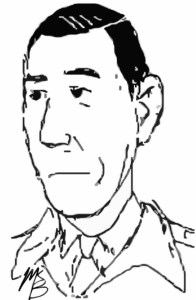
On returning to his Battalion Headquarters he suddenly found himself faced by two German Officers. He promptly shot one with his revolver and the other disappeared in the dark. As he entered his Headquarters a German Self-Propelled Gun which had entered the farmyard fired at the house at point blank range and set it on fire … Lt-Col Baker Baker led his [HQ] staff out through the opposite side of the house.
(D.S.O. citation, 7 June 1945)
Born on 11 November 1912 in Romsey, Hampshire, Henry Conyers Baker-Baker was the son of a Royal Navy admiral and educated at Eton College. After graduating from RMC, Sandhurst in 1933, he was commissioned into the Black Watch. In 1939, he was aide-de-camp to General Archibald Wavell. During the Western Desert and North African campaigns, he was a staff officer in the 51st Highland Division.
He was awarded Member of the Order of the British Empire and then the Distinguished Service Order for leadership in the invasion of Sicily, where he served as company commander in the 1st Black Watch. On 22 July 1943, after the commanding officer was wounded in an assault, Baker-Baker “maintained a thorough grip on this situation, and was seen on many occasions rallying tired men and encouraging them to still greater efforts.” The D.S.O. citation concluded:
The decision to withdraw and the handing of the withdrawal by Major Baker-Baker averted the arduous consequences which might have resulted had the Gerbini locality in the absence of our tanks, been surrounded by enemy armour. His action throughout the battle was beyond praise – during the whole action he was under heavy fire and, in spite of this conducted operations, coolly and soundly.
In mid-October 1944, in the North West Europe theatre, Baker-Baker was appointed commanding officer of the 2nd Glasgow Highlanders. He succeeded Lieutenant-Colonel P.U. Campbell who had been relieved for nervous strain. Baker-Baker went on to earned a D.S.O. Bar for difficult operations on 14/15 April 1945. When enemy penetrated the battalion permitter, the colonel went to his company commanders, making “it quite clear to them that there must be no question of a withdrawal, and that he expected every man to stand where he was and fight it out.” Baker-Baker restored order and pushed the enemy counterattack back.
After the war, he returned to the Black Watch, and commanded the regiment in Berlin from 1955 to 1956. He then commanded the 51st Brigade in Cyprus from 1957 to 1960, after which he retired from the active army as a brigadier. He served colonel of the Black Watch from 1964 to 1969.
Baker-Baker died on 31 December 1992 in Humshaugh, Northumberland.
 World War Graphic History