Lieutenant-Colonel J.W. Tweedie
2nd Battalion, Argyll and Sutherland Highlanders
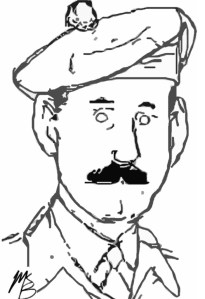
His explosions of wrath, like squalls of rain soon blew over. A devout Catholic, he was in fact a sensitive and very kind-hearted man … a worrier, prone to periods of self-doubt.
(Quoted in Ian Daglish, Operation Epsom)
Born on 5 June 1907 in British India, John William Tweedie was commissioned with the Argyll and Sutherland Highlanders after graduating from RMC, Sandhurst in 1926. He was aide-de-camp to the governor-general of New Zealand in 1931 and was battalion adjutant from 1936 to 1939. He attended staff college and became staff, captain, brigade major, then general staff officer for higher formations.
By January 1943, Tweedie was appointed commanding officer of 2nd Battalion, Argyll and Sutherland Highlanders. An orthodox disciplinarian but an efficient leader, trained the troops over the next year and a half for the eventual invasion of the continent. After D-Day, later in June 1944, the 2nd Argylls landed in Normandy with the 15th Scottish Division.
Tweedie earned the D.S.O. for the capture and defence of a key bridgehead:
The Bn remained in this difficult situation for over 3 hrs and throughout this time of constant strain, threat of enemy attack and infiltration from all sides, Lt Col Tweedie remained completely calm and in control of the situation, and by his personal example sustained the spirit of the troops. Thanks to his skilful disposition when the order to withdraw was received the Bn was extricated with comparatively light casualties.
Tweedie’s health broke down and needed but soon resumed command. In August 1944, he was assigned to take over the 91st Anti-Tank Regiment. He was eventually succeeded by his cousin, Lieutenant-Colonel D. Russell Morgan who had been 2iC for the 2nd Argylls until an appointment to command the 10th Highland Light Infantry a month earlier.
Tweedie held various postwar staff appointments in South East Asia and the British Army of the Rhine. He was awarded Commander of the Most Excellent Order of the British Empire in 1958 and retired from the army a few years later. He died on 26 July 1991.
 World War Graphic History