Lieutenant-Colonel E.H.G. Grant
5th Battalion, Queen’s Own Cameron Highlanders
7th Battalion, Seaforth Highlanders
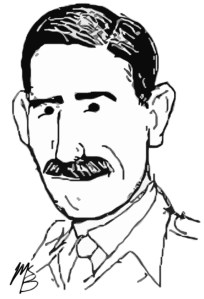
Peter Hunt was a typical example of the best sort of traditional British general: brave, upright, straightforward, cheerful, friendly and with a sympathetic understanding of the needs, interests and emotions of all ranks, whether Scottish, English, Welsh, Irish or Gurkha.
(Michael Carver, The Independent, 7 Oct 1988, 17)
Born on 11 March 1916 in London, Peter Mervyn Hunt was a graduate of Royal Military College, Sandhurst and commissioned into the Queen’s Own Cameron Highlanders in 1936. In summer 1939, he was captain and adjutant of the 2nd Battalion, Liverpool Scottish before transferring to the 1st Battalion, Queen’s Own Cameron Highlanders following the declaration of war. He was wounded during the evacuated from Dunkirk and four years later returned to France as a reinforcement officer for the 5th Battalion, Queen’s Own Cameron Highlanders.
Within days of his arrival in mid-July 1944, the casualties mounted. Commanding officer Lieutenant-Colonel Hugh Cairns was wounded followed by second-in-command Major C.A.H.M. Noble. Hunt found himself in command—the fourth commanding officer since the battalion arrived in Normandy after D-Day. Before the end of the month, Lieutenant-Colonel Derek Lang arrived from England to take over.
Although his tenure leading the 5th Camerons was brief, by August Hunt had been appointed commanding officer of the 7th Battalion, Seaforth Highlanders, succeeding Lieutenant-Colonel D. Robertson. By the end of the North West Europe campaign, he had been recognized with a D.S.O. and from the Beglan government, the Chevalier of the Order of Leopold II with palm and Croix de Guerre 1940 with palm:
Throughout the campaign he showed himself to be a most competent commander sound in his planning, intrepid in his leadership, calm in the line of danger and enjoying the full confidence of the troops under his command … Throughout this long period in command Lt-Col Hun invariably displayed great personal courage and was always cheerful and confident even in the most difficult circumstances.
In late 1945, Hunt was assigned to the Far East, first serving as a staff officer in India and then assistant adjunct general in Malaya. For this role, he was made Officer of the Order of the British Empire in 1948. Afterwards he attended US Army staff college at Fort Leavenworth and then returned to the United Kingdom to be an instructor at Staff College, Camberley and later instructor at the Imperial Defence College. He commanded 1st Battalion, Queen’s Own Cameron Highlanders from 1957 to 1960 when he was promoted to 152nd (Highland) Infantry Brigade. This preceded a string of important appointments in the 1960s from Scotland to Borneo to commandant at Sandhurst to commander-in-chief of British Army of the Rhine in 1970.
He became Chief of the General Staff in 1973, but refused the traditional promotion to field marshal. He felt it not right to accept the rank while other officers were being forced into retirement due to defence reductions. His tenure most notably coincided with the Troubles in Northern Ireland. After over forty years in the army, Hunt retired in August 1976.
He died on 2 October 1988.
 World War Graphic History