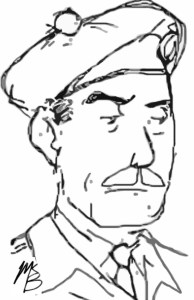
Lieutenant-Colonel J.G. Shillington
6th Battalion, King’s Own Scottish Borderers
From an Army point of view such a Team might be the Section, Platoon, Company, Battalion, Brigade or Division. In fact, this pride in the Team is described as esprit de corps ; but the term can have a wider meaning than that—it can embrace groups of Armies, such as the 21st Army Group, or a combination of the three Services, where mutual trust and pride are essential as was so well proved when, for instance, the Royal Navy successfully landed the Army on the beaches of Normandy under the umbrella of the Royal Air Force. Indeed, it can extend to nations, groups of nations and, in our utopian dreams, to the World itself.
(Shillington, “Morale,” RUSI Journal, 1950, 254)
Born on 18 December 1900 in Portadown, Armagh, Northern Ireland, John Graham Shillington was a steeplechaser and officer in the King’s Own Scottish Borders since 1921. His father Major David Graham Shillington was elected member of parliament for Armagh (1921–1929) and Armagh Central (1929–1941) for the Ulster Unionist Party. The younger Shillington followed his father in a military career and served as adjutant of the 2nd Battalion while stationed in Hong Kong during the late 1920s.
In October 1941, Shillington assumed command of 6th Battalion, King’s Own Scottish Borderers. After an unusually long period as CO, he led the unit into Normandy with the 15th Division on D-Day + 1. After just over a month in the field, he was wounded in action on 16 July 1944 and put out of action. Major C.W.P. Richardson took over the 6th Battalion.
In a 1950 article for the Royal United Service Institution Journal, Shillington explained the crucial role of morale for military forces. Drawing on his own experience, he explained:
Discipline does not mean fear of punishment, but the cheerful and willing obedience of commands because the recipients are confident that orders given by their leaders are for the good of the individual and the team ; it goes even further—it entails the desire to find out the right thing to do and to do it and see that others do it so as not to let the team down.
Compare this type of discipline with that which existed in the German Army, where it was apt to be based on fear; and with that of the Japanese which was apt to be based on fanatical belief. In both cases the discipline was brittle and liable to break down under stress when the individual was not under direct supervision.
Reflecting on changing public attitudes toward the military after the world wars, Shillington argued: “Throughout the ages the. British soldier has been looked down on in peace and made a hero in war. In spite of this he has provided the illustrious pages of history and tradition. In most wars he has had to suffer early defeats. This he has done cheerfully; and he always wins the last battle”:
The low prestige of the soldier in the public eye has been getting less and less throughout the ages. Originally the term “Gone for a soldier” was considered a disgrace in some families. Now their achievements and the true qualities which bring about such achievements are evident, and it is becoming common knowledge that the good soldier and good citizen are one. An anecdote concerning the Duke of York, who was Commander-in-Chief of the British Army from 1798 to 1809, shows how well aware he was of this fact. One day he found his butler turning away from the door the wife of an old soldier. He reprimanded him and said “‘but what else is Her Royal Highness The Duchess of York?”’ This is quoted as an example of the true comradeship which must exist between the highest and the lowest in the British Army—indeed in all our Services.
Shillington died in July 1972 in Norfolk.
 World War Graphic History