Lieutenant-Colonel C.H.R. Howie
1st Battalion, Hampshire Regiment
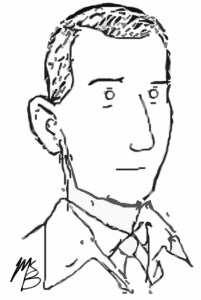
He was an extraordinary commander. He fought the enemy with a furious passion. He encouraged, enthused, chivvied everyone into attack. ‘Keep going forward. Always go forward.’ When battle was joined it was his custom to site his headquarters well forward; and then himself to go forward of that. He spent more time within a stone’s throw of the enemy than anywhere else. And when things were quiet-he was known to take the humble weapon of the Piat and go hunting German tanks. He told one of our officers it was his ambition to die for King and Country. He achieved this ambition without knowing he had been awarded the DSO.
(Geoffrey Picot, Accidental Warrior, [1994], 98)
Born in British India on 12 February 1905, Charles Henry Roger Howie served four years in the ranks before taking a commission with the King’s Regiment (Liverpool) in 1928. He was promoted to captain in 1938 and made temporary major in 1940. When Lieutenant-Colonel H.D. Nelson Smith of the 1st Battalion, Hampshire Regiment was wounded on D-Day, and the second-in-command war killed, Howie was assigned as the new commanding officer.
In Accidental Warrior, veteran Geoffrey Picot, recalled Howie as a hard-driving, indefatigable commander, writing how he “was seldom with us. He would race ahead to reconnoitre, scout the flanks and contact junior commanders to impart some of his limitless enthusiasm to them.” Picot described Howie as constantly urging the men on from his carrier: “‘I am going forward’ were the words most frequently on his lips. He kept pushing me forward. ‘Get into position there!’ ‘Move up there!’ ‘Go forward!’”
While characteristically in a forward position, he was killed during an assault against German positions on 11 July 1944. The regimental history offered as a tribute: “In the month in which Colonel Howie had commanded the Battalion his fearlessness, at a time when nerves were stretched to the uttermost, had been a splendid example to his men.” He received a posthumous D.S.O. for leading an earlier action on 19 June:
On several occasions the leading troops were pinned to the ground and losing the advantage of the barrage. Colonel Howie immediately went forward, and despite the fact that bullets were hitting his carrier and mortar bombs falling all around him, he rallied his battalion and by his inspiring leadership and determination to push on, others followed and the attack went through.
Throughout the attack Colonel Howie was most energetic in spotting enemy posts, tanks and guns and as a result it was possible to destroy them and allow the attack to succeed. His courageous and skilful leadership was quite outstanding.
 World War Graphic History