Lieutenant-Colonel H.D. Nelson-Smith
1st Battalion, Hampshire Regiment
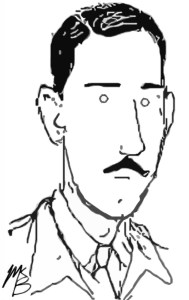
I was behind the leading companies and its an old story because I had got 50 yards up the beach and was hit. Some soldier dragged me along a bit further and I was hit again. And that was really the end of the story … I remember the drip feed and being taken aboard an American [ship], otherwise I was out for the count.
(Nelson-Smith, IWM interview, Jan 1993)
Born on 30 November 1913, Harold David Nelson-Smith was commissioned into the Hampshire Regiment in 1934, and served with the 1st Battalion in India, Palestine and the Western Desert. He became second-in-command when the unit was attached the 231st Independent Brigade and participated in the defence of Malta before it joined the invasion of Sicily campaign. Nelson-Smith earned the Military Cross and assumed command of the battalion in September before it returned to the United Kingdom as part of the 50th Division.
In preparation for the invasion of France, Nelson-Smith instituted a thorough training program for his officers and men. He stressed: “The principles of war in the case of the Infantry have always been MARCHING, SHOOTING, and DIGGING. In our case, these all want the adjective ‘blitz’ added to them … Our shooting must be more of the ‘Chicago Gunman’ type than hitherto.” To junior officers, he underlined the importance of dynamic leadership:
Platoon commanders must therefore regard their platoons as a Football Team, and work out with them during all attacks, the best method of shooting the ball into the net—or in other words the rifle group on to the objective. What is more, it must be realised, that as in football, the tactics of the platoon will probably have to be changed as the ‘game’ goes on in order to keep the ‘ball’ moving forward—and the players must do this changing without orders.
Although the troops crossed the channel on D-Day trained and prepared, Nelson-Smith found the operation did not go according to plan. Aerial bombardment had failed to level the enemy defences and obstacles. Some of the landing craft grounded on sandbars. The CO recalled terrible scenes where “leading troops jumped out into six foot of water, in their heavy equipment they sank like stones. Some others struggling on the surface where then run over by their own craft which surged forward with their lightened load.”
When asked about his thoughts at the time on D-Day, Nelson-Smith responded, “Well, I was a bit put out. I mean this was no part of the plan and it just made it that much more difficult. The toughest casualties you can well imagine for a CO before he even got on to Terra firma was very upsetting.”
Nelson-Smith himself was wounded very soon after landing on Gold Beach and needed to be evacuated. The battalion also lost its second-in-command when Major A C W Martin was killed by a sniper. Lieutenant-Colonel C.H.R. Howie then took command of the 1st Hamps on 7 June 1944.
After a five-month recovery, Nelson-Smith was assigned to take over the 1/5th Battalion, Welch Regiment in the 53rd Division. He commanded from October 1944 until he was wounded in the Ardennes offensive in January 1945. Afterwards he was posted to the headquarters staff of British Second Army and then XXX Corps.
Nelson-Smith end his army career at the rank of brigadier. He died on 1 January 2001 in Dean, Cumberland.
 World War Graphic History